
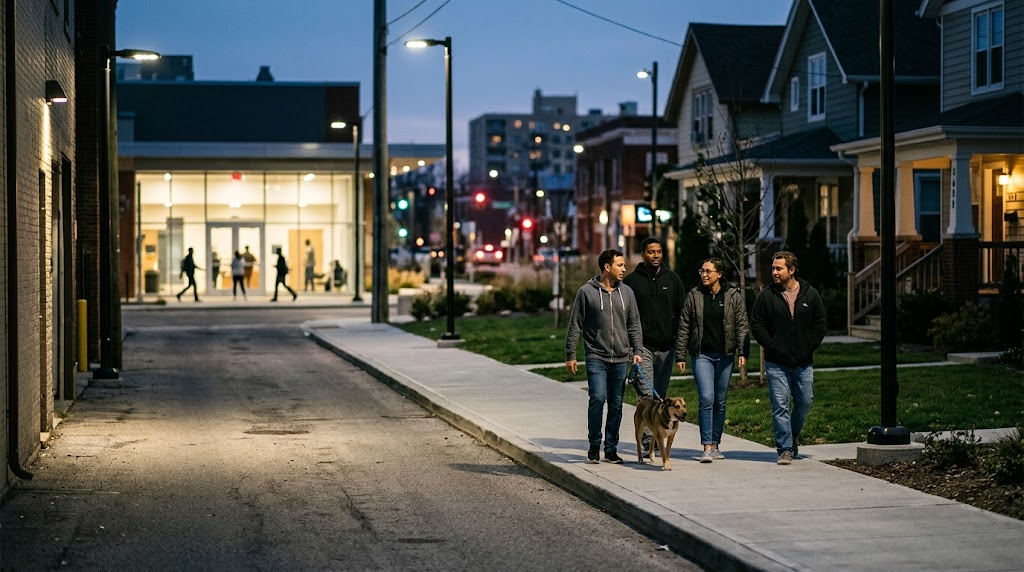
On a quiet evening in any city, the physical character of a street block silently dictates human behavior. A wide, well-lit pedestrian boulevard lined with storefront windows, low hedges, and active residential balconies invites foot traffic, fosters casual social interactions, and encourages a sense of shared community oversight. Conversely, a dark, narrow corridor flanked by windowless concrete walls, unmaintained vacant lots, and flickering, burned-out streetlamps creates an environment of isolation and vulnerability.
For over half a century, criminologists, urban planners, architects, and law enforcement executives have recognized that the physical design of the built environment plays a central role in shaping patterns of local crime. Rather than treating criminal acts purely as isolated decisions made by individual offenders, environmental criminology demonstrates that crime is heavily opportunistic. It thrives where physical space minimizes the risk of detection, eliminates natural oversight, and signals social neglect.
At the intersection of public safety and municipal planning lies Crime Prevention Through Environmental Design (CPTED)—a multidisciplinary philosophy that uses urban architecture, spatial layout, land-use policies, and targeted infrastructure, such as modern street lighting, to reduce criminal opportunity. As cities globally navigate changing urban demographics, budgetary constraints, and evolving public safety models, the strategic design of physical space has emerged as one of the most effective, cost-efficient, and non-punitive interventions available to local governments.
The Evolution of Environmental Criminology
The foundational idea that physical surroundings influence human behavior gained significant momentum in the mid-20th century. Urban theorist Jane Jacobs famously introduced the concept of “eyes on the street” in her landmark 1961 work, The Death and Life of Great American Cities. Jacobs argued that safe urban neighborhoods are not maintained primarily by police patrols, but by an intricate, natural network of voluntary surveillance—residents, shopkeepers, pedestrians, and street vendors whose daily presence provides a continuous, informal check on disruptive behavior.
In the 1970s, sociologist C. Ray Jeffery formally coined the term Crime Prevention Through Environmental Design (CPTED), while architect Oscar Newman formulated the concept of “Defensible Space.” Newman’s research demonstrated that specific architectural layouts could empower residents to feel a sense of ownership over public and semi-private spaces, naturally discouraging intruders.
Today, modern CPTED framework rests on four core, overlapping pillars:
- Natural Surveillance: Designing physical layouts to maximize the visibility of public spaces for residents, visitors, and passing traffic.
- Natural Access Control: Utilizing physical elements such as walkways, fences, landscaping, and lighting to guide pedestrian and vehicular movement logically while restricting entry to vulnerable or unmonitored zones.
- Territorial Reinforcement: Creating clear physical markers—such as distinct paving textures, low decorative walls, and signage—that define boundaries between public, semi-private, and private property, signaling community ownership.
- Maintenance and Management: Ensuring that infrastructure, landscaping, and public amenities are continuously maintained, reinforcing the perception that a space is actively cared for and monitored.
When these principles are integrated into municipal planning, they alter the calculus for potential offenders by increasing the effort and risk required to commit a crime while diminishing the anticipated reward.
The Criminology of Street Lighting: Visibility and Perception
Among all environmental interventions, street lighting remains the most visible, widely deployed, and thoroughly researched tool in municipal crime prevention strategies. The intuitive belief that light deters crime is ancient, but the criminological mechanics behind it are nuanced.
Street lighting operates through two distinct, complementary pathways: increasing the real and perceived risk of apprehension for potential offenders, and altering community utilization of public space.
1. Enhancing Natural Surveillance and Risk Calculation
For an offender considering a property break-in, physical assault, or street robbery, darkness provides critical operational advantages. It conceals identity, masks movement, and delays victim response. Upgraded street lighting strips away this cover.
When public spaces are properly illuminated, potential offenders perceive a substantially higher probability that their actions will be observed by residents looking out windows, passing motorists, or security systems. This psychological shift alters the immediate risk calculation, often deterring the act entirely or displacing it away from the illuminated zone.
2. Boosting Public Space Activation and Social Control
The secondary effect of quality street lighting is sociological. Dark, poorly lit streets instill fear, causing law-abiding citizens to avoid public thoroughfares during evening hours. This avoidance creates a self-fulfilling cycle of isolation: as pedestrian density drops, natural surveillance evaporates, leaving the street even more vulnerable to illicit activity.
Properly placed illumination restores public confidence, encouraging residents to walk dogs, patronize evening commercial districts, and utilize public transit hubs after dark. Higher pedestrian volume increases the density of “eyes on the street,” strengthening informal social control and making criminal behavior vastly more conspicuous.
Empirical Evidence: What the Data Shows
For decades, academic debate persisted regarding whether street lighting actively reduced crime or merely displaced it to adjacent, darker streets. However, modern multi-city field trials and rigorous statistical meta-analyses have provided clear empirical clarity.
A landmark study conducted by researchers from the University of Chicago, the University of Pennsylvania, and Crime Lab New York examined the impact of street lighting in high-crime public housing developments across New York City. The randomized controlled trial—the gold standard of academic methodology—involved deploying temporary, high-intensity LED light towers to select housing developments while leaving control sites unchanged.
The results, published by the National Bureau of Economic Research (NBER), demonstrated that developments receiving the lighting upgrades experienced a 36 percent reduction in outdoor nighttime index crimes—which include murder, robbery, aggravated assault, and burglary—compared to the control sites. Crucially, the researchers observed no evidence that crime was simply displaced to neighboring unlit blocks; instead, they documented a “diffusion of benefits,” where crime rates slightly decreased in immediate adjacent areas as well.
Similarly, a comprehensive systematic review conducted by the UK College of Policing analyzed dozens of independent lighting studies across the United Kingdom and North America. The research concluded that improved street lighting led to a consistent, statistically significant 21 percent reduction in overall crime in targeted areas. The findings reinforced that lighting interventions are particularly effective at curbing property theft, vehicle break-ins, and street-level robberies.
IMPACT OF CPTED & LIGHTING INTERVENTIONS (DATA SUMMARY)

New York City NYCHA Randomized Controlled Trial:
- Nighttime Index Crime Reduction: ~36% drop in targeted outdoor areas
- Spatial Displacement Effect: None detected (observed a diffusion of benefits to adjacent zones)

UK College of Policing Systematic Review:
- Overall Crime Reduction: ~21% decrease across illuminated target areas
- Highest Efficacy Offense Categories: Property theft, vehicle break-ins, residential burglary
From Sodium to Smart LEDs: Quality, Spectrum, and Directionality
Not all artificial light produces equal safety outcomes. The historical reliance on High-Pressure Sodium (HPS) streetlamps—which emit a deep, monochromatic yellow-orange glow—introduced significant operational limitations for public safety and urban aesthetics.
Monochromatic sodium lighting severely degrades color rendering. Under an amber HPS lamp, an observer or closed-circuit camera cannot accurately distinguish between a red, brown, or black jacket, nor can they reliably identify vehicle colors. This lack of spectral clarity hampers real-time witness reporting and post-incident law enforcement investigations.
The modern transition to Light Emitting Diode (LED) technology has revolutionized urban lighting strategies, offering distinct operational advantages:
Enhanced Color Rendering Index (CRI)
Broad-spectrum “white” LED light replicates natural daylight far more effectively than traditional sodium lamps. High CRI illumination allows pedestrians, witnesses, and security cameras to discern colors, facial features, and subtle physical movements accurately from a distance, dramatically improving situational awareness.
Directional Control and Reduced Glare
Legacy fixtures frequently cast light in all directions, creating severe glare that can temporarily blind motorists and pedestrians while casting harsh, deep shadows behind fences, parked vehicles, and building recesses. Advanced LED optics allow municipal engineers to direct light precisely where it is needed—onto sidewalks, crosswalks, and building entrances—eliminating unintended “shadow pools” where offenders can conceal themselves.
Smart Lighting and Adaptive Controls
Modern municipal lighting infrastructure is increasingly connected to Internet of Things (IoT) management platforms. Smart lighting systems allow city authorities to adjust illumination dynamically based on real-time conditions:
- Motion-Activated Surge Illumination: Streetlamps can maintain an energy-conserving dim baseline, automatically brightening to full intensity when motion sensors detect approaching pedestrians or vehicles.
- Emergency Response Integration: In the event of a reported crime or emergency dispatch, central operators can immediately increase lighting levels across an entire block to assist responding first responders and medical personnel.
- Automated Outage Reporting: Networked lighting systems automatically notify municipal maintenance crews the moment a fixture fails, eliminating weeks-long blind spots caused by unreported burned-out bulbs.
Designing the Streetscape: Beyond Illumination
While street lighting provides immediate visibility, it represents only one component of a broader urban design framework. Effective spatial design integrates architectural features, landscaping standards, and land-use policies to build a naturally resilient environment.
Landscaping and the “3-Foot / 7-Foot” Rule
Landscaping can either enhance security or completely undermine it. Unmanaged vegetation provides ideal concealment for intruders near ground-floor windows, entryways, and walkways.
Urban safety protocols emphasize the “3-foot / 7-foot” landscaping rule:
- Keep low shrubs, hedges, and ground cover trimmed to a maximum height of 3 feet to preserve unobstructed sightlines across front yards and sidewalks.
- Prune lower tree branches up to a minimum height of 7 feet from the ground to prevent sightline obstructions for pedestrians, drivers, and overhead streetlights.
Applying this rule ensures that mature trees provide shade and environmental benefits without blocking light cast from streetlamps or obstructing views from residential windows.
Transparency and Active Frontages
Architectural design strongly influences natural surveillance. Buildings with blank, windowless facades along street corridors create dead zones devoid of human oversight. Modern urban design codes increasingly mandate “active frontages”—requiring ground-floor commercial spaces to feature large transparent windows, street-facing entrances, and outdoor seating areas.
In residential developments, incorporating active front porches, balconies, and shallow front setbacks ensures that residents naturally overlook the street during daily domestic activities, reinforcing Jacobs’ vision of continuous community oversight.
SPATIAL DESIGN HARDENING COMPARISON

High-Risk Urban Spatial Attributes:
  - Blank, windowless ground-floor walls
  - Overgrown vegetation obscuring sightlines and fixtures
  - Deep building recesses and unlit alcoves
  - Unclear boundaries between public sidewalks and private grounds

Low-Risk / CPTED-Compliant Attributes:
  - Active frontages with clear glass and street-facing doors
  - Adherence to the 3-foot / 7-foot landscaping rule
  - Uniform LED lighting across walkways and entry portals
  - Clear physical markers (paving shifts, low walls) defining property lines
Natural Access Control and Path Articulation
Unstructured spatial layouts that allow pedestrians to wander aimlessly through residential complexes increase property vulnerability. Effective urban design uses subtle physical cues to guide human movement logically:
- Well-defined, well-lit concrete footpaths direct pedestrians along intended routes.
- Low decorative fencing, architectural pillars, and garden beds naturally channel visitors toward primary entrance portals while signaling that stepping off the path constitutes entering private space.
- Eliminating unmonitored rear alleyways or securing them with controlled-access gates prevents convenient escape routes for potential offenders.
Maintenance, Broken Windows, and Collective Efficacy
The physical condition of urban infrastructure communicates a clear message to residents and visitors alike. In 1982, social scientists James Q. Wilson and George L. Kelling introduced the “Broken Windows Theory,” suggesting that visible signs of physical disorder, decay, and administrative neglect foster an environment where crime can escalate unchecked.
When a broken streetlight remains unrepaired for weeks, graffiti goes unpainted, or trash accumulates in a vacant lot, it signals to potential offenders that local social control is weak and that community members are unlikely to intervene or call authorities.
Conversely, prompt municipal maintenance strengthens a neighborhood’s collective efficacy—the shared trust among neighbors and their willingness to intervene for the common good.
THE CYCLE OF INFRASTRUCTURE CARE & COMMUNITY SAFETY

[Prompt Infrastructure Repair & Lighting Upgrades]
                        │
                        ▼
[Signals Active Ownership & Municipal Investment]
                        │
                        ▼
[Increases Public Space Usage & Pedestrian Density]
                        │
                        ▼
[Enhances Collective Efficacy & Natural Surveillance]
                        │
                        ▼
[Deters Opportunistic Crime & Reduces Fear]
When local governments invest in swift infrastructure repairs, clean public parks, and bright, functional street lighting, residents feel valued and safe. This sense of pride encourages homeowners and business owners to invest in their own properties, lock doors, maintain yards, and report suspicious activity, establishing a self-reinforcing cycle of community stability.
Ethical Considerations: Light Pollution, Equity, and Inclusivity
While the public safety benefits of urban design and lighting are clear, modern planners must balance safety objectives with ecological health, civil liberties, and social equity.
Light Pollution and Environmental Impact
Excessive or poorly directed artificial light contributes to severe light pollution, disrupting natural ecosystems and human biology:
- Ecological Disruption: High-intensity night lighting can disorient nocturnal wildlife, disrupt migratory bird patterns, and alter insect populations critical to urban biodiversity.
- Human Circadian Rhythms: Over-illumination—particularly exposure to high-kelvin “cool blue” light late at night—suppresses melatonin production in humans, leading to sleep disruption and associated health risks.
- Dark Sky Initiatives: Municipalities are increasingly adopting “Dark Sky” compliant fixtures. These shielded luminaires direct 100 percent of their light downward onto footpaths and streets, eliminating upward spill light, reducing glare, and preserving the night sky without compromising ground-level security.
Avoiding “Hostile Architecture”
A critical critique of some urban design practices is the rise of “hostile” or “defensive” architecture—such as anti-homeless bench dividers, ground spikes, or high-frequency acoustic deterrents. Critics note that design elements meant to exclude specific vulnerable populations can make public spaces feel cold, unwelcoming, and authoritarian.
Authentic CPTED focuses on inclusive design that invites legitimate public activity rather than alienating community members. Designing comfortable, accessible, well-lit spaces for all residents fosters natural social cohesion, which ultimately serves as a far stronger deterrent to crime than physical barriers alone.
Equitable Infrastructure Distribution
Historically, municipal infrastructure investments—including street lighting upgrades and park maintenance—were distributed unevenly, often favoring affluent suburban developments while neglecting low-income urban neighborhoods.
Modern urban safety strategies demand an equity-first framework. Municipalities are increasingly prioritizing historically under-resourced, high-crime corridors for lighting upgrades, sidewalk repairs, and green space restoration. Investing in disadvantaged neighborhoods addresses core environmental vulnerabilities, providing non-punitive public safety improvements where they are needed most.
A Holistic Architecture for Safer Communities
The physical design of our cities does far more than move traffic or shelter commerce; it actively shapes the daily social interactions, fear levels, and safety of every citizen.
Street lighting and urban design are not silver bullets capable of eradicating the deep socio-economic drivers of crime on their own. However, when deployed thoughtfully alongside broader community development, social services, and economic investments, environmental design provides an indispensable, highly effective foundation for public safety.
By brightening dark corridors with intelligent, eco-friendly lighting, maintaining clear sightlines, encouraging vibrant street-level activity, and instilling a sense of shared ownership over public spaces, cities can systematically diminish criminal opportunity. In doing so, urban planners transform cold, defensive spaces into warm, welcoming, and resilient communities—proving that the path to safer streets begins with how we build them.
Leave a Reply