
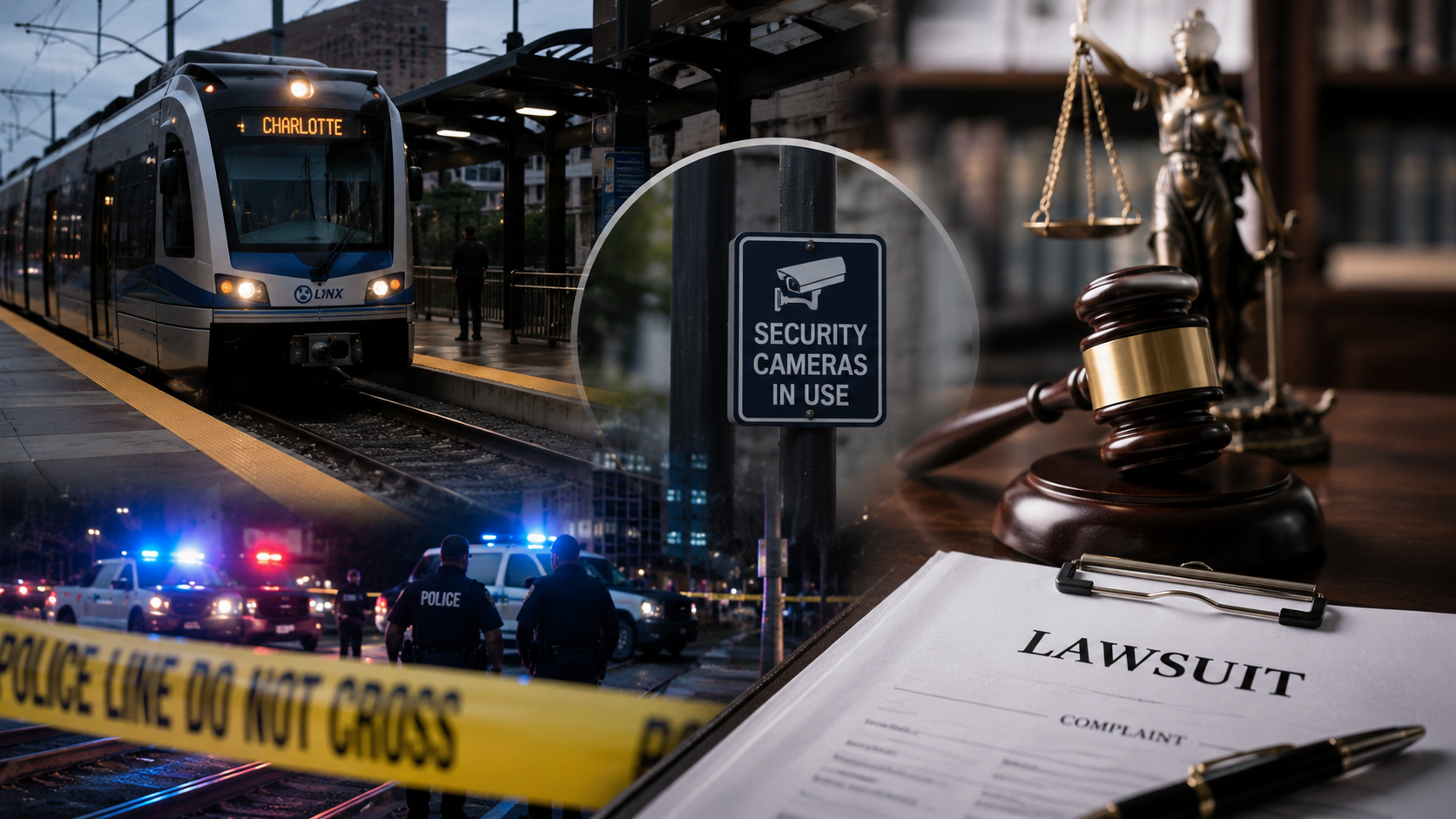
A Charlotte family has filed a lawsuit following a deadly stabbing on the city’s light rail system, alleging that security failures contributed to a tragedy that left a passenger dead.
The case has drawn renewed attention to safety measures aboard Charlotte Area Transit System (CATS) trains and at transit stations, as questions remain about whether more could have been done to prevent the fatal attack.
Lawsuit Alleges Security Failures
According to the lawsuit, the family is seeking accountability over circumstances surrounding the deadly stabbing and alleges that inadequate security contributed to the incident.
The legal action places the spotlight on the responsibilities of transit officials and other parties involved in maintaining passenger safety.
Civil lawsuits can contain allegations that have not been proven in court. The defendants may dispute the claims, and the filing itself does not establish liability.
Deadly Stabbing on Charlotte’s Light Rail
The lawsuit follows a fatal stabbing involving a passenger on Charlotte’s light rail system.
The incident prompted a law enforcement response and renewed concerns among riders about safety aboard public transportation.
Charlotte’s light rail network carries thousands of passengers throughout the region, connecting neighborhoods with employment centers, entertainment districts and other destinations.
For the victim’s family, however, the incident has transformed a routine transit trip into a devastating loss.
Family Seeks Answers and Accountability
The lawsuit is expected to focus attention on what happened before, during and after the stabbing.
Among the central issues raised by the family’s allegations are whether appropriate security measures were in place, whether warning signs were missed and whether the transit system responded appropriately when the incident occurred.
Those questions will ultimately be examined through the legal process.
The family’s decision to pursue a civil case also reflects a broader concern frequently raised after violent incidents on public transportation: how transit agencies can balance accessibility with effective security.
What the Lawsuit Could Mean for CATS
A lawsuit involving a deadly incident on the light rail could have implications beyond the individual case.
If the allegations proceed through litigation, evidence and testimony could shed light on security policies, staffing, surveillance, emergency response procedures and communications between transit personnel and law enforcement.
The case could also prompt renewed scrutiny of existing safety practices.
For passengers, the issue is straightforward: they expect to be able to use public transportation without becoming victims of serious violence.
Legal Claims Are Still Allegations
It is important to distinguish allegations in a civil lawsuit from facts established by a court.
The family’s complaint represents its account of what happened and its legal arguments regarding responsibility. Any defendants named in the lawsuit will have an opportunity to respond to those allegations.
The court process may ultimately determine which claims, if any, are supported by the evidence.
Investigation and Legal Proceedings Continue
The lawsuit is now adding a legal dimension to a tragedy that has already raised concerns about public safety in Charlotte.
As the case develops, additional information could emerge about the circumstances of the stabbing, the security measures in place at the time and the actions taken by transit personnel.
For the victim’s family, the lawsuit represents an effort to obtain answers and accountability after a deadly incident.
For Charlotte transit officials and the wider community, the case could become another test of how effectively public transportation systems protect passengers from violence.
This is a developing legal story. Allegations contained in the lawsuit should be treated as unproven unless and until established through court proceedings.
Leave a Reply