
In quiet cul-de-sacs and master-planned developments across the country, a distinct shift is transforming the traditional landscape of suburban life. Neighborhoods long considered low-crime havens are increasingly taking public safety into their own hands, hiring private security firms, deploying mobile road patrols, and installing high-tech surveillance networks to monitor their streets.
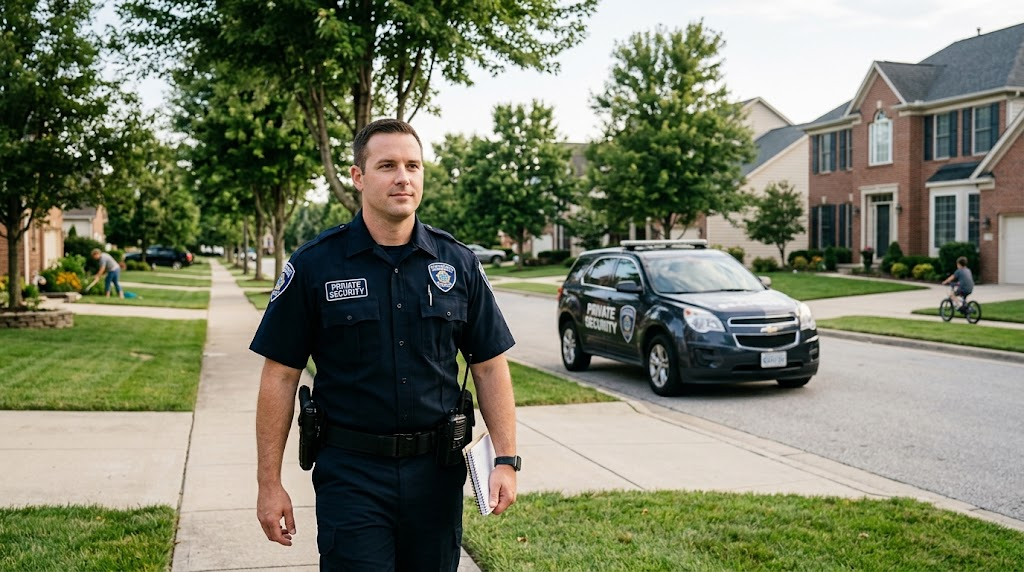
What was once a luxury reserved for exclusive gated compounds or high-density urban commercial districts has quietly become a standard amenity in suburban communities. Driven by anxieties over property crime, municipal police staffing shortages, and the rapid democratization of surveillance technology, Homeowners Associations (HOAs) and informal neighborhood coalitions are transforming how residential security is delivered.
This expanding footprint of private guards and automated surveillance is reshaping the relationship between citizens, private enterprise, and public law enforcement. As private security officers take on duties historically managed by municipal police—from routine neighborhood patrols to investigating package thefts—communities are confronting complex questions about equity, accountability, and the future of public safety.
The Drivers of Suburban Privatization
The proliferation of private security in suburban jurisdictions is the product of several converging social and operational factors. Principal among them is a shift in how suburban residents perceive personal safety and risk.
While violent crime remains statistically low across most suburban jurisdictions, property offenses—including vehicle break-ins, catalytic converter thefts, residential burglaries, and porch piracy—have generated widespread frustration among homeowners. In an era dominated by neighborhood social media apps and ring-camera networks, videos of opportunistic thefts circulate rapidly within local communities, amplifying the perception of vulnerability even in statistically safe zip codes.
Concurrently, municipal police departments nationwide have grappled with persistent recruitment and retention challenges. Facing constrained operational budgets and reduced sworn personnel, many city and county police agencies have been forced to prioritize emergency 911 calls involving violent crimes or active threats over minor property infractions.
For suburban homeowners accustomed to rapid municipal responses, longer dispatch delays for non-emergency calls have created a perceived void in routine deterrence. Private security firms have moved swiftly to fill that gap.
Homeowners associations, which manage millions of suburban residences across the United States, have emerged as the primary institutional vehicle for this transition. By leveraging pooled community dues, HOAs can easily contract dedicated security services without requiring municipal tax increases or city council approvals. For many board members and residents, spending a fraction of monthly association fees on dedicated patrol vehicles is viewed as an essential investment in protecting property values and quality of life.
From Security Guards to High-Tech Command Outposts
The modern suburban private security model looks vastly different from the stationary gate-guards of previous decades. Today’s residential security contracts routinely integrate physical guard presence with advanced digital surveillance technologies.
In many patrolled subdivisions, marked security vehicles—often equipped with dashboard cameras, flashing yellow or green light bars, and GPS tracking—conduct scheduled and randomized sweeps through neighborhood streets. These patrols focus on high-visibility deterrence, checking empty homes for vacationing residents, monitoring community amenities like clubhouses and pools, and enforcing parking rules.
However, the true force multiplier for suburban security lies in automated technology. Neighborhoods are increasingly turning to static surveillance networks, particularly Automated License Plate Readers (ALPRs) installed at neighborhood entry and exit points. These camera systems capture real-time data on vehicles entering a subdivision, automatically cross-referencing plate numbers against stolen vehicle registries, active law enforcement alerts, or custom neighborhood “watchlists.”
When an ALPR system flags a suspect vehicle, real-time alerts are instantly routed to mobile security patrols or designated HOA board members. In many cases, these private networks maintain direct data-sharing agreements with local police departments, allowing municipal officers to receive immediate digital notifications when a vehicle linked to a felony is detected entering a patrolled neighborhood.
Beyond static cameras, private security firms are increasingly deploying drone surveillance for perimeter checks, AI-driven motion detection across common areas, and specialized smartphone applications that allow residents to request immediate security escorts or report suspicious activity directly to on-duty patrol officers.
Public-Private Collaboration and the Multiplication Effect
The expansion of private security into residential zones has altered the operational dynamics of public law enforcement. Far from viewing private guards as rivals, many police chiefs and county sheriffs welcome the presence of private security as a valuable force multiplier.
Criminological studies evaluating public-private security partnerships indicate that visible private patrols produce a measurable deterrent effect against non-violent property crime. By maintaining a constant physical presence on suburban streets, private security officers free up public law enforcement to focus on high-priority emergency calls and complex criminal investigations.
This collaboration often takes the form of informal co-policing:
- Initial Response and Triage: Private security officers are frequently the first to arrive at a neighborhood scene, assessing alarm activations, securing physical evidence following a break-in, and providing initial reports to emergency dispatchers.
- Evidence Collection: Private camera networks and ALPR databases provide law enforcement investigators with immediate, high-definition digital evidence that accelerates suspect identification following local crime spikes.
- Non-Emergency Order Maintenance: Private guards handle minor civil disputes, noise complaints, and parking violations within private developments, relieving municipal agencies of routine administrative burdens.
In several jurisdictions, municipal police departments have formalized these relationships through joint training programs, shared radio frequencies, and regular intelligence briefings between precinct commanders and private security managers.
Questions of Equity, Oversight, and Civil Liberties
Despite its growing popularity, the rapid expansion of private security into suburban residential life has sparked significant debate among legal scholars, civil rights advocates, and public policy experts.
At the heart of the critique is the issue of economic equity and the creation of a two-tiered system of public safety. Unlike municipal police departments, which are funded by public taxation and mandated to protect all residents equally regardless of income, private security is an explicitly commercial service. Wealthier suburban subdivisions and gated communities can afford dedicated, around-the-clock armed patrols and automated camera networks, while lower-income neighborhoods must rely entirely on understaffed public departments. Critics argue that this dynamic risks privatizing safety, concentrating protection in affluent enclaves while shifting crime toward unmonitored communities.
Accountability and legal authority represent another friction point. Private security guards are not sworn law enforcement officers; their legal authority is generally limited to that of a private citizen, supplemented by the property rights of the landowner or HOA that hires them.
Unlike public police officers, who are bound by Fourth Amendment constitutional constraints, qualified immunity doctrines, and statutory training standards, private security guards operate under a patchwork of state regulations and private employment contracts. This regulatory disparity raises concerns regarding:
- Training Standards: Private security guard training requirements vary widely by state, with some jurisdictions requiring only minimal classroom hours before guards are deployed in residential neighborhoods.
- Over-Surveillance and Profiling: Without rigorous constitutional training, private guards or overly vigilant neighborhood monitoring committees may subject delivery drivers, contractors, or non-resident visitors to unprovoked stops, questioning, or bias-based harassment.
- Data Privacy: The proliferation of ALPR cameras and private video databases collects vast amounts of location data on innocent motorists. Questions regarding who owns this data, how long it is stored, and whether it can be sold or shared with third parties remain largely unresolved in many jurisdictions.
The Future of Suburban Neighborhood Safety
As suburban demographics evolve and technology becomes more integrated into daily life, the private security industry’s footprint in residential neighborhoods is projected to expand.
Security analysts anticipate that the next generation of suburban security will rely even more heavily on hybrid models—combining low-cost, automated AI surveillance networks with rapid-response mobile patrol units shared across multiple adjacent neighborhood associations. This model lowers the financial entry barrier, allowing mid-tier and un-gated suburban communities to access security infrastructure previously limited to ultra-wealthy enclaves.
For municipal leaders and public safety directors, the challenge lies in establishing clear regulatory frameworks, transparent data-governance standards, and effective communication channels with the private security sector.
The growing reliance on private security in suburban neighborhoods reflects a fundamental redefinition of community safety. While private patrols offer immediate peace of mind and tangible loss deterrence for individual subdivisions, maintaining public trust across the broader community will require ensuring that the pursuit of neighborhood security does not come at the expense of privacy, civil liberties, and equal access to justice.
Leave a Reply