
Home security is often discussed in terms of hardware: high-definition cameras, smart locks, motion sensors, and reinforced doors. Yet, law enforcement officers and crime prevention experts routinely observe that the majority of residential burglaries do not involve sophisticated lock-picking or bypassed alarm systems. Instead, they begin with simple, overlooked human habits.
Most property crimes are crimes of opportunity. Intruders favor low-risk, low-effort targets where entry can be made quickly, quietly, and without attracting neighbor attention. Often, daily routines intended to make home life more convenient inadvertently provide potential intruders with the exact vulnerabilities, visibility, and timing they need to strike.
Understanding how everyday behavior signals vulnerability to external observers is the first step in hardening a residence. Here are five common household habits that accidentally invite home intrusions, along with the straightforward adjustments needed to eliminate them.
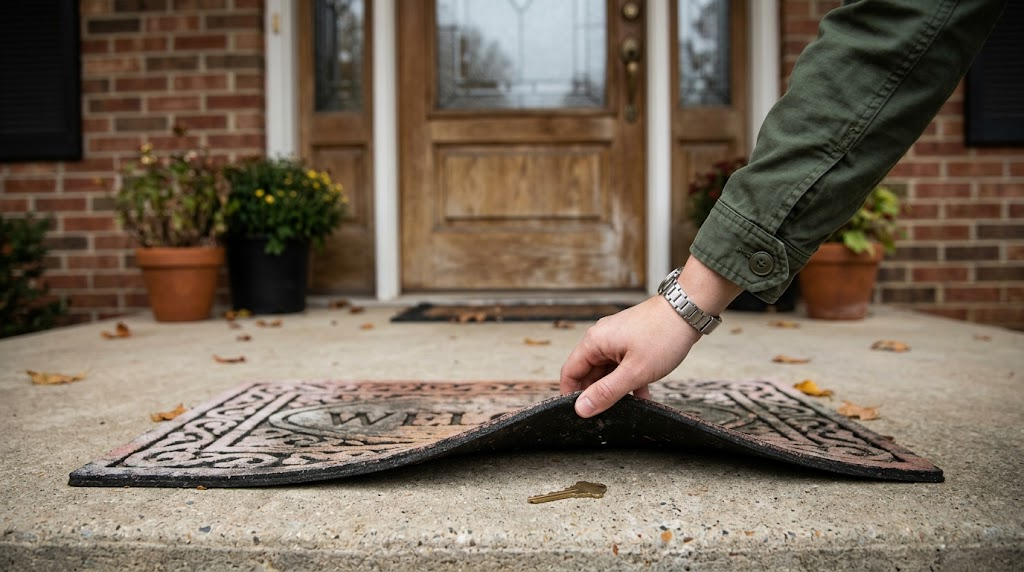
1. Leaving “Hidden” Keys in Predictable Outdoor Locations
The habit of hiding a spare key under a doormat, inside a faux rock, or along the lip of a doorframe remains one of the most widespread residential security vulnerabilities. While intended as a practical backup for family members or service workers who lose access, these traditional hiding spots are universally known to experienced intruders.
When searching a property for quick access, opportunistic burglars check predictable locations within seconds:
- Beneath front and back porch entrance mats
- Inside decorative potted plants adjacent to entry doors
- Along the top edge of door frames or window sills
- Inside hollow plastic rocks placed near landscaped walkways
- Above gas meters or electrical utility boxes
Placing a key in these locations effectively hands an intruder open access to the home. Entering with a key allows an intruder to unlock the front door without making noise, raising alarm among neighbors, or causing visible structural damage that might trigger an immediate call to law enforcement.
TRADITIONAL HIDING SPOTS vs. MODERN ALTERNATIVES

Traditional (High Risk):
  - Beneath doormats or potted plants
  - Inside plastic "hide-a-rocks"
  - Above door frames or window ledges

Modern Alternatives (Low Risk):
  - Smart electronic door locks with temporary PIN codes
  - Secured combination lockboxes placed away from the entry door
  - Entrusting spare keys directly to trusted neighbors
The Solution: Eliminate physical hidden keys entirely. Upgrade entry doors to smart deadbolts or digital keypad locks that allow family members and guests to enter via unique access codes. If a physical backup key is necessary, store it inside a heavy-duty, mechanical combination lockbox mounted in a discreet, well-lit location away from the immediate entryway, or entrust a spare key directly to a trusted neighbor.
2. Maintaining Open Curtains and Blinds During Evening Hours
Indoor lighting during evening hours creates a basic optical phenomenon: it turns window panes into illuminated display cases for anyone standing outside in the dark. A common household habit is leaving curtains, blinds, and shades open while interior lights, televisions, and desktop monitors are fully active.
This visibility provides potential intruders with an unobstructed vantage point to conduct passive surveillance—often referred to as “casing” a property—without stepping onto the lawn.
Open windows during evening hours reveal critical operational details:
- High-Value Inventory: Clear views of television screens, laptops, sound systems, art, and personal valuables left on counters or tables.
- Layout and Navigation: An unobstructed look at the internal floor plan, allowing an intruder to map out hallways, locate stairs, and identify entry points before ever attempting a break-in.
- Occupancy and Habits: Real-time visibility into how many people are inside, their age, their daily schedules, and whether they are currently distracted in rear rooms.
- Security Hardware: Direct sightlines to security system keypads, motion detector placements, or arming status indicators.
The Solution: Establish a strict household routine of closing window coverings—blinds, drapes, or shades—at sunset before turning on interior lights. Ground-floor windows and those accessible from low roofs or exterior decks should receive priority attention. Consider installing top-down, bottom-up shades or one-way privacy window films that allow natural daytime light while blocking interior visibility from the street.
3. Disposing of Intact Packaging for High-Value Goods
Trash day offers subtle cues about a household’s internal contents. A frequent oversight occurs immediately following major purchases, holiday periods, or home renovations: breaking down and placing intact cardboard boxes for high-value items directly on the curb for waste pickup.
Leaving large, branded boxes for 65-inch OLED televisions, gaming consoles, high-end computers, designer electronics, or power tools at the sidewalk functions as an explicit advertisement of new inventory inside the residence.
STREET-SIDE INVENTORY ADVERTISING

Intact Box at the Curb:
[Branded Box: "Ultra-HD 65-Inch TV / High-End Gaming PC"]
                       │
                       ▼
Public Signal to Street Traffic:
"New high-value, easily portable electronics are now inside this home."
Opportunistic intruders routinely drive or walk through residential neighborhoods during pre-trash pickup hours specifically looking for branded packaging. A single box indicates not only that a desirable item is present, but that older, replaced electronics may still be inside as well.
The Solution: Never place intact, branded boxes on the curb. Use a utility knife to break down all cardboard packaging into flat, unbranded panels that fit entirely inside closed recycling bins. For oversized boxes, fold them inside-out so the plain brown cardboard faces outward, or drop off large electronics packaging directly at a local municipal recycling drop-off depot.
4. Allowing Mail, Packages, and Lawn Care to Accumulate
An intruder’s primary goal is to target unoccupied homes, as encountering a resident dramatically increases the likelihood of confrontation, noise, and immediate police response. The habit of leaving signs of absence unmanaged provides clear indicators that a house is empty.
Accumulated deliveries signal an empty house:
- Stacks of unopened mail or newspapers overflowing from a front door slot or box
- Multiple delivery boxes resting on a front porch over consecutive days
- Unclaimed flyers, takeout menus, or promotional doorknob hangers left dangling from the front entrance
- Overgrown grass during summer months or un-shoveled driveways following winter snowfalls
- Parked vehicles sitting unmoved in the driveway for extended periods with accumulated dust or debris
OVERT SIGNALS OF RESIDENTIAL ABSENCE

Porch Front:
  - Stacked cardboard delivery boxes
  - Door hangers and promotional flyers dangling from the latch

Driveway & Yard:
  - Un-shoveled snow paths or overgrown lawn grass
  - Empty driveway or stationary vehicle covered in leaves/dust

Mailbox:
  - Overflowing mail slot or stuffed newspaper tube
Leaving items on a porch or failing to coordinate home maintenance while away for business or vacation signals that no one is present to manage the property, marking the residence as an easy target.
The Solution: Before departing for extended periods, submit a formal mail hold request through the postal service and temporarily pause newspaper subscriptions. Coordinate with trusted neighbors, friends, or family members to collect unexpected delivery packages immediately upon arrival. Hire a local service to handle lawn mowing or snow clearing during extended trips, and consider asking a neighbor to park a vehicle in the driveway to maintain the appearance of daily occupancy.
5. Oversharing Real-Time Travel Plans on Social Media
The digital landscape has fundamentally reshaped physical home security. One of the most prevalent modern habits is posting real-time location updates, vacation photos, itinerary details, and flight check-ins to public or semi-public social media accounts.
While shared to engage with friends and family, real-time travel posts publish precise timing data regarding home occupancy to a broader audience than most users realize.
DIGITAL LOCATION DATA vs. PHYSICAL SECURITY RISKS

Social Media Action:
  - Live airport check-in: "Off to Europe for 14 days!"
  - Real-time vacation photos posted from a resort
  - Geotagged posts highlighting current distance from home

Physical Reality:
  - Confirms the primary residence is completely unoccupied
  - Discloses the exact duration of the vacancy
  - Removes the element of unpredictability regarding resident return
Social media oversharing creates specific security risks:
- Public Visibility: Privacy settings on social platforms are frequently updated, complex, or bypassed. Posts can often be viewed by acquaintances, service contractors, or strangers who gain indirect access through shared networks.
- Exact Timelines: Captions such as “Day 1 of our two-week tropical getaway!” inform potential intruders of the time window available to access the home without interruption.
- Geotagging: High-definition photos uploaded directly from vacation spots contain embedded metadata and geotags that confirm the user is far removed from their primary address.
The Solution: Adopt a strict policy of “post-vacation sharing.” Enjoy trips without broadcasting location updates in real time, and wait until returning home before uploading photo albums, check-ins, or travel stories. Review privacy settings on all social media accounts regularly to ensure personal posts are restricted strictly to verified personal contacts, and remind family members—especially teenagers—about the physical security risks of broadcasting travel itineraries online.
Hardening the Home Through Everyday Awareness
Effective residential security requires balancing physical hardware with disciplined daily habits. High-grade deadbolts, security lighting, and alarm systems are valuable tools, but their protective value is diminished when routine behavior continuously creates easy opportunities for entry.
By auditing daily household routines—securing spare keys, closing window coverings at dusk, concealing packaging for major purchases, managing signs of occupancy, and exercising digital discretion—homeowners can eliminate the common signals that draw unwanted attention. Removing easy opportunity remains the single most effective way to keep a residence safe.
Leave a Reply