
When an individual suffers harm—whether through physical assault, sexual abuse, a drunk-driving collision, or a violent robbery—the immediate aftermath is often characterized by disorientation, trauma, and a urgent desire for justice. Yet, as victims step into the legal landscape, they frequently encounter an opaque, bifurcated system that handles wrongful acts through two entirely separate avenues: criminal charges and civil lawsuits.
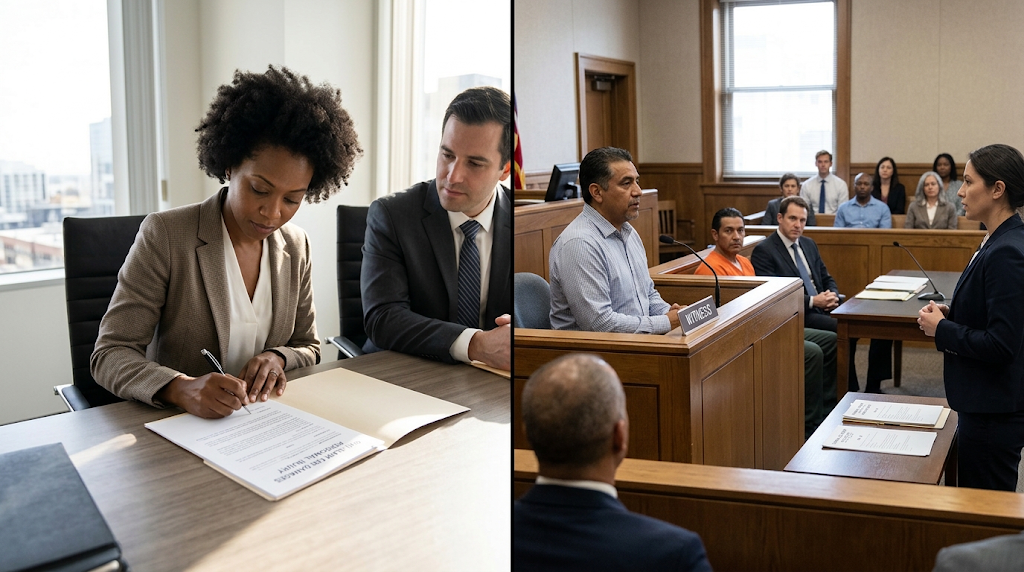
To those outside the legal profession, the distinction between these two systems can appear confusing. A crime is inherently a civil wrong against a person, just as it is an offense against society. However, the legal architecture treats criminal court and civil court as fundamentally distinct arenas, governed by different rules, presided over by different authorities, and designed to achieve entirely different objectives.
Understanding the structural differences between criminal charges and civil lawsuits is more than an academic exercise; it is a vital prerequisite for victims seeking accountability, safety, and financial recovery.While the criminal justice system focuses on penalizing the offender and protecting the broader public, the civil justice system provides victims with a direct mechanism to assert their individual rights, compel financial compensation, and hold negligent institutions accountable.
The following breakdown examines the key legal, procedural, and strategic differences crime victims must navigate when weighing their options within the judicial system.
The Core Mandate: Public Punishment vs. Private Restitution
The primary difference between a criminal proceeding and a civil lawsuit lies in the fundamental purpose of the litigation.
Criminal Law: State Action for Societal Wrongs
In criminal law, a crime is defined as an offense against the state or society as a whole, codified under public statutes.When a perpetrator commits a crime—such as battery, grand theft, or manslaughter—the violation is viewed legally as a disruption of public order and societal safety.
Consequently, the primary goal of the criminal justice system is punitive and deterrent.It seeks to punish the wrongdoer through incarceration, probation, community service, or state-administered fines, while simultaneously deterring others from engaging in similar conduct.In a criminal courtroom, the legal focus centers squarely on the accused: Did the defendant break the law, and if so, what penalty does society demand?
Civil Law: Private Dispute Resolution and Restitution
Conversely, a civil lawsuit is a private legal action initiated by one party (the plaintiff) against another party (the defendant) to resolve a dispute or seek remedy for an injury.In civil court, the law views the wrong not primarily as a violation of state statutes, but as a specific, actionable harm inflicted upon an individual’s person, property, reputation, or rights.
The overarching objective of civil justice is compensatory—it aims to “make the victim whole” to the greatest extent possible through monetary damages.While a civil court cannot restore a victim’s physical health or eliminate trauma, it utilizes financial judgments to offset medical bills, replace lost income, compensate for emotional distress, and fund long-term care. A civil judge or jury cannot send a defendant to prison; their authority is strictly limited to ordering financial compensation, declaring legal rights, or issuing court injunctions.
Who Controls the Case? Prosecutors vs. Victims as Plaintiffs
One of the most profound, and often frustrating, realizations for crime victims is how little direct control they possess over a criminal prosecution.
CRIMINAL PROSECUTION vs. CIVIL LITIGATION

Criminal Case Architecture:
[State / Prosecutor] ───> Controls Charges, Plea Deals & Trial ───> Target: Offender

Civil Case Architecture:
[Victim / Plaintiff]  ───> Controls Strategy, Settlement & Trial ───> Target: Offender / Negligent Entity
The Prosecutor’s Role in Criminal Court
In a criminal case, the government is the party bringing the action. The case title itself reflects this dynamic: State v. Defendant or People v. Defendant. The attorney directing the prosecution—whether a District Attorney, State’s Attorney, or Federal Prosecutor—represents the government, not the individual victim.
While modern victim-rights statutes mandate that prosecutors inform victims of case milestones and consult them regarding plea bargains, the ultimate legal authority rests entirely with the prosecutor. A prosecutor possesses sole discretion to:
- Determine whether to file formal charges or drop the case entirely.
- Decide which specific charges to pursue.
- Offer plea bargains that reduce charges or minimize prison sentences.
- Dismiss a case over the explicit objections of the victim.
In criminal proceedings, the victim functions primarily as a key witness for the state rather than a managing party.
The Victim’s Authority in Civil Court
In a civil lawsuit, the dynamic is entirely inverted.The victim enters the courtroom as the plaintiff—the party initiating and driving the litigation.
As the plaintiff, the victim retains absolute decision-making authority.Working alongside a privately retained attorney or a contingency-fee legal representative, the victim decides:
- Whether to file a lawsuit and whom to sue (including third-party entities whose negligence enabled the crime).
- What specific legal theories to assert (e.g., assault, battery, gross negligence, premises liability).
- Whether to accept a monetary settlement offer or proceed to a jury trial.
- Whether to withdraw or dismiss the lawsuit at any stage.
This autonomy can offer significant psychological empowerment to survivors.While the criminal process often leaves victims feeling sidelined by state bureaucracy, civil litigation restores agency, allowing survivors to actively direct the pursuit of justice.
Standards of Proof: ‘Beyond a Reasonable Doubt’ vs. ‘Preponderance of Evidence’
Perhaps the most critical technical distinction between criminal and civil trials lies in the burden of proof required to secure a favorable verdict.
BURDEN OF PROOF THRESHOLDS

Criminal Standard: Beyond a Reasonable Doubt
[===================================================> 95%+]
Statutory Guarantee: High threshold to protect individual constitutional liberty.

Civil Standard: Preponderance of the Evidence
[=====================> 51%]
Statutory Guarantee: More likely than not that the defendant is legally liable.
The Criminal Standard: Beyond a Reasonable Doubt
Because a criminal conviction can strip an individual of their fundamental constitutional liberties—resulting in incarceration, severe social stigma, or, in extreme capital cases, execution—the legal system imposes the highest evidentiary threshold known to law: proof beyond a reasonable doubt.
Under this standard, the prosecution must present evidence so complete, logical, and convincing that no reasonable person could harbor a genuine, logical doubt regarding the defendant’s guilt.If a jury believes there is even a plausible alternative explanation consistent with innocence, they are legally required to acquit.
The Civil Standard: Preponderance of the Evidence
Civil trials involve financial remedies rather than the loss of physical liberty.Consequently, the law applies a significantly lower, more flexible standard of proof: a preponderance of the evidence.
Often described in plain terms as the “51 percent rule” or “tipping the scales of justice,” this standard requires the plaintiff to prove that their claim is more likely true than not.If the jury believes there is a 51 percent probability that the defendant caused the victim’s injuries or failed in their legal duty of care, the plaintiff wins the verdict and is entitled to full financial recovery.
The Practical Impact: The O.J. Simpson Precedent
This stark difference in evidentiary standards explains why a defendant who is acquitted of criminal charges can still be held fully liable in a subsequent civil lawsuit based on the exact same set of facts.
The most prominent historical illustration of this principle occurred in the trials of O.J. Simpson. In 1995, a criminal jury acquitted Simpson of the murders of Nicole Brown Simpson and Ronald Goldman because the defense established sufficient reasonable doubt regarding forensic evidence processing. However, in 1997, the victims’ families filed a civil wrongful death lawsuit against Simpson.Operating under the lower preponderance-of-the-evidence standard, the civil jury evaluated the same factual matrix and found Simpson liable, ordering him to pay $33.5 million in damages.
For crime victims, this legal distinction provides a vital safety net: even if criminal prosecutors fail to secure an indictment or conviction, a civil lawsuit remains a viable, highly effective avenue for legal accountability.
Financial Outcomes: Criminal Restitution vs. Civil Damages
When an individual suffers harm due to a criminal act, the financial fallout can be devastating.Medical bills, rehabilitation costs, missed paychecks, psychiatric therapy, and property damage quickly aggregate into severe financial strain.While both courts offer financial mechanisms, their scope, collectibility, and structure differ dramatically.
| Financial Category | Criminal Court Restitution | Civil Court Damages Award |
| Primary Beneficiary | Victim receives direct out-of-pocket costs; state receives criminal fines. | Plaintiff receives complete financial judgment. |
| Covered Expenses | Direct, verifiable economic losses (medical bills, funeral expenses, property damage). | Comprehensive economic losses (past/future medical care, lost earning capacity) plus non-economic harm. |
| Pain & Suffering | Strictly excluded by law in almost all jurisdictions. | Full recovery permitted for pain, suffering, and emotional trauma. |
| Punitive Damages | Excluded (Fines go to state coffers rather than the victim). | Awarded directly to the victim in cases of gross negligence or intentional malice. |
| Collectibility Rate | Exceptionally low; defendants are frequently indigent or incarcerated. | Higher potential; targets corporate insurance policies, commercial assets, and liable third parties. |
The Limits of Criminal Restitution
In many criminal convictions, judges issue a restitution order as a mandatory component of sentencing.Restitution requires the convicted offender to repay the victim for specific out-of-pocket expenses directly resulting from the crime.
However, criminal restitution carries major statutory limitations:
- Strict Economic Limits:Restitution covers only hard, documented out-of-pocket costs, such as medical invoices or broken property.It strictly excludes non-economic damages, such as physical pain and suffering, loss of enjoyment of life, or severe emotional distress.
- The Collectibility Problem:The vast majority of criminal defendants lack financial assets, income, or commercial insurance.Once an offender is incarcerated, their earning capacity drops to near zero, leaving court-ordered restitution orders unpaid for years or decades.
The Scope of Civil Damages and Third-Party Liability
Civil litigation offers a far more expansive and realistic framework for financial recovery.A civil lawsuit allows plaintiffs to seek both economic damages (verifiable financial losses) and non-economic damages (intangible human losses):
- Economic Damages:Coverage for past and future medical care, specialized surgeries, long-term physical therapy, psychological counseling, prescription medications, past lost wages, and diminished future earning capacity.
- Non-Economic Damages:Compensation for physical pain, disfigurement, permanent disability, post-traumatic stress disorder (PTSD), mental anguish, and loss of consortium.
- Punitive Damages:In cases involving egregious, intentional, or wildly reckless conduct, civil courts may award punitive damages designed specifically to punish the wrongdoer and set a public deterrent example.
The Critical Role of Third-Party Liability
The most crucial strategic insight in victim advocacy involves identifying third-party defendants.In many crimes—such as an assault in an unlit commercial parking garage, a hotel room invasion, or a shooting at an apartment complex—the direct perpetrator may be unidentified or indigent.
However, a civil lawsuit allows victims to sue negligent third parties whose failure to fulfill a legal duty of care created the conditions that allowed the crime to occur.Under legal doctrines such as premises liability or negligent security, victims can hold commercial property owners, security firms, hotel chains, or employers accountable for failing to maintain adequate lighting, working locks, background-checked staff, or trained security personnel.
Because commercial entities and property owners carry commercial general liability (CGL) insurance policies, civil verdicts and settlements in third-party cases provide real, collectible financial compensation that supports a victim’s long-term medical and personal recovery.
Procedural Mechanics: Fifth Amendment Protections and Discovery
The procedural rules governing criminal and civil courtrooms shape how evidence is gathered and presented, creating distinct strategic advantages in civil litigation.
The Fifth Amendment Privilege: Criminal vs. Civil Context
The Fifth Amendment to the U.S. Constitution guarantees that no person shall be compelled in any criminal case to be a witness against themselves.
In a criminal trial, an accused perpetrator has an absolute right to remain silent.The prosecution cannot force the defendant to take the witness stand, and crucial to the constitutional framework, the judge and prosecutor are strictly forbidden from suggesting to the jury that the defendant’s silence implies guilt.
In a civil trial, the Fifth Amendment operates under fundamentally different rules:
- Compelled Testimony:A civil plaintiff can call the defendant to the witness stand under subpoena and question them directly under oath.
- The Adverse Inference:If a civil defendant asserts their Fifth Amendment privilege and refuses to answer questions regarding their wrongful conduct, civil law permits the judge or jury to draw an adverse inference.The trier of fact is legally allowed to assume that truthful answers to the questions would have damaged the defendant’s position, substantially bolstering the victim’s case.
Expansive Pre-Trial Discovery
Civil litigation provides plaintiffs with broad discovery tools that are often unavailable in criminal proceedings.Through formal civil discovery, a victim’s legal team can issue subpoenas to compel:
- Submission of internal corporate communications, emails, and incident logs.
- Unredacted security camera footage and maintenance histories.
- Sworn, recorded out-of-court depositions of business managers, property owners, eye-witnesses, and corporate executives.
- Detailed employment, security audit, and prior crime reports for a specific location.
This aggressive discovery capacity enables victims to unearth evidence of systemic neglect, institutional cover-ups, or unaddressed safety hazards that go far beyond what a standard police investigation might uncover.
Parallel Proceedings: Navigating Simultaneous Cases
In many instances, a criminal prosecution and a civil lawsuit arise from the exact same incident and run concurrently.When parallel proceedings occur, victims must navigate strategic timing considerations alongside their legal representatives.
Stays of Proceedings
When a criminal case is active, the defense attorney in the civil case will frequently request a temporary pause, known legally as a “stay of proceedings.” Judges routinely grant stays in civil cases until the criminal trial concludes. This prevents civil discovery from interfering with the constitutional rights of the accused in the criminal matter or compromising active police investigations.
The Strategic Value of a Criminal Conviction
While a civil lawsuit can be filed and successfully won completely independent of a criminal case, waiting for or utilizing a criminal conviction offers immense strategic leverage.
Under the doctrine of collateral estoppel (often referred to as issue preclusion), if a perpetrator is convicted of a crime in criminal court—either through a jury verdict or a formal guilty plea—the facts establishing that crime are legally considered conclusively proven.
In the subsequent civil trial, the victim does not need to re-prove that the perpetrator committed the wrongful act; the criminal conviction establishes civil liability automatically.The civil trial can then bypass the liability phase entirely, focusing exclusively on quantifying the financial damages owed to the victim.
Timelines, Costs, and Practical Considerations
Deciding whether and when to pursue a civil lawsuit requires balancing financial realities, legal deadlines, and emotional capacity.
Statutes of Limitations
Every state enforces strict legal deadlines, known as statutes of limitations, governing how long a victim has to file a civil lawsuit.While serious criminal offenses (such as murder or sexual assault) may have long or non-existent statutes of limitations for state prosecutors, civil personal injury and wrongful death actions carry much tighter filing windows—often ranging from one to three years from the date of the injury.Missing a civil statute of limitations permanently bars a victim from seeking financial recovery, making early legal consultation critical.
Financial Accessibility: Contingency Fee Arrangements
A common misconception among crime victims is that hiring a civil attorney requires substantial upfront financial resources.In personal injury, wrongful death, and crime-victim civil litigation, private attorneys routinely operate on a contingency fee basis.
Under a contingency structure:
- The victim pays zero upfront retainer fees or out-of-pocket legal expenses.
- The law firm covers all costs associated with investigation, filing fees, expert witness testimony, and discovery.
- The attorney receives a contractually agreed-upon percentage (typically 33% to 40%) of the final financial recovery only if the case wins through a settlement or court verdict.
- If the civil lawsuit is unsuccessful, the victim owes nothing in legal fees.
This model ensures that financial hardship does not prevent victims from accessing top-tier legal representation to assert their rights against well-funded corporate defendants or insurance carriers.
Managing the Emotional Toll
While civil litigation offers financial recovery and accountability, it is an adversarial legal process.Victims must be prepared to give sworn depositions, answer detailed questions regarding their injuries and medical histories, and potentially testify in a public courtroom.
Victim advocates recommend that individuals pursuing civil litigation assemble a comprehensive support system—including specialized trauma counselors, victim-advocacy organizations, and trusted family members—to assist them throughout the legal journey.
Comprehensive Justice: Reclaiming Control After Harm
Criminal charges and civil lawsuits represent two distinct pillars of the justice system, each addressing harm through a different legal lens.Criminal court answers society’s demand for public safety, law enforcement, and offender punishment.Civil court addresses the victim’s human needs: restoring financial stability, holding negligent institutions accountable, and funding long-term physical and psychological recovery.
For crime victims and their families, these two legal pathways do not exist in opposition; rather, they serve as complementary mechanisms of justice.While a criminal conviction can bring societal validation and closure, a civil lawsuit provides the tangible financial resources and personal agency necessary to rebuild a life disrupted by violence or neglect.
By understanding these key structural distinctions, crime victims can move through the legal system with clarity and confidence—ensuring that their rights, their safety, and their future remain fully protected.
Leave a Reply