
In popular culture, the administration of justice is almost exclusively depicted as a high-stakes courtroom drama. Television shows and feature films routinely culminate in impassioned closing arguments before a jury of twelve citizens, followed by a tense wait for a unanimous verdict.

Yet inside actual courthouses, this dramatic vision represents a statistical anomaly. The vast majority of criminal indictments and civil lawsuits never make it to a jury trial. Instead, they are resolved, dismissed, or settled long before a jury is ever impaneled.
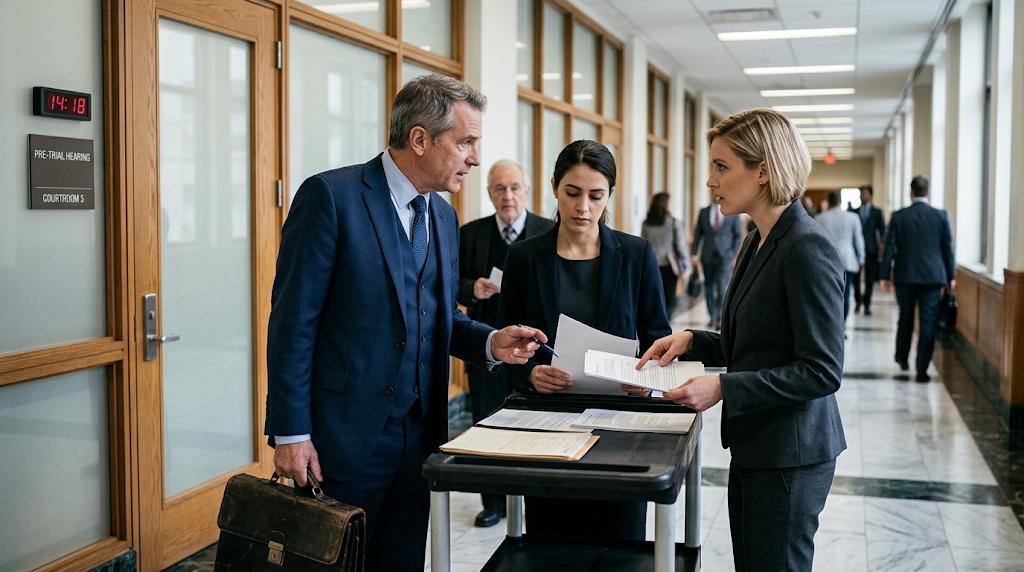
The true heart of the judicial process resides in a series of procedural appearances known collectively as pretrial hearings. Conducted in quieter, less sensational court sessions, these proceedings serve as the operational machinery of the legal system. It is during the pretrial phase that judges, prosecutors, defense attorneys, and corporate litigators challenge evidence, resolve procedural disputes, assess legal risks, and negotiate terms.
Understanding how pretrial hearings function reveals why the jury trial has largely vanished from modern courtrooms—and how the business of justice is actually conducted.
The Vanishing Jury Trial: A Statistical Reality
Legal scholars and judicial administrators often refer to the phenomenon of the “vanishing trial.” Over the past several decades, the percentage of court cases resolved by a jury has steadily declined across federal, state, and municipal courts.
In federal criminal courts, upwards of 95% of defendants resolve their cases through plea agreements rather than going to trial. State court statistics reflect a similar reality, where guilty pleas and pretrial dismissals routinely account for 94% to 97% of all criminal dispositions.
The trend is even more pronounced in civil litigation. Out of thousands of civil complaints filed annually—ranging from personal injury claims and employment disputes to complex corporate contract actions—fewer than 2% ultimately proceed to a jury verdict. The vast majority are resolved via pretrial summary judgments, motions to dismiss, or private financial settlements negotiated during pretrial status conferences.
Far from being a structural failure, this reliance on pretrial resolution is by design. If every filed case proceeded to a full jury trial, judicial systems would experience immediate and catastrophic gridlock. Pretrial hearings act as an essential regulatory valve, processing dockets efficiently while establishing the legal boundaries within which cases are evaluated.
What Happens at a Pretrial Hearing?
A pretrial hearing is any formal court proceeding that takes place after an initial complaint or indictment is filed, but before a trial begins. Depending on the complexity of the case, a lawsuit or criminal prosecution may involve multiple pretrial hearings spanning several months or even years.
While specific procedures vary by jurisdiction, pretrial hearings generally serve four major operational functions:
┌─────────────────────────────────────────────────────────┐
│              STAGES OF PRETRIAL LITIGATION              │
├─────────────────────────────────────────────────────────┤
│ 1. Initial Appearance & Arraignment                     │
│    • Formal reading of charges                          │
│    • Entering initial plea                              │
│    • Setting bail / pre-trial release conditions        │
├─────────────────────────────────────────────────────────┤
│ 2. Scheduling & Status Conferences                      │
│    • Establishing discovery deadlines                   │
│    • Setting motion schedules and trial dates           │
├─────────────────────────────────────────────────────────┤
│ 3. Discovery Management & Evidentiary Motions           │
│    • Resolving document and witness disputes            │
│    • Motions to Suppress evidence                       │
│    • Motions for Summary Judgment                       │
├─────────────────────────────────────────────────────────┤
│ 4. Pretrial Settlement / Plea Negotiations              │
│    • Judicial encouragement of resolution               │
│    • Finalizing plea bargains or civil settlements      │
└─────────────────────────────────────────────────────────┘
1. Arraignment and Initial Scheduling
In criminal cases, the pretrial process begins with an initial appearance or arraignment. The court formally presents the charges to the defendant, reviews constitutional rights, addresses bail or pre-trial release conditions, and records an initial plea—typically “not guilty.” In civil litigation, the equivalent stage involves the defendant filing a formal answer to the complaint, followed by an initial scheduling conference where the judge sets firm deadlines for the litigation.
2. Status Conferences and Case Management
As cases move forward, judges hold periodic status conferences to monitor progress. These hearings ensure that both sides adhere to court-ordered timelines for exchanging evidence, taking depositions, and hiring expert witnesses. Status hearings also provide judges with regular opportunities to inquire whether the parties have engaged in meaningful settlement discussions or plea negotiations.
3. Evidentiary and Suppression Hearings
Evidentiary hearings represent the most decisive category of pretrial proceedings. During these sessions, attorneys argue over what evidence, witness testimony, or expert analysis will be legally admissible at trial.
In criminal matters, these sessions often take the form of suppression hearings, where defense attorneys argue that law enforcement obtained evidence unconstitutionally. In civil matters, judges hold specialized proceedings (such as Daubert hearings in federal courts) to determine whether an expert witness’s scientific methodology is sufficiently reliable to be presented to a jury.
Strategic Motion Practice: Filtering Out Weak Cases
The primary mechanism that eliminates cases during the pretrial phase is motion practice. A motion is a formal request asking the judge to make a specific legal ruling. Pretrial motions allow attorneys to test the legal sufficiency of an opposing party’s case before committing time and capital to a trial.
Motions to Dismiss
Early in litigation, a defendant may file a Motion to Dismiss. This motion argues that even if all the facts alleged in the complaint or indictment are accepted as true, they fail to establish a violation of the law. If a judge grants a motion to dismiss with prejudice, the case is permanently terminated without a jury ever hearing a single piece of evidence.
Motions to Suppress Evidence
In criminal law, a successful Motion to Suppress can dismantle the prosecution’s case in a single morning. If a defense attorney demonstrates that police conducted an illegal traffic stop, executed a search warrant without probable cause, or interrogated a suspect without administering proper Miranda warnings, the judge must exclude the resulting evidence under the constitutional Exclusionary Rule.
If the suppressed evidence happens to be the primary drug evidence, the murder weapon, or a central confession, the prosecutor is often left with no legal ground to stand on, forcing an immediate dismissal of charges or a drastic reduction in the plea offer.
Motions for Summary Judgment
In civil litigation, the Motion for Summary Judgment serves as the ultimate pretrial filter. Under Rule 56 of the Federal Rules of Civil Procedure (and state equivalents), a judge will grant summary judgment if the moving party demonstrates that there is “no genuine dispute as to any material fact” and that they are entitled to judgment as a matter of law.
If the written evidence, sworn depositions, and affidavits reveal that the fundamental facts of a dispute are uncontested, the judge decides the legal outcome directly, eliminating the need for a jury trial entirely.
The Economics of Litigation: Risk, Cost, and Resource Allocation
While legal rulings eliminate many cases, financial and strategic considerations motivate the resolution of most remaining disputes during the pretrial phase.
The Financial Cost of Trial
Preparing for and conducting a jury trial is extraordinarily expensive. In civil litigation, a full-scale trial requires hundreds of hours of attorney preparation, expensive expert witness fees, trial presentation technology, jury consultants, and court reporting costs. For corporate entities and individual litigants alike, the financial expense of proceeding to trial frequently outweighs the cost of agreeing to a pretrial settlement.
In the criminal justice system, resource constraints exert pressure on both sides. Public defender offices and prosecutor facilities manage enormous caseloads with finite budgets and limited staff. If every felony case proceeded to trial, the system would founder under administrative costs. Pretrial plea bargaining allows prosecutors to secure convictions and convictions records while conserving trial resources for the most severe offenses.
The Risk of Unpredictability
Juries are inherently unpredictable. Regardless of how strong a case may appear on paper, presenting evidence to twelve laypeople carries an unavoidable element of risk.
- In Civil Cases: Defendants face the threat of runaway jury awards, punitive damages, and reputational damage. Plaintiffs face the risk of receiving zero compensation after years of costly litigation. A negotiated pretrial settlement replaces that volatility with financial certainty.
- In Criminal Cases: Defendants face what legal scholars term the “plea penalty”—the stark disparity between the sentence offered in a pretrial plea deal and the significantly longer sentence typically imposed if the defendant loses at trial. Faced with the threat of mandatory minimum sentences, many defendants choose the guaranteed outcome of a negotiated plea agreement over the existential gamble of a jury verdict.
The Evolving Role of the Managerial Judge
The high rate of pretrial case resolution also reflects a fundamental shift in the judicial role over the past half-century.
Historically, trial judges operated primarily as passive referees, stepping in only to rule on evidentiary objections during live trial proceedings. Today, modern jurists act as active case managers. Armed with expanded authority under modern procedural rules, judges actively oversee pretrial scheduling, enforce discovery deadlines, limit redundant testimony, and encourage settlement discussions.
During pretrial status conferences, judges frequently offer candid evaluations of the strengths and weaknesses of each side’s case. While judges cannot force civil litigators to settle or compel a criminal defendant to plead guilty, their preliminary feedback during pretrial hearings carries enormous persuasive weight. When a judge points out during a pretrial conference that a specific legal claim is unlikely to survive a jury charge, sensible litigants take note and move toward settlement negotiations.
Furthermore, courts increasingly require civil litigants to participate in court-annexed Alternative Dispute Resolution (ADR)—such as court-ordered mediation or non-binding arbitration—as a mandatory pretrial step before granting a trial date.
Systemic Advantages and Ethical Trade-Offs
The dominance of pretrial hearings over jury trials generates sharp debate among legal scholars, civil rights advocates, and court administrators.
The Arguments for Pretrial Dominance
Proponents of the current system emphasize its overwhelming practical benefits:
- Systemic Efficiency: Pretrial resolutions prevent judicial collapse, allowing courts to process millions of civil complaints and criminal filings each year.
- Speed and Finality: Pretrial settlements and plea bargains resolve legal matters months or years faster than full trials, providing prompt compensation to civil victims and immediate resolution for criminal dockets.
- Certainty and Control: Parties retain agency over their outcomes. Civil litigants control the financial terms of their settlement, while criminal defendants gain control over their maximum sentencing exposure.
The Critiques and Systemic Risks
Critics, however, contend that the displacement of the jury trial compromises core constitutional values:
- The Erosion of the Sixth Amendment: The Sixth Amendment explicitly guarantees the right to a public trial by an impartial jury. When structural incentives, severe trial penalties, and bail conditions compel the vast majority of defendants to take pretrial pleas, critics argue the constitutional guarantee becomes largely theoretical.
- Pressures on the Innocent: In low-level criminal matters, incarcerated defendants who cannot afford bail are often offered pretrial plea deals for “time served.” Faced with the choice of remaining in jail for months waiting for a trial or pleading guilty to go home immediately, many choose the plea regardless of factual guilt.
- Loss of Public Transparency and Oversight: Jury trials are public events that hold government prosecutors, law enforcement agencies, and powerful corporate institutions publicly accountable. Pretrial plea negotiations and confidential civil settlements occur behind closed doors, depriving the public of the opportunity to scrutinize systemic misconduct or safety hazards.
The Real Crucible of Modern Law
While the jury trial retains its cultural stature as the ultimate symbol of western jurisprudence, it no longer reflects the everyday mechanics of the courtroom. The modern legal system operates not through dramatic jury verdicts, but through the rigorous, procedural, and economic machinery of pretrial hearings.
It is during these preliminary proceedings that evidence is vetted, legal theories are tested, rights are asserted, and the vast majority of legal disputes find their ultimate resolution. Pretrial hearings may lack the theatrical flair of a jury trial, but they represent where the actual business of justice is weighed, negotiated, and delivered.
Leave a Reply