
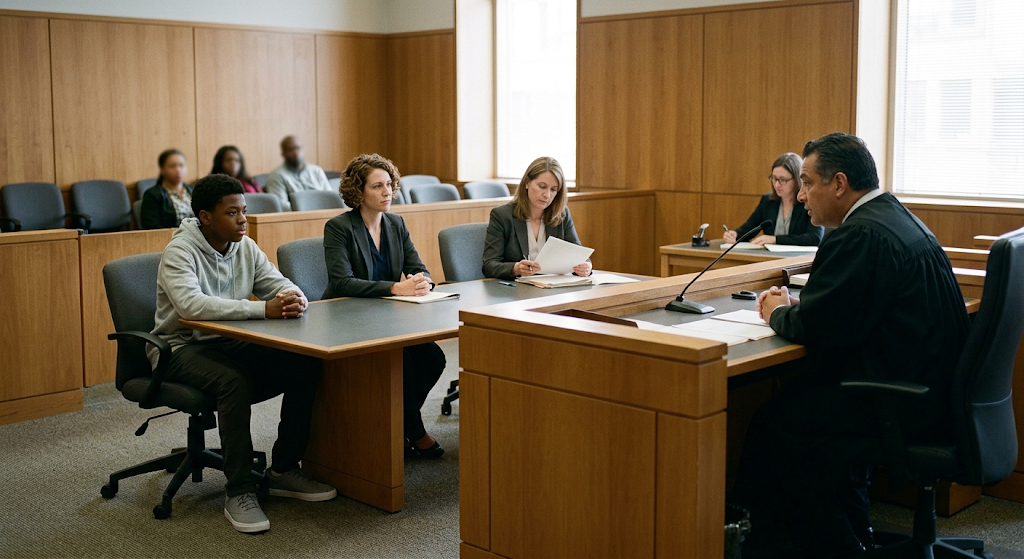
When an adult is accused of a crime, the legal system sets into motion a process built fundamentally around personal accountability, deterrence, and proportional punishment. The state asserts that a statute was broken, formal charges are filed, and an adversarial trial determines guilt or innocence before a jury of peers. If convicted, the defendant faces standardized penalties ranging from court fines and probation to lengthier terms in state or federal prison.

When a minor commits the exact same physical act, however, the legal system responds through a separate, specialized apparatus: the juvenile court.
While both systems handle violations of criminal law, juvenile court proceedings and adult criminal trials operate under vastly different legal philosophies, constitutional frameworks, procedural rules, and ultimate goals. Understanding these distinctions reveals how justice systems balance public safety against society’s evolving understanding of adolescent development, human capacity for reform, and the legal rights of young people.
Philosophical Foundations: Rehabilitation vs. Retribution
The fundamental divide between adult criminal trials and juvenile court proceedings lies in their underlying philosophy.
The modern adult criminal justice system is largely retributive and deterrent in nature. It operates on the legal presumption that competent adults possess the full cognitive capacity to understand the consequences of their actions. Consequently, when an adult breaks the law, the primary objective of the court is to deliver just deserts, deter future misconduct, isolate dangerous individuals from the community, and provide retribution to victims.
By contrast, the juvenile justice system was founded on the doctrine of parens patriae—a Latin legal term meaning “parent of the country.” Established in the United States at the end of the 19th century with the creation of the first juvenile court in Cook County, Illinois, the system treats youth not as irredeemable criminals, but as wards of the state in need of guidance, correction, and protection.
This philosophical difference is supported by modern neuroscientific research. Studies in brain development consistently show that the prefrontal cortex—the region responsible for impulse control, risk assessment, emotional regulation, and long-term decision-making—is not fully matured until a person reaches their mid-twenties.
Because adolescents are biologically more prone to peer pressure and impulsive risk-taking, the law views their legal culpability as inherently diminished compared to adults. As a result, juvenile court proceedings prioritize rehabilitation, psychological intervention, and educational support over punishment.
Key Differences in Terminology and Framing
To emphasize rehabilitation over punishment and avoid stigmatizing young people with a permanent criminal identity, the juvenile system uses a distinct legal vocabulary. What occurs in adult court has a direct parallel in juvenile court, but the language is intentionally altered.
| Legal Concept | Adult Criminal Court | Juvenile Court |
| Initiating Document | Criminal Complaint / Indictment | Delinquency Petition |
| The Offense | Crime (Felony or Misdemeanor) | Delinquent Act or Status Offense |
| Apprehension | Arrest | Taking into Custody |
| Initial Hearing | Arraignment | Initial Hearing / Detention Hearing |
| Plea | Guilty / Not Guilty | Admission / Denial |
| The Trial | Criminal Trial | Adjudicatory Hearing |
| The Verdict | Conviction (Guilty / Not Guilty) | Adjudication of Delinquency |
| The Sentence | Sentencing | Disposition |
| Housing Facility | Jail / Prison | Detention Center / Residential Treatment |
In addition to delinquent acts (actions that would be crimes if committed by adults, such as theft or assault), juvenile courts also exercise jurisdiction over status offenses. These are behaviors that are deemed unlawful solely because of the individual’s age—such as truancy, running away from home, violating local youth curfews, or underage alcohol consumption. Adult courts have no jurisdiction over status offenses.
Constitutional Rights and Procedural Divergences
For the first half of the 20th century, juvenile courts operated with wide informal discretion. Judges acted almost as father figures or social workers, making decisions with few procedural rules. However, this lack of structure often led to arbitrary decisions and severe consequences for minors without formal legal protections.
A series of landmark decisions by the United States Supreme Court in the 1960s and 1970s extended core constitutional rights to juveniles, while preserving key procedural differences between the two court systems.
Due Process Protections (In re Gault)
In the landmark 1967 case In re Gault, the Supreme Court ruled that juveniles facing delinquency proceedings that could result in commitment to an institution are entitled to fundamental Due Process rights under the Fourteenth Amendment. These include:
- The right to timely, written notice of the specific charges.
- The right to legal counsel (including court-appointed counsel for indigent youth).
- The right to confront and cross-examine adverse witnesses.
- The privilege against self-incrimination (the right to remain silent).
Subsequent rulings, such as In re Winship (1970), established that the state must prove juvenile delinquency charges under the same rigorous evidentiary standard used in adult court: proof beyond a reasonable doubt.
The Right to a Jury Trial (McKeiver v. Pennsylvania)
Despite granting many due process protections, the Supreme Court drew a firm line regarding jury trials. In McKeiver v. Pennsylvania (1971), the Court held that juveniles do not have a constitutional right to a jury trial under the Sixth Amendment.
The Court reasoned that introducing formal jury trials into juvenile proceedings would destroy the informal, protective, and therapeutic nature of the juvenile court, turning it into a fully adversarial clone of the adult system.
As a result, the vast majority of juvenile cases are resolved through bench trials (adjudicatory hearings), where a single judge hears the evidence, evaluates witness testimony, and determines whether the youth committed the alleged delinquent act. While a small minority of states permit jury trials in juvenile court by statute, it remains an exception rather than the standard.
Bail vs. Detention Intake Risk Assessment
In the adult criminal justice system, arrested individuals generally have a constitutional right to seek monetary bail or pre-trial release on their own recognizance while awaiting trial.
Juveniles do not have a constitutional right to monetary bail. Instead, when a youth is taken into custody, an intake officer or juvenile judge conducts a risk assessment evaluation. The court determines whether the minor should be:
- Released immediately to the custody of their parents or legal guardians.
- Released under electronic monitoring or court supervision.
- Held in a secure juvenile detention facility prior to the adjudicatory hearing.
Pre-adjudication detention for juveniles is governed strictly by considerations of public safety and whether the minor presents an immediate flight risk or danger to themselves, rather than their financial ability to post cash bail.
Publicity, Confidentiality, and Court Records
The public nature of court proceedings represents another major structural divide between adult and juvenile justice.
Open Courtrooms vs. Closed Proceedings
Adult criminal trials are public proceedings protected by the Sixth Amendment. Members of the press, community residents, and family members are generally permitted to sit in the courtroom gallery, observe testimony, and review public court files.
Juvenile proceedings have historically been closed to the general public. Judges maintain broad authority to clear the courtroom, permitting only the youth, their parents or guardians, legal counsel, probation officers, and necessary court staff to be present. The goal is to protect the youth from public embarrassment, societal stigmatization, and media scrutiny that could hinder long-term rehabilitation.
In recent decades, some jurisdictions have opened juvenile courtrooms for proceedings involving severe violent felonies, allowing victims and media representatives to attend under specific judicial ground rules. However, confidentiality remains the default baseline for standard juvenile matters.
Record Sealing and Expungement
Adult criminal convictions routinely follow individuals for the rest of their lives, appearing on background checks for employment, housing applications, professional licensing, and military enlistment, unless formal pardon or expungement criteria are met years down the line.
Juvenile records, by contrast, are subject to strict privacy protections. Access is generally restricted to law enforcement, prosecutors, and court personnel. Furthermore, most jurisdictions provide streamlined statutory mechanisms for former juvenile offenders to have their delinquency records sealed or expunged upon reaching adulthood, provided they have completed their dispositional terms and maintained a clean record. This procedural shield is designed to grant young individuals a genuine fresh start as they enter adulthood.
Adjudication and Disposition: Comparing Outcomes
When an adult is convicted of a crime, the trial moves to the sentencing phase. Sentencing in adult court relies heavily on statutory guidelines, mandatory minimum sentences, and fixed prison terms that correspond to the severity of the offense. While judges may consider mitigating factors, the primary goal of the sentence is to enforce punishment proportional to the crime.
When a juvenile is adjudicated delinquent, the court proceeds to a dispositional hearing. The approach at disposition differs fundamentally from adult sentencing.
Individualized Treatment Plans
Rather than relying solely on the specific act committed, juvenile judges focus heavily on the background, social environment, and individual needs of the youth. Prior to disposition, a juvenile probation officer prepares a comprehensive social history report. This evaluation examines:
- The youth’s family dynamics and home stability.
- School attendance, academic progress, and behavioral records.
- Psychological assessments and trauma history.
- Substance abuse patterns or mental health needs.
- Peer relationships and community involvement.
Based on this evaluation, the judge constructs an individualized disposition plan tailored to address the root causes of the youth’s behavior.
Range of Dispositional Options
Juvenile courts possess wide latitude in crafting dispositional outcomes, which often combine multiple intervention strategies:
- Informal Supervision or Deferred Adjudication: The case is paused while the youth completes specific court conditions. If successful, the charges are dismissed entirely without a formal adjudication on their record.
- Community-Based Probation: The youth remains at home under the supervision of a juvenile probation officer, adhering to curfews, mandatory school attendance, regular drug screenings, and counseling sessions.
- Restitution and Community Service: The youth is ordered to pay financial restitution to victims for property damage or perform community service hours to repair harm caused to the neighborhood.
- Out-of-Home Placement: If the home environment is deemed unsafe or unsupportive, the court may place the youth in a licensed foster home, therapeutic group home, or specialized residential treatment center.
- Commitment to Youth Correctional Facilities: For severe offenses or chronic offenders, the court can commit the youth to a secure state juvenile facility focused on education, vocational training, and behavioral rehabilitation.
Indeterminate Terms and Jurisdictional Limits
Sentences in adult court are typically determinate—such as a fixed term of five years in prison.
Juvenile dispositions are frequently indeterminate. A judge may commit a youth to a residential treatment center or state facility until the youth demonstrates sufficient rehabilitation and progress, as determined by facility directors and treatment staff.
Crucially, juvenile court authority is bounded by age. In most jurisdictions, juvenile court jurisdiction terminates when the individual turns 18, 21, or in some states, 25. Once a young person reaches the statutory age limit, the juvenile system must release them, regardless of whether the original rehabilitation plan is complete.
Waiver and Transfer: Entering the Adult System
While the juvenile court system is built to handle young offenders, it does not retain exclusive control over every case involving a minor. When a juvenile commits an exceptionally serious crime—such as homicide, armed robbery, or sexual assault—or when a chronic offender shows no response to rehabilitative interventions, the law provides mechanisms to transfer the case to adult criminal court.
This process is known as juvenile waiver, transfer, or certification.
Mechanisms of Transfer
Jurisdictions utilize three primary statutory avenues to move a juvenile into adult criminal court:
- Judicial Discretionary Waiver: A juvenile court judge holds a formal waiver hearing to evaluate whether the minor should remain in the juvenile system. The judge weighs factors such as the minor’s age, criminal history, the severity of the offense, public safety risks, and the youth’s amenability to treatment. If the judge grants the waiver, the juvenile court relinquishes jurisdiction, and the case moves to adult court.
- Statutory Exclusion (Mandatory Transfer): State legislatures enact laws that automatically exclude specific violent offenses from juvenile court jurisdiction based on the defendant’s age. For example, a statute may mandate that any 16- or 17-year-old charged with first-degree murder is automatically processed as an adult, bypassing juvenile intake entirely.
- Prosecutorial Direct File: In some jurisdictions, laws grant prosecutors concurrent jurisdiction, allowing them sole discretion to choose whether to file charges in juvenile court or directly in adult criminal court for certain specified felonies.
The Consequences of Transfer
When a juvenile is transferred to adult court, they leave behind the protective framework of the juvenile system. They are tried in open court, face potential jury trials, receive public criminal records, and become subject to adult sentencing standards—including long terms in adult prisons.
During the “get tough on crime” era of the late 1980s and 1990s, statutory changes dramatically increased the number of youths transferred to adult courts. However, subsequent empirical studies revealed that juveniles transferred to adult prisons had higher recidivism rates than those retained in juvenile facilities for similar offenses, prompting many states to recalibrate their transfer laws.
The Supreme Court and the Science of Youth
Over the past two decades, the intersection of developmental neuroscience and constitutional law has reshaped how the legal system handles young offenders facing severe penalties.
In a series of landmark decisions, the Supreme Court utilized Sixth, Eighth, and Fourteenth Amendment principles to establish clear boundaries on how juveniles can be punished, even when tried as adults:
- Roper v. Simmons (2005): The Court struck down the death penalty for individuals who were under the age of 18 at the time of their capital crime, ruling that executing juveniles constitutes cruel and unusual punishment under the Eighth Amendment.
- Graham v. Florida (2010): The Court banned sentences of life imprisonment without the possibility of parole for juveniles convicted of non-homicide offenses.
- Miller v. Alabama (2012): The Court ruled that mandatory sentences of life without parole for juvenile homicide offenders are unconstitutional. Judges must consider an offender’s youth, background, and capacity for change before imposing such a severe sentence.
- Montgomery v. Louisiana (2016): The Court declared that the decision in Miller applied retroactively, granting thousands of individuals sentenced to mandatory life terms as juveniles the right to seek parole hearings or resentencing.
These rulings formally encoded into constitutional law what juvenile courts were designed to recognize over a century ago: children are categorically different from adults in their vulnerability, culpability, and potential for transformation.
Two Paths to Justice
The distinct structures of juvenile court proceedings and adult criminal trials reflect a conscious division in how society defines justice.
Adult criminal trials operate as formal, public, and adversarial contests focused on establishing guilt and enforcing proportional punishment for past conduct. Juvenile courts operate as specialized, confidential, and interventionist institutions designed to evaluate a young person’s life context, address behavioral drivers, and chart a path toward future citizenship.
While the boundaries between the two systems continue to evolve through ongoing legislative reforms and judicial decisions, the core principle of juvenile justice remains intact: accountability for young people must be paired with an enduring commitment to their capacity to change.
Leave a Reply