
Hundreds of prospective jurors are arriving at the federal courthouse this week as jury selection officially begins in one of the most closely watched federal trials of the year. The milestone marks the transition from months of intense pretrial motions, evidentiary battles, and public anticipation into the crucial first phase of a trial that could set far-reaching legal and regulatory precedents.
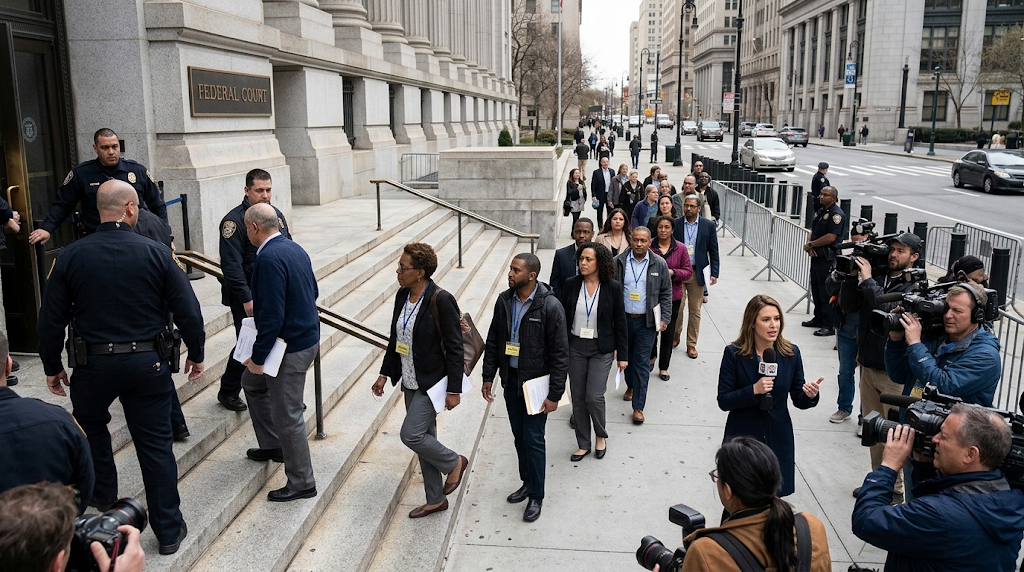
Outside the federal courthouse, heightened security measures, barricades, and rows of broadcast trucks underscored the extraordinary nature of the proceedings. Inside, federal marshals escorted batches of citizens selected from the district’s voter and driver registration rolls into a secure assembly room. Over the coming days, prosecutors, defense attorneys, and the presiding federal judge will engage in the meticulous process of winnowing down a large jury pool to a panel of twelve impartial jurors and several alternates.
The case, which brings together formidable legal talent, high-volume digital evidence, and complex statutory frameworks, has drawn international attention. Yet, before any opening statements can be delivered or witness testimony heard, the immediate challenge centers on an elemental requirement of constitutional justice: finding twelve citizens capable of putting aside personal biases, media exposure, and preconceived notions to render a fair and impartial verdict based strictly on the evidence presented in court.
The Mechanics of Federal Voir Dire Under Intense Scrutiny
Jury selection in a high-profile federal trial is a delicate, highly structured procedure governed by the Federal Rules of Criminal and Civil Procedure, supervised closely by the presiding judge. Unlike state courts where attorneys often conduct extended questioning of prospective jurors, federal judges typically retain primary control over the process, known as voir dire—a French term meaning “to speak the truth.”
Beginning early Monday morning, prospective jurors began filling out extensive, multi-page supplemental questionnaires designed jointly by the court and counsel. These questionnaires delve far deeper than standard jury forms, asking prospective panel members about their media consumption habits, opinions on government institutions and corporate entities, familiarity with the parties involved, and personal experiences that could color their objectivity.
“The objective during federal jury selection in a major case is not to find jurors who have lived in a bubble and know absolutely nothing about the news,” said a former federal prosecutor now specializing in complex litigation. “The constitutional standard does not require total ignorance of the facts; it requires an open mind and a willingness to follow the judge’s instructions on the law, regardless of prior impressions.”
Following the evaluation of written responses, prospective jurors are brought into the courtroom in smaller cohorts for oral questioning. The federal judge leads the inquiry, asking targeted questions to assess whether individuals hold deep-seated biases that would prevent them from evaluating the evidence impartially.
During this phase, legal teams on both sides exercise two primary types of challenges to remove prospective jurors:
- Challenges for Cause: Unlimited in number, these challenges are granted by the judge when a prospective juror demonstrates clear bias, personal conflict of interest, or an inability to follow legal instructions.
- Peremptory Challenges: A strictly limited number of challenges that allow each side to dismiss a prospective juror without stating a specific reason, provided the dismissal is not based on race, ethnicity, or gender.
The strategic deployment of peremptory challenges is often described by trial strategists as a process of “subtraction rather than addition”—a systematic effort to eliminate individuals who pose the highest statistical or psychological risk to a party’s core theory of the case.
High Stakes and Complex Allegations at the Center of the Case
The trial comes after more than a year of intensive investigation, grand jury proceedings, and voluminous pretrial discovery. The indictment and civil filings paint a detailed picture of alleged misconduct, bringing statutory claims that carry significant financial, operational, or penal consequences.
At the heart of the government’s case is a multi-count narrative supported by thousands of pages of internal documents, encrypted communications, financial ledgers, and forensic digital evidence. Prosecutors contend that the defendants engaged in a deliberate, structured pattern of unlawful activity that misled investors, regulators, and the general public.
Counsel for the defense, comprising elite white-collar defense attorneys and veteran trial advocates, has forcefully rejected the allegations. In preliminary motions, the defense argued that the government’s case rests on selective reading of internal communications, misinterpreted business practices, and a fundamental misapplication of federal statutory standards.
The evidentiary presentation is expected to be technical and highly detailed. Expert witnesses specializing in forensic accounting, digital telemetry, regulatory compliance, and corporate governance are listed on both sides’ witness rosters. Translating this complex wall of technical evidence into a clear, understandable narrative for lay jurors will be the primary task for lead attorneys once the panel is seated.
“When you are dealing with thousands of spreadsheets, server logs, or complex statutory definitions, jury selection becomes even more critical,” noted a senior defense attorney unaffiliated with the case. “You need jurors who possess the cognitive stamina to sit through weeks of dense technical testimony without losing sight of the core legal burden—which remains proof beyond a reasonable doubt.”
Navigating Media Saturation, Gag Orders, and Anonymity
Selecting an impartial jury is immensely complicated by the pervasive news coverage and social media commentary surrounding the case. In an era of instantaneous mobile alerts and viral online commentary, insulating prospective jurors from pre-trial publicity requires aggressive judicial management.
To safeguard the integrity of the proceedings, the presiding judge has implemented a series of protective measures:
- Strict Gag Orders: Attorneys, witnesses, and court personnel remain under court orders restricting out-of-court statements that could prejudice the potential jury pool.
- Partial Anonymity Measures: In light of public interest and the potential for external harassment, the court has ordered that the names, exact addresses, and specific places of employment of prospective jurors remain confidential throughout the selection process and trial.
- Digital Decoupling Directives: Jurors are repeatedly warned that conducting independent online research, reading news reports, or posting about their jury service on social media platforms constitutes a serious breach of federal law punishable by contempt of court.
The challenge of pre-trial publicity was evident during the opening hours of voir dire. Several prospective jurors were excused almost immediately after acknowledging that they had formed unalterable opinions based on news reports or commentary published prior to arriving at the courthouse. Others expressed deep anxiety about the potential personal and professional disruptions associated with serving on a high-profile, multi-week trial.
Judges in high-profile federal cases must balance two competing constitutional mandates: the First Amendment right of the public and press to attend judicial proceedings, and the Sixth Amendment right of the defendant to a fair trial by an impartial jury. By utilizing partial anonymity, controlled access, and rigorous oral examination, the court aims to preserve both principles without resorting to extreme measures like total jury sequestration, which is generally reserved for rare, exceptional circumstances.
Strategic Calculations by Prosecution and Defense
Behind the scenes in the courtroom, both legal teams are flanked by trial consultants, jury research specialists, and behavioral analysts. Utilizing data gleaned from pre-trial focus groups, community attitude surveys, and real-time analysis of prospective jurors’ responses, these teams work quickly to build psychological profiles of the panel.
For the prosecution, the ideal juror is often someone who respects institutional authority, demonstrates comfort with quantitative data, and displays a willingness to hold powerful entities or individuals accountable under complex statutory rules. Prosecutors seek individuals who can follow an intricate chain of circumstantial evidence to reach a logical conclusion.
For the defense, the focus shifts toward identifying prospective jurors who harbor a healthy skepticism of government overreach, appreciate the nuances of executive decision-making under uncertainty, and will rigorously enforce the presumption of innocence. Defense consultants look closely for signs of implicit bias or moralizing attitudes that could lead a juror to rush to judgment before the defense presents its side of the story.
The interaction during voir dire is as much about observation as it is about listening. Consultants analyze body language, vocal tone, hesitation, and eye contact as prospective jurors answer questions from the bench. A hesitation when responding to a question about fairness or an overly eager demeanor can be as telling as the spoken answer itself.
“Jury selection is the only part of a trial where the attorneys and the court are listening to the public, rather than the public listening to the attorneys,” said a veteran jury consultant. “Every response provides a window into a person’s worldview, their willingness to deliberate constructively with strangers, and their capacity to set aside personal feelings in pursuit of legal accuracy.”
Broader Implications for the Federal Justice System
The outcome of this week’s jury selection and the trial that follows will resonate far beyond the walls of the federal courthouse. High-profile federal trials serve as significant bellwethers for federal enforcement priorities, corporate compliance standards, and the evolution of federal criminal jurisprudence.
A verdict in this case could reframe regulatory boundaries, influence pending parallel litigation in other districts, and send a clear signal to industry leaders regarding the legal risks associated with contested practices. Furthermore, the court’s handling of complex evidentiary issues—such as the admissibility of encrypted digital communications and expert statistical modeling—will likely be cited in appellate briefs across the circuit for years to come.
From an administrative standpoint, the trial tests the capacity of the federal court system to manage high-density, media-saturated proceedings efficiently while upholding the fundamental procedural protections guaranteed by the U.S. Constitution.
As jury selection continues through the middle of the week, the court’s immediate goal remains simple and urgent: identifying twelve citizens and a roster of alternates who can take the solemn oath to well and truly try the matter in issue, and a true verdict give according to the evidence.
The Timeline Ahead
Court officials expect jury selection to conclude within several days, provided the court can successfully identify a qualified panel that satisfies both sides and survives for-cause and peremptory challenges.
Once the final panel of twelve jurors and alternates is sworn in, the trial will formally enter its next phase:
- Preliminary Judicial Instructions: The judge will deliver detailed instructions outlining the burden of proof, the presumption of innocence, and the strict rules governing juror conduct throughout the trial.
- Opening Statements: Prosecutors will present their opening narrative, laying out a roadmap of the evidence they intend to introduce. Lead defense counsel will follow, outlining their counter-arguments and highlighting the gaps in the government’s burden of proof.
- Presentation of the Government’s Case-in-Chief: The prosecution will begin calling its witness roster, introducing physical, documentary, and digital exhibits under direct examination, subject to cross-examination by the defense.
With opening statements anticipated shortly after jury selection concludes, the legal teams are making their final preparations for what promises to be an intense, multi-week courtroom battle. The eyes of the legal community, industry observers, and the general public remain fixed on the federal courthouse as twelve ordinary citizens are chosen to render judgment in a case of extraordinary significance.
Leave a Reply