
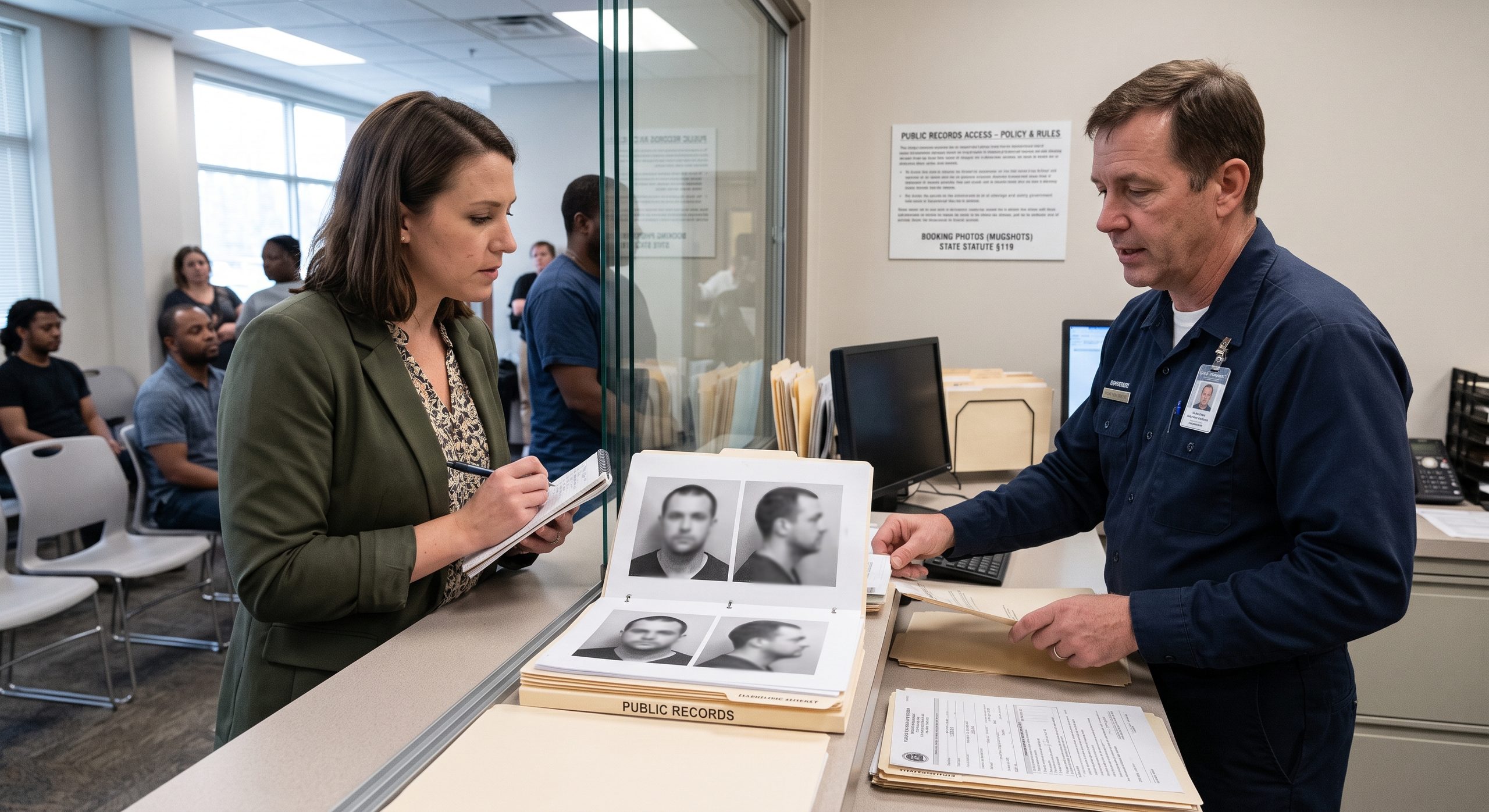
For over a century, the booking photograph—commonly known as a mugshot—has served as a standardized record of the American criminal justice process. Originally developed in late 19th-century Paris by police biometrics pioneer Alphonse Bertillon, the simple front-and-profile snapshot was designed as a utilitarian tool for law enforcement identification.

In the digital era, however, the mugshot has transformed into something far more pervasive. A single booking photo, captured seconds after an arrest, can spread across internet search engines, social media feeds, and commercial databases within minutes. For high-profile defendants, a mugshot becomes an indelible icon of public scrutiny. For ordinary citizens, it can establish a permanent digital footprint that lingers long after charges are dropped, dismissed, or resolved through acquittal.
This reality has sparked intense legal, legislative, and constitutional debates nationwide. While many citizens assume that all booking photos are freely accessible public records under open-government laws, the legal reality is far more complex. Today, access to mugshots is governed by a patchwork of federal court precedents, state sunshine laws, privacy exemptions, and rapid statutory reforms designed to curb digital mugshot exploitation and protect the constitutional presumption of innocence.
Federal vs. State Jurisdictions: A Fractured Legal Landscape
To understand whether a booking photo is a public record, one must first draw a firm distinction between federal law enforcement agencies and state or local police departments. There is no single nationwide mandate that renders every mugshot automatically open to the public.
The Federal Standard: Prioritizing Personal Privacy
At the federal level, booking photographs maintained by agencies such as the Federal Bureau of Investigation (FBI), the Drug Enforcement Administration (DEA), and the U.S. Marshals Service are generally not accessible to the public under standard Freedom of Information Act (FOIA) requests.
For decades, federal policy sat in a state of flux. However, a landmark en banc decision by the U.S. Court of Appeals for the Sixth Circuit—Detroit Free Press v. Department of Justice (2016)—fundamentally shifted federal disclosure standards. The court overruled its own previous precedent, holding that individuals possess a non-trivial, constitutionally protected privacy interest in their booking photos, particularly prior to conviction.
The Department of Justice (DOJ) codified this privacy framework under FOIA Exemption 7(C), which protects law enforcement records that could constitute an unwarranted invasion of personal privacy. Under current federal policy, the DOJ will not release federal mugshots to the public or the media unless doing so serves a compelling law enforcement or public safety interest—such as assisting in the capture of a fleeing fugitive or warning the public of an immediate threat.
The State Standard: A 50-State Mosaic
Unlike the federal government, state and local law enforcement agencies operate under individual state public records acts—often called “Sunshine Laws.”
Historically, most state public record frameworks treated booking photos as public documents once an individual was formally processed into a municipal jail or county detention center. Because local law enforcement agencies are public entities funded by taxpayers, arrest logs, charge sheets, and accompanying booking images were routinely classified as disclosable administrative records.
However, state public record laws are rapidly evolving. Today, whether a municipal police department or county sheriff must release a mugshot depends entirely on the state in which the arrest took place, the nature of the alleged offense, and recent legislative amendments passed in that specific jurisdiction.
The Legislative Shift: Combating Digital Exploitation and Public Shaming
The traditional rationale for keeping police records open was civic transparency: public oversight prevents secret arrests, ensures law enforcement accountability, and informs communities about public safety risks.
However, the transition from paper-based police blotters kept at local station houses to searchable digital databases completely altered the privacy equation. The public availability of booking photos spawned a lucrative, predatory business model known as “publish-for-pay” or mugshot extortion websites.
The Rise of Mugshot Monetization
Beginning in the late 2000s, commercial entities began using automated scraping scripts to harvest hundreds of thousands of mugshots daily from local sheriff websites and jail rosters. These businesses republished the photos on private websites, optimizing the pages so that an arrestee’s mugshot would rank at the top of internet search results for their name.
If an arrested individual—regardless of whether they were ultimately convicted, acquitted, or never formally charged—wanted their photo removed from search results, the website operators demanded “unpublishing” or “administrative” fees ranging from several hundred to thousands of dollars. If paid, the image was often transferred to a affiliated site, triggering a secondary extortion demand.
State Statutory Crackdowns
In response to widespread public outcry, state legislatures began enacting targeted statutory restrictions to neutralize commercial mugshot exploitation:
- Commercial Dissemination Bans: States including Florida, Texas, Illinois, Oregon, and Utah enacted statutes prohibiting individuals or commercial entities from publishing booking photos if the entity demands a fee or financial gain to remove or destroy the image. Violations of these statutes are classified as unfair trade practices, exposing operators to civil damages and criminal penalties.
- Prohibitions on Initial Agency Release: States such as Louisiana, California, Utah, and Oregon enacted legislation prohibiting law enforcement agencies from releasing booking photos to the public except under specified conditions. For instance, Louisiana law restricts police from providing copies of booking photos for non-violent offenses to third parties.
- Social Media Restrictions: California passed legislation (Assembly Bill 1475 and subsequent expansions) prohibiting law enforcement agencies from posting mugshots of individuals arrested for non-violent crimes on social media platforms like Facebook or Instagram, unless specific public safety threats exist. The law also requires police departments to remove previously posted mugshots from social channels upon the request of individuals whose charges were dismissed or acquitted.
- Pre-Conviction Mugshot Shielding: In states like Utah and New Jersey, legislation has restricted local sheriffs from releasing booking images of arrestees until a formal criminal conviction is entered, treating the photograph as a private administrative file throughout the trial process.
Constitutional Tensions: Press Freedom vs. Due Process
The legal evolution of mugshot disclosures sits at the intersection of two fundamental constitutional guarantees: the First Amendment right to a free press and the Fifth and Fourteenth Amendment guarantees of due process and the presumption of innocence.
The First Amendment Argument for Access
Journalists, media organizations, and open-government advocates contend that public access to booking records remains a vital check on state power.
Under First Amendment jurisprudence, news organizations argue that law enforcement transparency requires full public access to arrest files. Restricting mugshots, press groups argue, allows police agencies to exercise arbitrary control over what the public sees, potentially concealing instances of physical mistreatment during arrest or hiding high-profile arrests involving public officials.
Furthermore, news outlets maintain that publishing mugshots serves legitimate public interest goals, such as assisting law enforcement in identifying additional victims or witnesses connected to an ongoing investigation.
The Due Process Argument for Privacy
Conversely, legal defense attorneys and civil liberties organizations stress that releasing a booking photo prior to conviction directly compromises the constitutional presumption of innocence.
A mugshot is not evidence of guilt; it is simply proof that an individual was booked into custody. However, in the public eye, a booking photograph carries a strong psychological connotation of culpability. Publication of a mugshot can prejudice potential jury pools, cause immediate employment termination, ruin personal reputations, and inflict severe psychological distress—even when the arrest was made in error or charges are subsequently dropped.
Courts evaluating these competing claims increasingly recognize that while arrest data (such as name, charge, and date of arrest) satisfies the public’s right to know, the visual image of an individual in custody carries an additional layer of reputational harm that often outweighs the public’s interest in routine cases.
Case Outcomes, Sealing, and Removal Mechanisms
A recurring point of confusion for individuals navigating the justice system is what happens to a public mugshot when a criminal case ends favorably for the defense.
Under traditional public records frameworks, an arrest record remains a matter of public history even if the case ends in a dismissal or an acquittal. However, modern legal frameworks have created specific pathways for record sealing, expungement, and image removal.
Automatic Clean Slate Laws and Expungement
A growing number of jurisdictions have enacted “Clean Slate” legislation, which automatically seals or expunges non-conviction records, misdemeanor files, and certain non-violent offenses after a designated period of clean conduct.
When a court issues an order sealing or expunging a criminal record:
- The law enforcement agency holding the underlying file is legally required to seal or destroy the corresponding booking photograph.
- State central criminal databases must update their records to reflect that the record is no longer accessible to the public.
- The individual can legally state on job applications and background checks that the arrest never occurred.
Mandatory Takedowns for Commercial Sites
In states with statutory mugshot regulations, individuals whose records have been sealed, expunged, or dismissed can issue formal written demands to private background check platforms and online publishers to remove their booking photos.
Under these statutes, commercial operators who fail to remove an expunged mugshot within a specified statutory timeframe (typically 30 days following written notice accompanied by court documentation) face civil liability, including statutory fines, mandatory attorney fees, and administrative enforcement by state attorneys general.
The Limits of Digital Erasure
Despite legal mechanisms for record sealing, complete digital erasure remains an operational challenge.
Once an image is published online, it can be mirrored across offshore servers, stored in private web archives, or indexed by third-party data aggregators operating outside the jurisdiction of state laws. While search engines have voluntarily updated their indexing policies to suppress commercial mugshot sites upon request, removing an image entirely from global internet infrastructure often requires ongoing monitoring and legal intervention.
Employment Screening and Fair Chance Regulations
The intersection of public booking records and pre-employment screening represents another area where legal rules have tightened significantly.
Employers conducting background checks routinely utilize consumer reporting agencies to review candidate histories. In the past, the presence of a publicly available arrest photo or police blotter entry frequently resulted in immediate candidate disqualification.
EEOC Guidance and “Ban the Box” Laws
To combat systemic employment discrimination, the U.S. Equal Employment Opportunity Commission (EEOC) issued comprehensive enforcement guidance stating that employers cannot automatically disqualify job applicants based solely on an arrest record. The EEOC emphasized that an arrest does not establish guilt, and relying on arrest records alone to deny employment can violate Title VII of the Civil Rights Act of 1964 due to disparate impact.
Furthermore, states and municipalities across the nation have enacted “Ban the Box” and “Fair Chance” laws. These regulations prohibit employers from:
- Asking about arrest records or criminal history on initial job application forms.
- Conducting criminal background checks until after a conditional offer of employment has been extended.
- Using unconvicted arrest records—including booking photographs—as a legal basis for revoking a job offer.
Under modern pre-employment screening standards, background checks are generally restricted to reporting official court conviction records rather than raw police booking logs.
The Evolving Standard of Booking Photo Access
The legal rules surrounding whether mugshots are public record have moved away from sweeping open-access defaults toward a nuanced, privacy-conscious legal standard.
While booking photos taken by federal law enforcement are largely protected under federal privacy rules, state and local access depends on a rapidly shifting statutory landscape. The modern trend across state legislatures and judicial bodies is clear: restricting the automatic public release of mugshots in routine, non-violent cases; outlawing commercial exploitation schemes; and protecting the long-term privacy of individuals who have not been convicted of a crime.
As society continues to balance judicial transparency against digital privacy rights, the booking photo is increasingly viewed not as a tool for public consumption, but as an administrative record subject to strict legal oversight.
Leave a Reply