
In the immediate aftermath of an arrest, navigating the criminal justice system can be overwhelming. Among the most crucial early legal concepts are bail, bond, and pretrial release. While these terms are frequently used interchangeably in everyday conversation and media coverage, they refer to distinct legal mechanisms, financial arrangements, and procedural statuses designed to balance two competing constitutional priorities: preserving the presumption of innocence for the accused and ensuring public safety and court attendance.
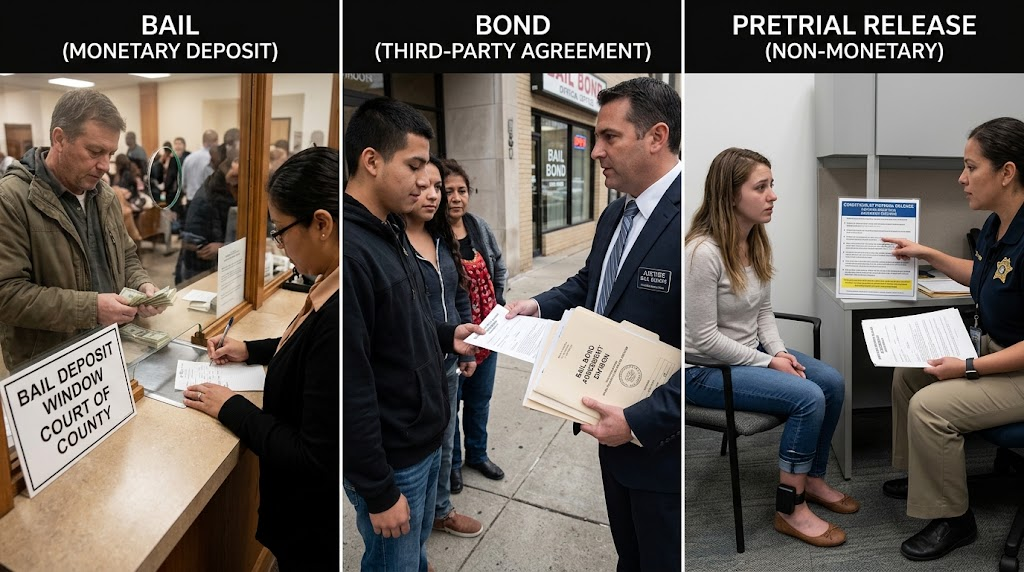
Understanding the differences among these three concepts requires examining how defendants secure their release prior to trial, the financial and legal structures that govern them, and how modern judicial systems evaluate risk.
What Is Bail?
Bail is the formal financial or conditional requirement set by a judge or magistrate that allows an arrested individual to be released from custody while awaiting trial.
At its core, bail is a guarantee. When a person is charged with a crime, the law presumes they are innocent until proven guilty. Denying freedom before a trial takes place is an extreme measure; however, releasing an accused person unconditionally creates a risk that they might flee the jurisdiction or fail to appear for scheduled court hearings.
Bail solves this dilemma by establishing a financial incentive or legal obligation: the court sets a specific monetary amount or set of conditions that the defendant must satisfy to leave jail. If the defendant attends all required court dates through the conclusion of their case, the posted bail is returned or exonerated. If the defendant fails to appear (known as “skipping bail”), the money is forfeited to the court, and a bench warrant is issued for their immediate arrest.
Key characteristics of bail include:
- Determined by a Judicial Officer: Set during a bail hearing or dictated by a standardized “bail schedule” for minor offenses.
- Constitutional Protections: Protected in the United States by the Eighth Amendment, which explicitly prohibits “excessive bail.”
- Returned at Case Conclusion: If paid directly to the court in cash, the full amount is returned to the payer at the end of the legal process, minus minor administrative fees, regardless of whether the defendant is found guilty or acquitted.
What Is a Bond?
A bond is the formal legal instrument or financial contract used to satisfy the bail amount set by the court when the defendant cannot or chooses not to pay the full cash bail out of pocket.
In many cases, the bail set by a judge—such as $10,000, $50,000, or $200,000—exceeds the liquid financial resources available to the defendant or their family. A bond serves as a third-party guarantee to the court that the full bail amount will be paid if the defendant skips their trial.
Bonds typically fall into several distinct categories:
1. Surety Bond (Commercial Bail Bond)
This is the most common type of bond. The defendant or their family contacts a licensed commercial bail bondsman (or surety company).
- The Fee: The defendant pays the bondsman a non-refundable fee, usually set by law at 10% to 15% of the total bail amount.
- The Guarantee: The bondsman posts a legal guarantee (surety) with the court, promising to pay the full bail amount if the defendant fails to appear.
- Collateral: The bondsman often requires the defendant or a co-signer to put up collateral (such as property, vehicle titles, or jewelry) to cover the full bail amount in case of forfeiture.
- Non-Refundable: Unlike cash bail paid directly to the court, the fee paid to a commercial bondsman is non-refundable; it is the cost of buying the bondsman’s financial backing.
2. Cash Bond
The defendant or a family member pays the full bail amount directly to the court clerk in cash, cashier’s check, or approved electronic transfer. No commercial bondsman is involved. The entire amount is refunded at the conclusion of the case if all court appearances are met.
3. Property Bond
The defendant or a co-signer pledges equity in real estate (such as a house or land) to the court as collateral for the bail amount. The equity value usually must be equal to or double the bail amount. If the defendant skips court, the state can initiate foreclosure proceedings against the property to collect the bail.
4. Personal Recognizance (PR) Bond
Also known as an “Unsecured Bond,” the defendant signs a legal contract promising to appear in court and agreeing to pay a specified dollar amount only if they fail to appear. No cash or property is handed over upfront.
BAIL vs. SURETY BOND FINANCIAL STRUCTURE

Example: Court Sets Bail at $50,000

Option A: Direct Cash Bail
[Defendant pays $50,000 directly to Court]
          │
          ▼ (Case Concludes / All Appearances Met)
[Court Returns $50,000 to Defendant]

Option B: Commercial Surety Bond
[Defendant pays $5,000 non-refundable fee (10%) to Bail Bondsman]
          │
          ▼ (Bondsman posts $50,000 guarantee with Court)
[Case Concludes / All Appearances Met]
[Court Releases Guarantee / Bondsman Keeps $5,000 Fee]
What Is Pretrial Release?
Pretrial Release is the overarching procedural status and umbrella framework that governs how an accused individual remains out of custody between their arrest and the final disposition of their criminal case.
While bail and bonds are specific financial tools used to secure freedom, pretrial release encompasses all mechanisms—both financial and non-financial—used to manage a defendant in the community.
Modern justice systems increasingly utilize non-financial pretrial release programs managed by professional Pretrial Services Agencies. These programs evaluate defendants using data-driven risk assessment tools, measuring two primary factors:
- Flight Risk: The likelihood that the defendant will fail to appear in court.
- Public Safety Risk: The likelihood that the defendant will commit a new crime while released.
Common Conditions of Pretrial Release
When a defendant is granted pretrial release—whether on cash bail, a bond, or non-financial terms—the court routinely imposes specific behavioral conditions that must be strictly followed:
- Travel Restrictions: Surrendering passports and remaining within county or state boundaries.
- Electronic Monitoring: Wearing a GPS ankle monitor or alcohol-detection monitor.
- Curfews and Check-Ins: Maintaining a set evening curfew and reporting weekly to a pretrial case manager.
- No-Contact Orders: Refraining from contacting alleged victims, co-defendants, or witnesses.
- Substance Testing: Submitting to randomized drug and alcohol screenings.
If a defendant violates any condition of their pretrial release, the judge can revoke their release status, forfeit their bond, and remand them to jail until their trial.
Comparing the Three Concepts
| Feature / Metric | Bail | Bond | Pretrial Release |
| Basic Definition | The financial or conditional requirement set by a court for release. | The contractual guarantee or payment method used to satisfy bail. | The overall legal status and monitoring framework of a defendant awaiting trial. |
| Primary Purpose | To ensure court appearance and mitigate public safety risk. | To provide financial backing when a defendant cannot pay full cash bail. | To manage and supervise the defendant safely within the community. |
| Involved Parties | Court, Judge, Defendant. | Defendant, Court, Commercial Bondsman / Co-signer. | Court, Pretrial Services Agency, Defendant, Community. |
| Financial Nature | A specific monetary value fixed by the judicial officer. | Can be cash, surety (commercial fee), property, or unsecured promise. | Can be financial (cash/surety) or completely non-financial. |
| Refundability | Fully refundable if paid directly in cash to the court. | Commercial fees (10-15%) are non-refundable; Cash bonds are refundable. | N/A (Refers to status, not a direct transaction). |
The Modern Bail Reform Movement
In recent years, the relationship among bail, bond, and pretrial release has been at the center of intense legal and legislative debate.
Critics of traditional commercial bail argue that monetary bail systems create a “two-tiered justice system”: wealthy individuals accused of serious crimes can easily purchase their release via cash or bondsmen, while low-income individuals accused of minor, non-violent offenses remain locked up in local jails for weeks or months simply because they cannot afford a $500 bail. This dynamic can lead to lost employment, housing instability, and pressure to accept guilty plea bargains regardless of actual guilt.
In response, numerous jurisdictions have enacted bail reform legislation, moving away from cash bail for non-violent offenses and expanding non-financial pretrial release programs based on objective risk-assessment scores rather than financial wealth.
Concurrently, public safety advocates and law enforcement leaders emphasize that risk assessments must rigorously evaluate prior criminal histories and flight risks, ensuring that individuals who pose genuine threats to public safety are detained or placed under strict supervised pretrial release.
Summary
- Bail is the monetary amount or requirement set by a judge to guarantee court attendance.
- Bond is the financial agreement or contract (often through a commercial bondsman) used to post that bail when cash isn’t available.
- Pretrial Release is the broader legal condition under which a defendant lives in the community—subject to specific rules and supervision—while waiting for their case to go to trial.
Leave a Reply