
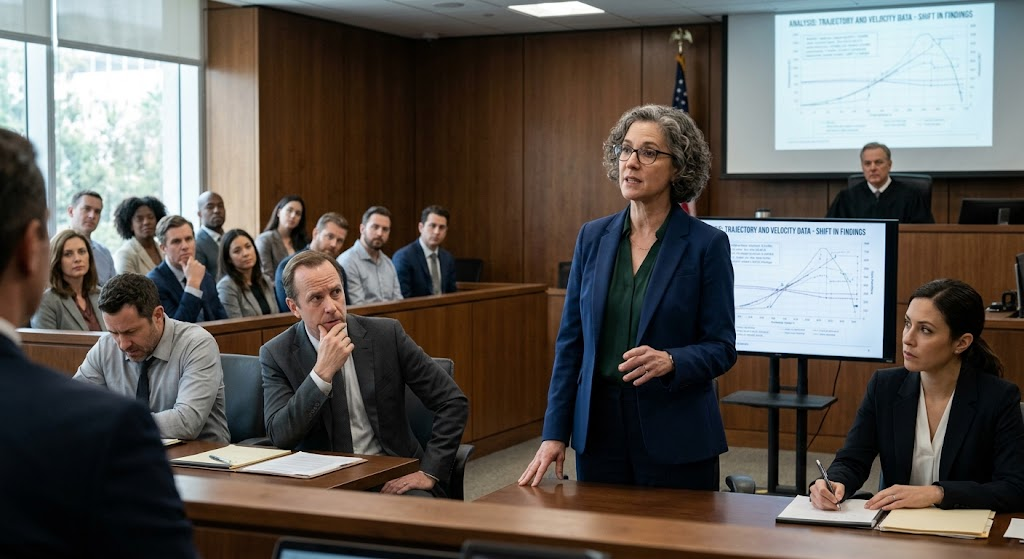
In high-stakes litigation, the trajectory of a multi-billion-dollar corporate dispute or a landmark criminal trial rarely hinges on a single piece of dramatic eyewitness testimony or a surprise courtroom confession. Modern legal battles are fought across increasingly dense, highly specialized terrain—encompassing financial algorithms, epidemiological modeling, digital forensic extraction, patent claim construction, and DNA sequencing.

For judges and juries tasked with resolving these disputes, the core challenge is often one of comprehension. Lay decision-makers are routinely asked to assess technical questions far outside their everyday experience.
Enter the expert witness.
As credentialed authorities permitted by courts to express opinions on matters within their specialized scope, expert witnesses bridge the gap between technical complexity and judicial decision-making. In complex proceedings, an effective expert does not merely clarify evidence; they define the factual framework through which the entire case is evaluated. The introduction of credible, well-reasoned expert testimony can alter settlement dynamics, trigger pre-trial dismissals, persuade juries, and reshape legal precedents across entire industries.
The Gatekeeper Standard: The Battle for Admissibility
Long before an expert witness walks into a courtroom to address a jury, their testimony must survive a crucial pre-trial threshold: judicial admissibility. The process of qualifying an expert and vetting their methodology is frequently the decisive strategic battle of a lawsuit.
In common law jurisdictions, trial judges act as evidentiary “gatekeepers.” In the United States, this role is governed primarily by Federal Rule of Evidence 702 and the landmark Supreme Court precedent Daubert v. Merrell Dow Pharmaceuticals, Inc. (1993), as well as the legacy Frye standard in several state jurisdictions. Under these frameworks, courts must evaluate whether an expert’s proposed testimony is not only relevant to the dispute, but grounded in scientifically valid and reliable methodology.
Judges assess specific criteria during pre-trial evidentiary hearings, including:
- Whether the methodology or theory can be—and has been—tested empirical style.
- Whether the technique has been subjected to peer review and academic publication.
- The known or potential error rate of the scientific method employed.
- The existence and maintenance of operational standards controlling the technique.
- Whether the theory or technique enjoys “general acceptance” within the relevant scientific or professional community.
The strategic consequences of these pre-trial challenges are vast. If a corporate defendant in a toxic tort class action successfully excludes a plaintiff’s primary epidemiological expert during a Daubert hearing, the plaintiff’s legal team may no longer be able to establish causation. Without a qualified expert to testify that exposure to a specific compound directly causes illness, the lawsuit often collapses via summary judgment before trial even commences.
Conversely, when an expert’s novel scientific theory clears the admissibility hurdle, defense teams face immediate exposure, often forcing settlement negotiations at significantly higher valuations.
Translating Complexity: The Expert as Educator
When high-stakes cases reach trial, the operational role of the expert witness undergoes a fundamental shift. On the stand, depth of academic knowledge is necessary, but insufficient on its own. The expert must serve as an effective educator and authoritative storyteller for the jury.
Trial consultants and seasoned litigators observe that juries evaluate expert witnesses along two distinct dimensions: perceived competence and perceived trustworthiness. High credentials—such as medical directorships, tenure at elite universities, or decades of executive experience—establish basic competence. However, trustworthiness is earned entirely on the witness stand through clarity, tone, and objectivity.
The Pitfalls of Over-Specialization and Academic Jargon
A recurring vulnerability in expert testimony is the tendency to resort to dense, highly technical jargon. Experts who rely heavily on academic acronyms or condescending explanations risk alienating jurors, who may interpret such delivery as obfuscation or arrogance.
The most effective experts employ clean analogies, clear structural explanations, and direct language. In an intellectual property trial involving microchip architecture, for instance, an expert who explains proprietary circuit design using everyday mechanical principles allows jurors to grasp the technical concept independently. When a juror feels they genuinely understand the underlying mechanism, they are far more likely to embrace the expert’s conclusions.
The “Hired Gun” Stigma
Opposing counsel routinely attempt to frame adverse experts as “hired guns”—professional witnesses who offer tailored opinions to whichever party writes the check.
Attorneys exploit this vulnerability by highlighting:
- Substantial annual earnings derived exclusively from litigation consulting.
- History of testifying exclusively for one side of an industry (e.g., exclusively defending pharmaceutical manufacturers or exclusively representing plaintiffs in personal injury actions).
- Opinions formed rapidly before conducting thorough primary investigations of the specific case files.
To counter this perception, top-tier experts emphasize their ongoing involvement in practical research, clinical care, or active industry operations outside the courtroom. Establishing that an expert’s testimony reflects principles they apply in their daily professional work neutralizes allegations of mercenary bias.
Core Arenas Where Experts Reshape Verdicts
The impact of expert testimony is evident across several major sectors of modern litigation:
1. Intellectual Property and Patent Disputes
In technology, biotechnology, and telecommunications litigation, patent suits often turn entirely on expert interpretations of claim language and technical functionality. In multi-hundred-million-dollar patent wars, competing software engineers dissect code line by line to determine whether an application infringes on a protected patent.
Equally critical are economic experts. Once liability is established, damages experts utilize econometric modeling to quantify reasonable royalties or lost profits. Their financial calculations regularly define the difference between a nominal damage award and a market-altering multi-million-dollar judgment.
2. Mass Torts and Environmental Liability
In mass tort litigation involving pharmaceuticals, consumer products, or environmental contamination, establishing legal causation is the central battleground.
Under legal standards, plaintiffs must prove both general causation (that a compound is capable of causing a specific injury in the general population) and specific causation (that the compound directly caused the individual plaintiff’s specific illness). Toxicologists, oncologists, and epidemiologists provide the foundation for these determinations. A single compelling meta-analysis presented by an expert can validate thousands of pending claims across consolidated multidistrict litigation (MDL) dockets.
3. Financial and White-Collar Litigation
In corporate governance lawsuits, insider trading prosecutions, and class actions alleging securities fraud, financial experts are central to reconstructing complex transactions.
Forensic accountants track untraceable capital flows through offshore entities, while financial economists conduct event studies to measure market reactions to corporate disclosures. By isolating the exact percentage of a stock price decline attributable to a corrective disclosure versus broader macroeconomic trends, financial experts establish the precise scope of investor damages.
4. Criminal Proceedings and Forensic Integrity
In criminal law, the evolution of expert forensic testimony has altered both prosecutions and wrongful conviction reviews.
While historical prosecutions relied heavily on subjective forensic techniques—such as hair microscopy, bite-mark comparison, and basic tire-tread analysis—modern criminal proceedings prioritize objective, scientifically validated disciplines. The introduction of probabilistic DNA profiling, cell-site location analytics, and digital media forensics has provided juries with precise evidentiary baselines.
Concurrently, forensic experts called by defense teams routinely challenge flawed crime lab protocols, chain-of-custody breaches, and unreliable forensic methodologies, securing acquittals or post-conviction relief.
The Battle of the Experts: How Decision-Makers Resolve Conflicts
In high-stakes proceedings, it is rare for only one side to present expert evidence. Trials frequently feature a “battle of the experts,” where highly credentialed authorities present diametrically opposed conclusions based on the exact same underlying facts.
When faced with conflicting expert testimony from equally qualified specialists, how do juries and judges choose which perspective to adopt?
Social-psychological studies of jury deliberation indicate that decision-makers rely on several key indicators to resolve expert conflicts:
- Analytical Consistency: Juries analyze whether an expert applied their stated methodology consistently across all available data, or if they selectively highlighted favorable evidence while ignoring contradictory data points.
- Concessions under Cross-Examination: An expert who reasonably acknowledges the limitations of their data, admits minor points of agreement with the opposing side, and maintains composure under aggressive cross-examination gains significant credibility. Conversely, experts who adopt an overly defensive or dogmatic posture often alienate lay jurors.
- Integration with Fact Evidence: The most effective expert testimony does not exist in an academic vacuum. It operates as an explanatory framework that aligns neatly with undisputed physical evidence, internal emails, witness testimony, and corporate documents. When an expert’s theoretical model mirrors the lived reality of the case, decision-makers view the conclusion as intuitive and reliable.
The Next Frontier: Artificial Intelligence and Complex Data
The nature of expert testimony is undergoing profound changes driven by artificial intelligence, complex machine learning algorithms, and deeptech infrastructure.
Courts are increasingly tasked with adjudicating disputes involving algorithmic bias, automated trade execution, autonomous system failures, and generative media. These cases present novel challenges for expert witnesses:
- The “Black Box” Problem: Modern deep-learning neural networks often reach conclusions through millions of weight adjustments that are not easily interpretable, even by the engineers who wrote the code. Experts are tasked with explaining the validity of algorithm outputs when the underlying decision-making process cannot be fully visualized.
- Authenticity and Deepfakes: As synthetic video, audio, and documents become visually indistinguishable from genuine media, digital forensic experts are becoming essential participants in basic evidentiary authentication. Experts must utilize algorithmic detection tools to verify file metadata, lighting consistency, and acoustic artifacts before evidence can be introduced.
- AI-Assisted Expert Preparation: Litigators are utilizing specialized AI models to analyze decades of an opposing expert’s published papers, past deposition transcripts, and previous trial testimony within seconds. This capability allows cross-examiners to highlight minor methodological shifts across an expert’s career with unprecedented precision.
Ethical Boundaries and the Integrity of Justice
As the influence of expert testimony expands, legal systems must address the structural tension between advocacy and objective science.
An expert witness occupies a unique legal status. Although retained and compensated by a specific party, their formal legal duty is to provide independent, objective assistance to the court. When experts act primarily as partisan advocates, the integrity of the judicial process is compromised.
To safeguard this process, judiciaries and professional organizations have strengthened oversight mechanisms:
- Mandatory Disclosure Rules: Modern civil procedure rules require broad pre-trial disclosures of an expert’s draft reports, data sets, financial compensation, and history of past testimony, limiting surprises on the stand.
- Court-Appointed Experts: In complex technical disputes, judges retain the authority to appoint independent experts under provisions such as Federal Rule of Evidence 706. Operating without financial ties to either litigant, court-appointed experts provide neutral evaluations that carry immense weight in judicial outcomes.
- Professional Standards and Sanctions: Professional societies actively audit expert testimony provided by their members. Medical boards, accounting associations, and engineering societies can discipline, suspend, or revoke the credentials of practitioners who provide false or unscientific testimony in legal proceedings.
The Ultimate Decisive Factor
In an era characterized by dense regulatory frameworks, rapid technological advance, and massive financial exposure, expert testimony has evolved from a supplementary trial tool into the central engine of high-stakes litigation.
Whether establishing the link between an industrial chemical and a medical condition, calculating damages in an international corporate dispute, or verifying the authenticity of digital evidence in a criminal trial, experts provide the analytical foundation upon which justice is rendered. When framed with clarity, supported by rigorous methodology, and delivered with professional integrity, expert testimony does not simply influence the outcome of high-stakes trials—it determines them.
Leave a Reply