
In the late evening hours inside an operational briefing room in a major metropolitan precinct, a composite map of the city glows on a digital display. Rather than shading entire zip codes or broad municipal districts in red, the software highlights a handful of specific street corridors, vacant lots, transit nodes, and residential blocks.
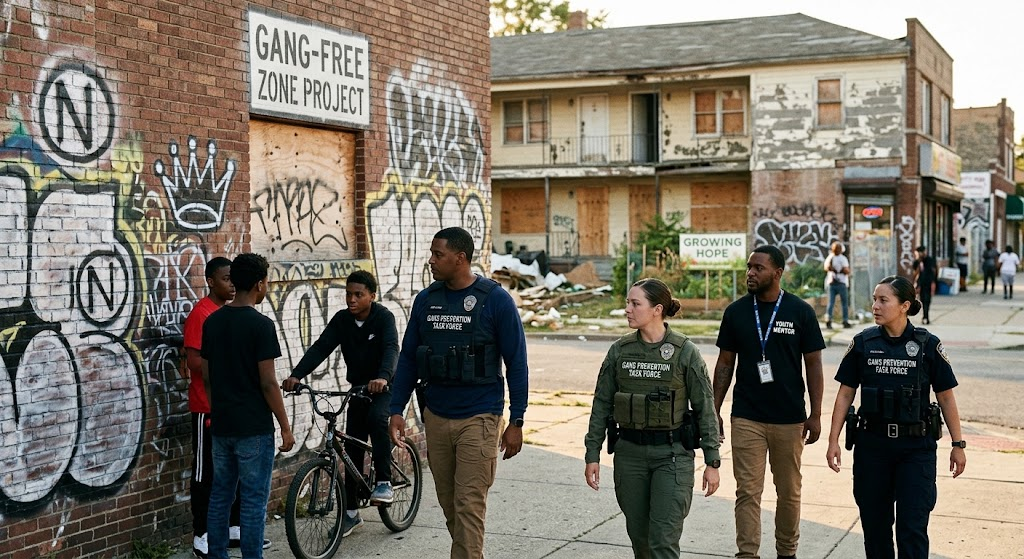
A room filled with federal agents, local police detectives, county prosecutors, probation officers, and civilian street outreach coordinators reviews the latest intelligence: recent non-fatal shootings, illegal firearm recoveries, active group rivalries, and social media disputes.
This scene reflects a fundamental shift in how law enforcement and municipal governments address urban gang violence. For decades, traditional gang enforcement relied primarily on sweeping neighborhood sweeps, mass stop-and-frisk tactics, and broad saturation patrols. While these heavy-handed approaches often yielded short-term surges in arrests, they frequently failed to reduce long-term violent crime, while severely damaging trust between law enforcement and local residents.
Today, modern gang prevention task forces operate under a radically different framework. Grounded in spatial criminology, network analysis, and evidence-based social intervention, these multi-agency coalitions combine precision policing with community-based prevention. By identifying the tiny fraction of geographic micro-zones and high-risk individuals driving the majority of violent incidents, task forces aim to disrupt cycles of retaliation before they escalate into neighborhood-wide crises.
From Mass Suppression to Precision Targeting
To understand how modern task forces operate, one must examine the evolution of gang enforcement strategies over the past thirty years.
During the gang violence peaks of the late 20th century, municipal police departments frequently deployed tactical units to conduct aggressive, area-wide suppression in impacted neighborhoods. Entire communities were effectively treated as high-risk zones, leading to widespread stops, minor infraction citations, and mass arrests.
Criminological evaluations subsequently demonstrated the limits of this approach. Blanket suppression tactics often swept up non-violent youth, accelerated justice-system involvement for minor offenses, and failed to dismantle the core leadership or structural incentives of criminal groups. Furthermore, indiscriminate enforcement fostered deep resentment among residents who felt unfairly profiled in their own communities.
The turn toward modern precision targeting began with the development of “Focused Deterrence”—a strategy pioneered in the 1990s through Boston’s Operation Ceasefire. Developed by criminologist David Kennedy alongside law enforcement leaders and community members, Focused Deterrence recognized two critical empirical realities:
- Group-Driven Violence: While gangs and informal street networks represent a tiny fraction of a city’s total population—often less than one or two percent—they are statistically tied to a vast majority of homicides and non-fatal shootings.
- Predictable Dynamics: Gang violence is rarely random. It follows predictable patterns of group rivalry, territorial friction, and retaliatory escalation.
Modern task forces build directly upon these principles, shifting their focus away from general broad-scale policing toward micro-targeted, high-impact interventions.
Data-Driven Intelligence and Spatial Mapping
The operational foundation of a modern gang prevention task force rests on sophisticated data integration. Before deploying personnel into a neighborhood, task forces analyze multiple streams of real-time and historical intelligence to map both physical geography and social networks.
Micro-Geographic Hotspot Analysis
Environmental criminology demonstrates that violent crime is not evenly distributed across a neighborhood; it concentrates intensely at specific micro-locations known as “hotspots.” A single liquor store parking lot, an unlit alleyway, a housing complex courtyard, or a specific convenience store block can generate more violent incidents than the surrounding ten-block radius combined.
Task forces utilize tools like Risk Terrain Modeling (RTM) and spatial-temporal regression algorithms to evaluate how the built environment creates opportunities for gang conflict. By identifying environmental vulnerabilities—such as broken streetlights, abandoned properties used for stash houses, or blind spots in public surveillance—authorities can address physical risk factors alongside enforcement efforts.
Group Violence Assessments and Network Analysis
In addition to geographic mapping, task forces conduct rigorous Group Violence Assessments (GVAs) to chart social networks. Using law enforcement incident logs, ballistics tracking, and intelligence from field personnel, crime analysts build detailed network maps that trace active group rivalries, alliances, and internal disputes.
THE NETWORK INTERVENTION MODEL

[Incident: Non-Fatal Shooting Involving Group A and Group B]
                           │
                           ▼
[Task Force Intelligence Analysis: Map Network Connections & Retaliation Risk]
                           │
                           ▼
[Parallel Operational Deployment]
 ┌─────────────────────────┴─────────────────────────┐
 │                                                   │
 ▼                                                   ▼
[Law Enforcement Track]             [Community Violence Intervention Track]
- Precision Patrols at Hotspots     - Street Outreach & Mediation
- Enforcement against Ringleaders   - Hospital Bedside Interventions
- Probation/Parole Checks           - Social Service & Relocation Offers
By tracking ballistics data through national networks like the National Integrated Ballistic Information Network (NIBIN), analysts can link shell casings recovered from different shooting scenes to specific firearms shared within a gang. This technological integration allows task forces to focus their investigative efforts on active shooters and prolific illegal firearm distributors rather than low-level group associates.
The Multi-Agency Task Force Architecture
A defining characteristic of modern gang prevention is the cross-jurisdictional and multi-disciplinary structure of the task force itself. Rather than operating in isolation, local police precinct units join forces with regional, federal, and civil entities to form integrated operational teams.
Federal and State Law Enforcement Partners
Federal agencies—including the Federal Bureau of Investigation (FBI), the Bureau of Alcohol, Tobacco, Firearms and Explosives (ATF), and Homeland Security Investigations (HSI)—bring critical investigative resources to local task forces. Federal involvement allows prosecutors to leverage racketeering statutes, such as the Racketeer Influenced and Corrupt Organizations (RICO) Act, and federal firearm laws. Federal indictments carry severe mandatory minimum sentences and remove high-level gang leaders from local jurisdictions to federal facilities without parole.
Prosecutors and Probation Officers
Including prosecutors directly within task force operations ensures that evidence collection meets strict legal standards for complex conspiracy indictments. Simultaneously, probation and parole officers provide real-time monitoring of individuals under court supervision, enforcing strict curfew, association, and travel restrictions designed to prevent high-risk individuals from re-engaging in group conflict.
Schools and Youth Services
Recognizing that gang recruitment targets young adolescents, task forces frequently interface with school resource managers, counselors, and local youth services. When intelligence signals that a neighborhood conflict may spill over into high school corridors or public transit routes, school authorities receive early warnings, allowing them to adjust campus security protocols and offer immediate intervention for vulnerable students.
The Dual-Track Strategy: Enforcement and Opportunity
When a task force identifies a high-risk neighborhood experiencing elevated gang friction, operations execute along a dual-track framework often summarized as “the carrot and the stick.” This strategy combines clear, inescapable legal warnings for chronic violent actors with accessible pathways out of the gang lifestyle for those seeking help.
Direct Call-Ins and Custom Notifications
A central mechanism of Focused Deterrence is direct communication with active gang members. Task forces organize formal “call-ins”—face-to-face meetings held in community centers or courthouses—or deliver individualized “custom notifications” directly to high-risk individuals.
During these interactions, a unified panel featuring law enforcement officials, community leaders, shooting survivors, and social service providers delivers a clear, unequivocal message:
- The Deterrence Message: “The violence must stop immediately. If any member of your group commits a shooting, the full resources of the multi-agency task force will be directed at your entire group. Every outstanding warrant, probation violation, and illegal activity tied to your network will be aggressively prosecuted.”
- The Community Message: “We care about your survival, and your community needs you alive and out of prison. But the violence is unacceptable, and we are here to support you if you choose a different path.”
- The Support Offer: “If you want to leave the street life, we will immediately connect you with job training, housing assistance, substance use treatment, educational programs, and relocation support.”
By explicitly linking group accountability to future violence, task forces leverage internal peer pressure within street networks. Group members realize that one individual’s decision to pull a trigger will bring intense, multi-agency legal scrutiny upon their entire social circle.
The Critical Role of Community Violence Intervention (CVI)
One of the most significant advancements in modern gang prevention is the integration of non-police Community Violence Intervention (CVI) professionals into neighborhood strategies. Operating independently of, but parallel to, law enforcement task forces, CVI programs employ credible messengers—individuals from the local community, often formerly incarcerated or past gang members, who possess the social capital to navigate high-risk street environments.
Street Outreach and Dispute Mediation
Violence interrupters work directly in high-risk neighborhoods to identify active disputes before they result in gunfire. When a territorial dispute or personal altercation occurs between rival groups, interrupters engage key influencers on both sides to mediate compromises, dispel false rumors circulating on social media, and cool down tensions.
Hospital-Based Violence Intervention (HVIP)
A crucial touchpoint for CVI teams occurs inside hospital trauma centers. When a young victim of gang violence arrives in an emergency room, hospital-based interrupters engage the victim, their family, and their peers directly at the bedside during a moment of severe crisis. By offering immediate emotional support, safety planning, and social services, interrupters disrupt the immediate cycle of retaliatory violence that frequently follows a non-fatal shooting.
While law enforcement task forces focus on deterrence and legal accountability, CVI workers address the immediate social and emotional drivers of violence, creating a comprehensive safety net that neither group could achieve independently.
Challenges, Civil Rights Guardrails, and Criticism
Despite the documented success of focused, multi-agency strategies, gang prevention task forces operate under intense public scrutiny and face significant operational challenges.
Gang Databases and Civil Liberties Concerns
A major point of contention centers on the maintenance and accuracy of municipal “gang databases.” Civil rights organizations and defense attorneys argue that historical criteria for including individuals in gang registries—such as wearing specific clothing colors, hanging out on certain street corners, or being pictured in social media posts with suspected gang associates—have led to severe demographic overrepresentation, particularly among young Black and Latino men.
Inclusion in a gang database can carry heavy collateral consequences, including higher bail amounts, enhanced criminal charges, restricted access to housing programs, and severe immigration consequences. In response to legal challenges and public outcry, leading task forces have instituted strict judicial oversight, standardized criteria for inclusion, mandatory transparency audits, and formal administrative appeal processes allowing individuals to petition for removal from registries once they disengage from street activities.
TASK FORCE BALANCING ACT

Public Safety Mandate:
- Interrupt active shooting cycles
- Neutralize violent chronic offenders
- Dismantle illegal firearm pipelines

Civil Rights Guardrails:
- Strict criteria for gang database inclusion
- Judicial oversight for multi-agency indictments
- Transparent public reporting and community oversight
The Risk of Displacement Versus Deterrence
A long-standing debate in criminology is whether targeted enforcement in high-risk neighborhoods truly prevents crime or merely displaces it to adjacent areas. While early research raised concerns about displacement, recent comprehensive evaluations suggest that focused deterrence strategies generate a “diffusion of benefits”—meaning that crime rates frequently drop not only within the targeted hotspot micro-zones, but also in surrounding street corridors as the overall climate of group conflict cools down.
Sustaining Long-Term Structural Funding
Task force operations require significant long-term coordination and capital investment across municipal, state, and federal budgets. A frequent failure point occurs when a task force successfully depresses violent crime rates in a high-risk neighborhood, prompting local leadership to prematurely reduce funding for community outreach, social services, and specialized police units. Without sustained investment in youth employment, educational infrastructure, and neighborhood development, the structural conditions that originally fostered gang recruitment inevitably re-emerge.
Measuring Impact: What the Data Shows
Rigorous academic evaluations of focused, multi-agency gang prevention strategies consistently demonstrate measurable reductions in violent crime when the models are executed with fidelity.
Systematic reviews conducted by criminologists analyzing dozens of focused deterrence interventions across major metropolitan areas reveal:
- Homicide Reductions: Cities implementing structured focused deterrence frameworks report statistically significant reductions in group-related homicides, with several jurisdictions recording drops of 20 to 30 percent in targeted violent offenses.
- Non-Fatal Shooting Drops: Micro-geographic hotspot deployments paired with street outreach yield marked decreases in overall shooting incidents in high-risk commercial and residential corridors.
- Long-Term Individual Outcomes: Longitudinal tracking of youth who participate in task-force-linked summer employment, CVI programs, and job training shows lower rates of re-arrest and higher rates of stable community integration compared to control groups.
Toward a Resilient Neighborhood Strategy
The evolution of gang prevention task forces marks a transition away from the blunt, ineffective suppression tactics of the past toward a nuanced, evidence-based, and multi-faceted model of public safety.
By combining the analytical precision of spatial criminology with the legal leverage of multi-agency law enforcement and the authentic mediation power of community violence interrupters, modern task forces focus their resources where they are needed most. They recognize that lasting neighborhood safety cannot be achieved through policing alone, nor can it be sustained without addressing chronic violent actors who terrorize vulnerable communities.
For high-risk neighborhoods, effective task force intervention offers more than an immediate reduction in crime statistics. By dampening the constant threat of street violence, creating clear exits from gang life, and restoring public space to local residents, precision prevention opens the door for long-term economic investment, stronger community relationships, and lasting civic resilience.
Leave a Reply