
In police department vaults, municipal archives, and federal storage facilities across the globe, millions of pages of paper tell the story of crimes that time forgot. Cold case files—containing crime scene photographs, handwritten detective notebooks, witness interview transcripts, and forensic logs—often sit untouched for decades once initial leads dry up. To grieving families and local communities, these stalled files represent an agonizing wall of silence.
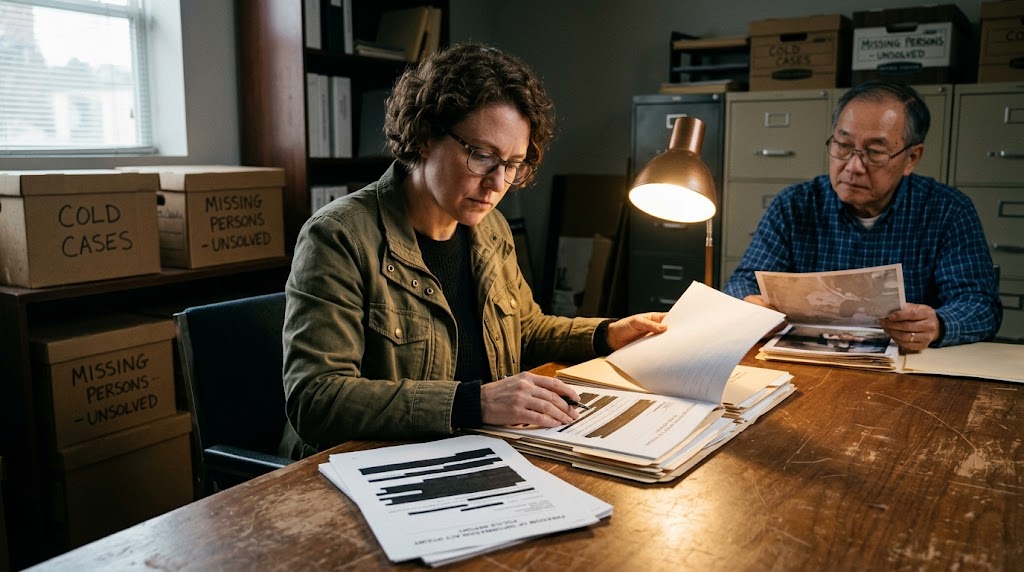
Yet across the legal and journalistic landscape, an administrative tool has increasingly emerged as the primary weapon against law enforcement inertia: the Freedom of Information Act (FOIA) and its state-level open records equivalents.
Originally designed as a mechanism to ensure general government oversight, statutory open records requests have transformed into a vital investigative pipeline. By forcing law enforcement agencies to surrender long-buried case files, journalists, legal scholars, independent researchers, and victims’ families are systematically unearthing forgotten evidence, identifying procedural missteps, and reviving investigations that official institutions had long declared dead.
1. Unlocking the Raw Evidence File
When a major crime goes unsolved, official public statements from police departments are typically brief, curated, and defensive. Press releases highlight the difficulty of the investigation while omitting internal uncertainties or administrative missteps.
Freedom of Information Act requests bypass this curated narrative by granting access to raw investigative files.When an open records request yields a cold case dossier, requesters receive the unedited, granular record of how an investigation actually unfolded.
What FOIA Releases Uncover
- Original Detective Field Notes: Handwritten observations recorded at crime scenes often contain raw details, names of casual bystanders, or initial impressions that never made it into finalized typed reports.
- Unedited Witness Statements: Audio recordings, transcripts, and interview logs frequently reveal contradictions, unpursued leads, or witnesses who were initially dismissed by lead investigators.
- Evidence Inventories and Chain-of-Custody Logs: Detailed lists of physical evidence stored in police lockers—including biological samples, clothing, and latent fingerprints—allow modern forensic experts to identify items suitable for advanced DNA testing.
- Interagency Communications: Memos exchanged between municipal police departments, county prosecutors, and federal entities like the FBI often expose jurisdictional rivalries, resource constraints, or tactical disagreements that derailed the original inquiry.
Access to these primary materials allows independent investigators to reconstruct crime scenes with modern analytical precision. Details that seemed insignificant to a detective in 1975—such as a specific vehicle description or a minor discrepancy in an alibi—can carry profound investigative weight when cross-referenced against modern digital databases.
2. Breaking Through the “Active Investigation” Exemption
The single greatest obstacle to obtaining police records in unsolved cases is the statutory “active investigation” exemption. Under federal FOIA law (specifically Exemption 7A) and parallel state public records acts, law enforcement agencies may withhold documents if their release could reasonably be expected to interfere with ongoing enforcement proceedings.
For decades, police departments routinely abused this exemption to maintain permanent secrecy over cold cases. By technically keeping a decades-old murder case listed as “open”—even if no detective had worked on it for twenty years—agencies could legally deny public records requests indefinitely.
Strategies Used to Dismantle Secrecy
Investigative journalists and public interest attorneys have developed sophisticated legal strategies to overcome this administrative stonewalling:
- Proving Abandonment: Requesters frequently challenge denials by demonstrating that the agency has taken no investigative steps for years. When courts review these challenges, judges increasingly rule that an agency cannot claim an investigation is active if there are no active leads, assigned investigators, or recent budget allocations.
- Statutory Aging and Time Limitations: Several jurisdictions have updated open records laws to stipulate that after a specified timeframe—such as 25 or 30 years—the presumption shifts heavily in favor of public disclosure, requiring law enforcement to meet a strict legal burden to justify continued secrecy.
- Targeted Administrative Appeals: Requesters use systematic administrative appeals to force agencies to conduct detailed item-by-item reviews of case files rather than issuing blanket rejections.
When these legal hurdles are breached, the resulting document releases often reveal that the primary reason for past secrecy was not the preservation of an active lead, but the protection of the agency from public accountability.
3. Re-Examining Civil Rights Era Cold Cases
The transformative power of public records legislation is nowhere more visible than in the re-examination of unsolved murders from the American Civil Rights era.Between 1945 and 1970, hundreds of racially motivated homicides across the American South went unprosecuted. In many instances, local law enforcement agencies were actively complicit in the crimes or deliberately sabotaged investigations.
For decades, federal and state agencies held vast troves of surveillance files, informant reports, and witness statements that remained hidden from the public.
Persistent FOIA requests filed by investigative journalists, civil rights advocates, and academic research centers finally broke this silence.These disclosures exposed systemic institutional failures and forced the federal government to establish dedicated cold case units.
Recognizing the administrative delays inherent in standard FOIA processing, Congress enacted the Civil Rights Cold Case Records Collection Act of 2018. Modeled after the JFK Assassination Records Collection Act, this statute created an independent review board mandated to review, digitize, and publicly release all federal government records related to civil rights cold cases occurring between 1940 and 1979.
The resulting public archives have allowed historians and investigative reporters to identify perpetrators, clarify the circumstances of forgotten deaths, and provide long-overdue answers to surviving family members.
4. The Synergy Between Open Records and Modern Forensics
While a FOIA request yields paper documents, those documents frequently serve as the essential catalyst for modern physical science. Advanced forensic technologies—such as forensic genetic genealogy, touch DNA analysis, and high-resolution ballistics scanning—are useless if scientists do not know what physical evidence exists or where it is stored.
Open records requests bridge the gap between historical case files and contemporary laboratory science:
Locating Forgotten Physical Evidence
In many decades-old cases, physical evidence was mislabeled, transferred between agencies, or stored in remote property warehouses. FOIA releases uncover property logs and chain-of-custody forms that pinpoint the exact storage locations of biological evidence. Identifying a preserved slide, an unexamined clothing item, or a cigarette butt listed on an old intake manifest allows legal teams to petition courts for modern DNA testing.
Constructing Genetic Family Trees
Forensic genetic genealogy requires extensive genealogical research to connect a suspect’s DNA profile to a family tree. Unredacted police files obtained via open records requests provide crucial contextual data—such as lists of suspects’ associates, local employment rosters, and neighborhood address directories—that genealogical researchers use to narrow down potential suspects identified through genetic matches.
Re-Evaluating Flawed Science
Forensic science evolves continuously. Forensic methods commonly used in the mid-20th century—such as microscopic hair comparison, bite-mark analysis, and primitive arson investigation techniques—have since been thoroughly debunked by the scientific community. FOIA requests allow independent experts to review original laboratory bench notes and expert testimony, exposing instances where convictions or abandoned leads were based on junk science.
5. Crowdsourced Intelligence and Investigative Journalism
The digitization of records obtained through FOIA has fundamentally altered who conducts cold case research. Investigative journalism is no longer confined to traditional newsrooms with massive legal budgets; it now encompasses collaborative networks of journalists, academic clinics, legal non-profits, and independent sleuths.
When investigative outlets obtain massive case files through open records requests, they frequently publish the raw documents in searchable online databases. This public hosting enables thousands of readers to analyze case materials simultaneously.
The Dynamics of Crowdsourced Discovery
- Domain-Specific Expertise: A retired auto mechanic examining a public case file might recognize that a car part found at a 1980 crime scene belonged to a different vehicle model than police originally assumed, opening an entirely new avenue of inquiry.
- Geographic Connections: Local residents examining historical property maps released under FOIA can connect old suspect addresses to localized geography in ways that out-of-town federal investigators originally missed.
- Witness Identification: The publication of historical interview logs often leads relatives or acquaintances of long-deceased witnesses to come forward with secondary accounts, diaries, or deathbed confessions that corroborate unpursued leads.
By shifting investigative records from closed police archives to public digital repositories, FOIA releases transform passive cold case files into active, crowdsourced investigations.
6. Systemic Obstacles: Redactions, Costs, and Administrative Friction
Despite its transformative power, using open records requests to investigate unsolved cases remains a grueling, resource-intensive endeavor. Requester networks routinely encounter administrative barriers designed to slow down or discourage public inquiries.
Heavy Redactions (The “Black Highlighter”)
Even when agencies comply with record requests, files are frequently returned with extensive redactions. Information protected under privacy exemptions—such as Social Security numbers or medical data—is legitimately obscured. However, agencies often over-redact files, blacking out entire narrative sections, suspect names, and police officer statements under the guise of protecting personal privacy or non-existent investigative leads. Challenging these over-redactions requires filing administrative appeals and, in many cases, initiating litigation in federal or state courts.
Extreme Delays and Processing Backlogs
Federal agencies like the FBI and DOJ, alongside large municipal police departments, face massive FOIA processing backlogs. It is common for complex cold case record requests to take three to five years to process. In cold case investigations—where elderly witnesses and suspects are dying—these administrative delays can permanently destroy the window for legal justice.
Exorbitant Search and Duplication Fees
To deter broad records requests, public agencies sometimes assess astronomical processing fees, charging requesters thousands of dollars for manual record searches, page scanning, and legal review time. While news media organizations and academic researchers are legally entitled to fee waivers under federal law, independent researchers and families of victims frequently struggle to overcome these financial hurdles.
The Public Right to Truth
The Freedom of Information Act was built on a fundamental democratic premise: a government accountable to the people cannot maintain absolute control over its own narrative. In the realm of criminal justice, secrecy has too often served as a shield for administrative incompetence, institutional prejudice, and official negligence.
Unsolved cases represent more than unresolved legal dockets; they represent unhealed wounds for families and unaddressed safety risks for communities. When law enforcement agencies exhaust their leads and shelve an investigation, locking the file in a drawer does not serve public safety—it merely guarantees that the truth remains buried.
By systematically deploying open records requests, journalists, advocates, and citizens are proving that transparency is an indispensable element of justice. Every unredacted page, forgotten interview transcript, and unearthed property log retrieved through FOIA serves as a reminder that while memories fade and investigations stall, public records remain—waiting for the light of inquiry to reveal what happened.
Leave a Reply