
When tens of thousands of spectators pack into a downtown stadium for a championship game, gather along city avenues for a holiday parade, or assemble in a public park for a multi-day music festival, they experience a seamless spectacle of entertainment. What they rarely see is the vast, highly orchestrated, and months-long operation unfolding quietly behind the scenes.
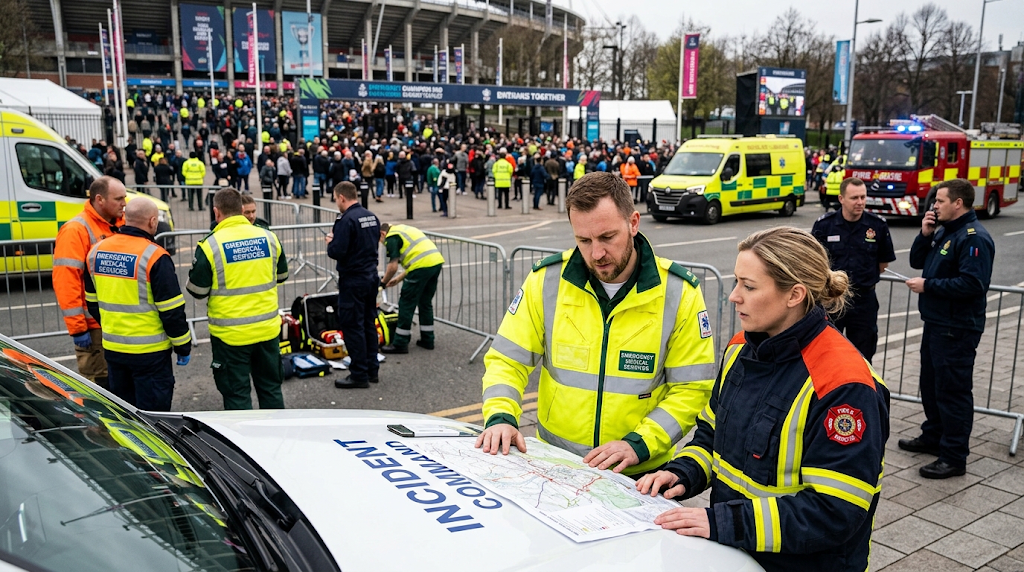
For local emergency responders—encompassing police departments, fire and rescue services, emergency medical services (EMS), public health agencies, and emergency management offices—a major public event is not merely a civic celebration. It is a complex operational challenge defined by high population density, spatial confinement, complex logistics, and an array of potential hazards ranging from heat exhaustion and crowd surges to active threats and severe weather.
Preparing for mass gatherings requires transitioning local public safety infrastructure from routine, daily emergency response to a specialized, proactive posture. Through rigorous threat assessment, unified command structures, scenario simulations, specialized logistics, and advanced technological integration, emergency responders construct an invisible safety net designed to protect the public while keeping emergency services fully operational for the surrounding municipality.
The Blueprint: Threat Identification and Risk Assessment
Preparation for a major public event often begins six months to a year before the first attendee arrives. The foundational phase of this preparation relies on a comprehensive threat and hazard identification assessment, which evaluates every plausible risk associated with the event’s location, demographic size, season, and political or cultural profile.
Public safety agencies categorize potential hazards into three primary vectors:
- Natural Hazards: Severe weather events, extreme heatwaves, flash flooding, lightning strikes, and high winds capable of destabilizing temporary structures, stage lighting, or tents.
- Technological and Structural Hazards: Power grid failures, structural collapses of temporary bleachers or stages, pyrotechnic fires, hazardous material leaks, and mass transit disruptions.
- Human-Caused and Intentional Threats: Crowd stampedes, civil unrest, coordinated terror attacks, active shooter scenarios, vehicle-ramming incidents, and cyberattacks targeting municipal infrastructure.
To build an accurate risk profile, local emergency planners collaborate with federal, state, and regional intelligence entities, such as fusion centers and federal law enforcement agencies. These partnerships help determine whether the event carries elevated security profiles that warrant specialized federal support or designation under national security frameworks.
Public safety officials also conduct detailed spatial audits of the event venue and surrounding areas. Analysts map out ingress and egress routes, evaluate street widths, assess the proximity of nearby Level-1 trauma centers, and identify potential physical bottlenecks that could impede crowd movement or delay emergency vehicle access.
The Operational Backbone: Incident Command and Multi-Agency Coordination
One of the greatest operational hurdles during a mass gathering is preventing jurisdictional friction among the numerous public and private entities involved. A single major event may require the simultaneous coordination of city police, county sheriffs, state troopers, municipal fire departments, private EMS vendors, transit authorities, public health officials, and private venue security staff.
To streamline management, emergency responders utilize the Incident Command System (ICS), a standardized, all-hazard operational framework built around a unified command structure.
Under Unified Command, top-ranking officials from each primary agency sit side by side in a centralized, forward-deployed Incident Command Post (ICP) or Emergency Operations Center (EOC). Rather than operating independently, these leaders share a single operational plan, a unified communications network, and a common situational awareness dashboard.
This unified hierarchy ensures that when an incident occurs—whether a localized fire behind a main stage, a medical emergency in a crowded plaza, or a lost child report—the response is executed seamlessly without duplicating efforts or conflicting orders.
Furthermore, public safety agencies establish formal Mutual Aid Agreements (MAAs) and Memorandums of Understanding (MOUs) with neighboring municipalities months in advance. These legal and logistical agreements allow surrounding jurisdictions to automatically deploy off-duty personnel, specialized equipment, or additional ambulance fleets to backfill local fire stations and police precincts, ensuring that routine 911 calls across the broader city are not neglected while primary resources are committed to the event.
Stress-Testing the Plan: Tabletop Exercises and Full-Scale Simulations
A comprehensive operational plan remains theoretical until it is thoroughly stress-tested. In the weeks leading up to a major event, public safety agencies conduct rigorous training exercises designed to identify operational gaps, communication breakdowns, and logistical friction points.
Tabletop Exercises (TTX)
These structured, discussion-based workshops bring together key stakeholders—agency chiefs, venue operators, hospital administrators, transit directors, and communications officers—around a single table. A facilitator introduces a series of evolving emergency scenarios, such as:
- A sudden severe thunderstorm requiring the evacuation of 60,000 outdoor venue attendees within 30 minutes.
- A main-stage pyrotechnic failure resulting in a localized fire and a localized crowd surge.
- A simultaneous power grid failure and mass transit shutdown during peak egress hours.
As the scenario unfolds, participants must walk through their agency’s response protocols in real time, exposing ambiguities in leadership handoffs, resource allocation, or public messaging.
Full-Scale Field Simulations
In high-profile or high-risk events, agencies supplement tabletop discussions with physical, full-scale simulation drills. Held on-site prior to the event, these drills involve hundreds of first responders, tactical units, and volunteer actors dressed as injured spectators.
Responders practice executing rapid active-threat extractions, deploying hazardous material decontamination corridors, clearing simulated crowd blockades, and testing mass casualty triage protocols. These physical rehearsals ensure that line-tested personnel are intimately familiar with the venue’s geography, access gates, and physical emergency infrastructure.
Forward Logistics: On-Site Infrastructure and Tactical Footprints
During a mass gathering, standard emergency response logistics—such as driving an ambulance through city streets to an incident scene—become functionally impossible due to dense crowds and road closures. Emergency responders must adapt by building a self-contained, miniature public safety infrastructure directly within the event perimeter.
Temporary On-Site Medical Networks
To prevent local hospital emergency rooms from becoming overwhelmed by minor injuries, event medical planners design a tiered, on-site medical system:
- Foot Patrols and Bike Medics: Teams of two to four paramedics equipped with lightweight medical kits, automated external defibrillators (AEDs), and communication radios patrol dense crowd sectors on foot or specialized bicycles, providing rapid first-response care within minutes.
- First Aid Stations and Mobile Field Hospitals: Air-conditioned, temporary medical tents stationed throughout the venue handle heat exhaustion, dehydration, minor lacerations, and intoxication. These facilities are staffed by physicians, nurses, and paramedics capable of administering IV fluids and basic triage on-site.
- Dedicated Transport Corridors: Planners designate barrier-protected, clear access lanes—referred to as “clean corridors”—that remain completely free of pedestrians and vendor vehicles, allowing dedicated event ambulances to transport critically ill or injured patients to off-site trauma centers without delay.
Specialized Tactical Deployments
Depending on the event’s size and risk profile, specialized units are pre-staged at strategic, non-disruptive locations around the perimeter:
- Bomb Disposal and EOD Teams: Hazardous devices units conduct thorough sweeps of the venue, stages, trash receptacles, and underground utility vaults using explosive-detection K-9 teams prior to opening gates.
- Hazardous Materials (HAZMAT) Units: Environmental monitoring specialists deploy air-sampling sensors to detect potential chemical, biological, or radiological contaminants in real time.
- Tactical and Counter-Sniper Teams: Law enforcement tactical units occupy elevated observation posts on surrounding rooftops and stage positions to monitor perimeter integrity and provide immediate intervention capability against high-level threats.
Crowd Physics, Spatial Controls, and Evacuation Strategy
Managing mass gatherings requires a sophisticated understanding of crowd dynamics and human movement mechanics. When crowd densities exceed four people per square meter, the physical environment changes: individual control over movement degrades, and the potential for dangerous crowd crushes or thermal stress increases exponentially.
Emergency managers work closely with urban planners and event directors to implement spatial controls that manage crowd flow and prevent dangerous pressure points:
CROWD SAFETY AND SPATIAL CONTROL METRICS

Normal Movement Zone:
  - Density: < 2 persons per square meter
  - Flow: Free movement, individual choice of pace and direction.

Monitored Zone:
  - Density: 2 to 3 persons per square meter
  - Flow: Movement slows, physical contact becomes likely.

Critical Friction Zone:
  - Density: 4 to 5 persons per square meter
  - Flow: Severe restriction; shockwaves can propagate through the crowd.
  - Action Required: Immediate ingress shutdown, barrier redistribution, and crowd diversion.
To maintain safe spatial dynamics, planners implement physical countermeasures:
- Serpentine Ingress Corridors: Staggered, zig-zagging fence barriers at entry gates slow the rate of incoming crowds, preventing surges at security metal detectors and ticket turnstiles.
- Pressure-Relief Penning: In large standing-room venues, the space is divided into distinct, fenced sub-quadrants with designated safety aisles. This prevents the cumulative forward pressure of tens of thousands of people from crushing attendees near the stage or front barriers.
- Perimeter Hardening: To mitigate the threat of vehicle-ramming attacks, agencies deploy heavy physical barriers—such as concrete Jersey barriers, water-filled barricades, automated retractable bollards, or heavy municipal vehicles parked crosswise—along all pedestrian access corridors.
Evacuation planning is built around the principle of redundant exit capacity. Emergency managers ensure that exit pathways are brightly illuminated, wide enough to accommodate peak surge capacity, completely free of vendor equipment, and equipped with panic-hardware gates that open outward under light pressure.
Technological Integration and Real-Time Surveillance
Modern event preparation relies heavily on advanced data feeds, sensor networks, and real-time analytical technology to maintain complete situational awareness across expansive venues.
Interoperable Communications Networks
Historical disaster analyses consistently reveal that communication failures between disparate public safety agencies represent a critical vulnerability. Today, emergency teams utilize dedicated, interoperable public safety networks—such as FirstNet and specialized Land Mobile Radio (LMR) trunked systems—that provide prioritized, un-congested voice and data channels even when commercial cellular networks become overloaded by the attending public.
Aerial and Sensor-Based Surveillance
From the Incident Command Post, analysts monitor dynamic, real-time data feeds:
- High-Definition CCTV and Drone Coverage: Tethered unmanned aerial vehicles (UAVs) and fixed high-resolution camera networks provide continuous aerial views of crowd density, traffic tailbacks, and perimeter gates.
- Acoustic and Environmental Sensors: Automated acoustic gunshot detection systems and thermal sensors offer instant, precise GPS alerts in the event of violent incidents or localized fires.
- Heat-Mapping Algorithms: Machine-learning software processes video feeds to identify emerging high-density crowd pockets, alerting command staff to dispatch ground monitors before dangerous crush conditions materialize.
Direct-to-Public Mass Notification Systems
Communicating swiftly with attendees during a crisis is essential to preventing mass panic. Emergency managers establish multi-channel communication strategies to issue immediate instructions:
- Geofenced Wireless Emergency Alerts (WEA): Authorities can broadcast urgent text alerts directly to every cell phone within a defined geographic radius without requiring users to download a specific app.
- Integrated Public Address Arrays: Venue audio systems and electronic stadium ribbon boards are wired to allow emergency operators to override stage programming instantly with clear, pre-recorded voice and visual evacuation directives.
- Digital Highway and Access Signage: Variable message signs positioned along transit corridors update incoming visitors regarding gate closures, weather warnings, or alternate transit routes in real time.
Post-Event Operations: Demobilization and Continuous Improvement
The operational responsibilities of emergency responders do not terminate when the main event concludes or the headline performer leaves the stage. In many respects, the egress phase represents one of the most volatile windows of a mass gathering, as tired, alcohol-impaired, or heat-fatigued crowds surge toward transit hubs, parking garages, and rideshare pickup zones simultaneously.
First responders maintain heightened operational posture throughout the egress window, managing pedestrian traffic crossings, monitoring transit station platforms for overcrowding, and providing medical support for heat- or substance-related collapse during the exit rush.
Once the venue clears, public safety leadership executes a structured, phased process:
POST-EVENT SYSTEMIC CYCLE

[Event Concludes & Egress Managed]
               │
               ▼
[Phased Resource Demobilization]
               │
               ▼
[Immediate Operational "Hot Wash"]
               │
               ▼
[Data Collection & After-Action Report (AAR)]
               │
               ▼
[Standard Operating Procedure Updates]
- Phased Demobilization: Specialized assets—such as bomb disposal units and tactical teams—stand down first, followed by a gradual reduction in medical foot patrols as cleaning crews enter the venue. Traffic management units remain deployed until surrounding highways return to baseline congestion levels.
- The Operational “Hot Wash”: Immediately following the event shift, command staff and unit leaders hold an informal, real-time debriefing to capture fresh observations regarding what worked, what failed, and what unexpected friction points emerged.
- Formal After-Action Report (AAR): Over the subsequent weeks, lead agencies compile data from 911 dispatch logs, medical triage records, arrest reports, and sensor feeds to produce a comprehensive After-Action Report. This document evaluates performance against original benchmarks, identifies systemic vulnerabilities, and outlines corrective actions.
These insights are archived and integrated into standard operating procedures, ensuring that the hard-won lessons from one event directly inform the planning, security protocols, and public safety architecture for the next mass gathering.
The Quiet Measure of Success
The measure of success for local emergency responders preparing for a major public event is unique in public administration: it is defined entirely by what does not happen.
When an international athletic championship, a massive music festival, or a multi-block holiday parade passes without major incident, the public remembers the performances, the victories, and the shared community experience. They rarely contemplate the thousands of hours of hazard modeling, spatial design, multi-agency meetings, tabletop simulations, and strategic medical positioning that made the day possible.
Through meticulous, forward-looking preparation, local emergency responders transform potentially volatile environments into secure, resilient spaces. Their invisible architecture of safety ensures that citizens can gather, celebrate, and return home securely, confident that behind the scenes, an expert multi-agency network stands ready to handle any crisis.
Leave a Reply