
When a emergency call rings into a dispatch center in downtown Chicago or Manhattan, it initiates a high-tech, multi-layered response: automated dispatch algorithms route the call, real-time crime analysts stream surveillance video to responding cruisers, and specialized tactical, K-9, or mental health units deploy within minutes.
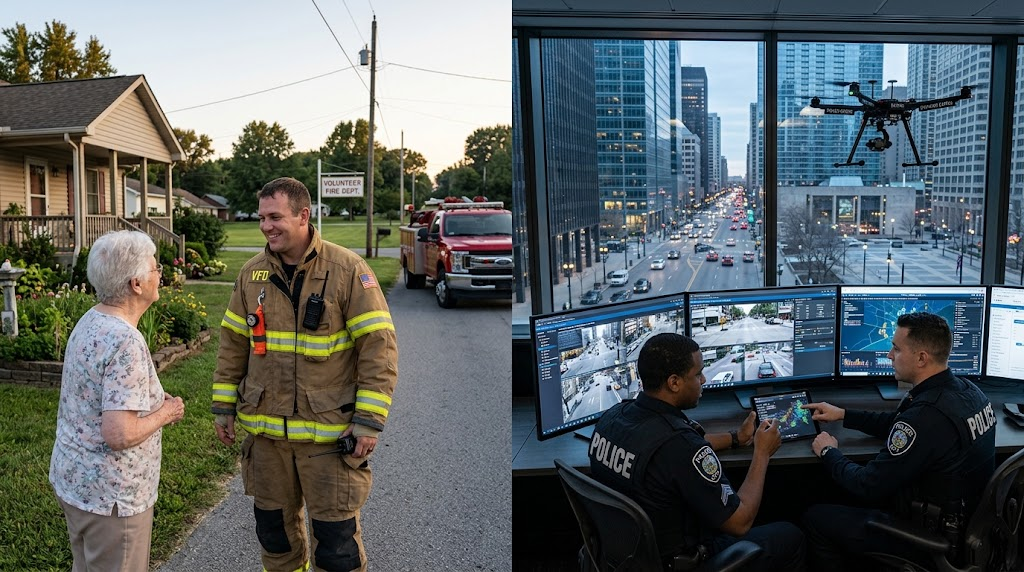
When that same call comes into a rural sheriff’s office or small-town police department in the Midwest, it may be answered by a single dispatcher managing all emergency services across three townships. The responding officer—working a solo shift across 50 square miles of country roads—may be the only law enforcement presence available for twenty minutes.
This stark operational contrast underscores a fundamental reality of public safety: while the core objective of protecting lives and property remains identical, the strategies, tools, and methodologies deployed by law enforcement agencies differ dramatically based on geographic scale, population density, and institutional resources.
Public safety strategy is not a one-size-fits-all discipline. The structural divide between big-city police departments and small-town law enforcement shapes everything from daily patrol tactics and community relations to technology integration, resource allocation, and emergency response capabilities.
1. Resource Dynamics: Specialized Squads vs. The Generalist Officer
The most immediate distinction between major metropolitan departments and small-town law enforcement lies in operational specialization versus generalist versatility.
THE ORGANIZATIONAL DIVIDE

Big City (Specialized Infrastructure):
[Precinct Patrol] ---> [Homicide / Robbery] ---> [Forensic Lab] ---> [Specialized Tactical Units]

Small Town (Generalist Execution):
[Solo Patrol Officer] ─── (Handles Initial Call, Forensic Evidence, Reports & Court Testimony)
The Big-City Model: High Specialization and Scale
Major urban police departments—such as the LAPD, NYPD, or Houston Police Department—operate with thousands of sworn officers organized into highly specialized divisions. An urban precinct officer who responds to a burglary call typically secures the perimeter and conducts an initial interview before handing the investigation over to dedicated units:
- Specialized Investigative Bureaus: Separate, dedicated divisions for homicide, sex crimes, financial fraud, narcotics, and organized crime.
- Technical Support Teams: In-house crime scene technicians, ballistics experts, digital forensics examiners, and evidence-processing laboratories.
- Tactical and Support Units: Full-time SWAT teams, air support divisions, marine units, and specialized mental health crisis intervention teams (CIT).
This division of labor allows urban officers to develop deep technical expertise within narrow domains, supported by massive institutional infrastructure.
The Small-Town Model: The Generalist Reality
In contrast, the vast majority of law enforcement agencies in North America are small. According to federal statistics from the Bureau of Justice Statistics (BJS), roughly half of all local police departments employ fewer than 10 sworn officers, with many rural agencies operating with only a handful of full-time personnel.
In a small-town setting, specialization is an unaffordable luxury. A single officer on duty must serve as patrol officer, traffic enforcer, crime scene investigator, evidence collector, youth mentor, and initial negotiator.
When a serious crime occurs in a small town:
- The responding officer collects physical evidence, interviews witnesses, files reports, and tracks leads independently.
- Complex cases requiring specialized forensics or extended investigations rely on regional task forces, county sheriff’s departments, or state police bureaus (such as the State Patrol or State Bureau of Investigation).
- Tactical calls often require assembling part-time, multi-agency SWAT teams drawn from several neighboring towns, a process that can take hours to mobilize.
2. Response Times, Geographic Scale, and Patrol Tactics
Geography and spatial density fundamentally alter how big-city and small-town agencies structure their daily operations and deploy patrol units.
METROPOLITAN DENSITY vs. RURAL GEOGRAPHY

Metropolitan Core:
- High Population Density / Concentrated Beat
- Response Time: 3 to 7 minutes
- Primary Challenge: Traffic congestion & high call volume

Rural / Small Town:
- Low Population Density / Expansive Geographic Territory
- Response Time: 15 to 45+ minutes
- Primary Challenge: Physical isolation & solo officer backup delay
Metropolitan High-Density Operations
Urban public safety strategies are designed around high population density, rapid call turnover, and concentrated geographic “beats.” An urban patrol car may cover an area of only a few square blocks.
- Rapid Response Capabilities: Because multiple cruisers patrol adjacent beats, emergency response times for critical calls in major cities average between 3 and 8 minutes. Backup units are usually moments away.
- Hotspot and Directed Patrols: Big-city departments rely heavily on spatial analytics to identify micro-locations (specific street corners or commercial strips) where crime concentrates, deploying high-visibility patrols to saturate small areas.
- Call Volume Management: Urban departments process thousands of 911 calls daily, forcing them to use strict call-prioritization frameworks and stacked dispatch queues for non-emergency complaints.
Rural and Small-Town Geographic Realities
In small towns and rural counties, population density is low, but geographic coverage is immense. A county deputy or small-town officer may be responsible for patrolling hundreds of square miles alone during an overnight shift.
- Extended Response Times: Due to physical distances, emergency response times in rural jurisdictions can range from 15 to 45 minutes or longer.
- The Reality of Solo Backup: When a small-town officer encounters a hostile situation, immediate backup from a neighboring department or state trooper may be 20 miles away. As a result, small-town patrol tactics emphasize early verbal de-escalation, self-reliance, and physical caution over aggressive confrontation.
- Community-Based Preventive Patrols: Rather than focusing on analytical hotspot mapping, small-town patrols center on high-visibility driving along main thoroughfares, business security checks, and personal presence at local schools and community gatherings.
3. Community Relationships: Anonymous Surveillance vs. Relational Policing
The nature of community interactions represents perhaps the most profound social difference between urban and rural public safety strategies.
COMMUNITY SAFETY PARADIGMS

Urban Paradigm: Formal / Analytical
- High turnover in officer-citizen interactions
- Professional distance & formal institutional communication
- Reliance on digital intelligence & citizen complaint logs

Small-Town Paradigm: Relational / Informal
- Deep generational relationships & familiar social networks
- Informal conflict resolution & direct community accountability
- Reliance on personal rapport & local institutional trust
The Big-City Paradigm: Distance and Formal Protocols
In a major metropolitan area, police officers interact primarily with strangers. An urban officer may handle twenty calls in a shift, rarely encountering the same citizen twice.
- Institutional and Professional Distance: To maintain fairness and manage intense call volumes, urban policing often relies on formal protocols, standardized enforcement, and institutional procedures.
- The Challenge of Alienation: High-density urban environments can foster anonymity. Building deep, personal trust across diverse urban neighborhoods requires structured community-policing programs, precinct council meetings, and dedicated neighborhood coordination officers.
- Data-Driven Accountability: Urban community relations are frequently evaluated through formal metrics—citizen complaint tracking, body-worn camera audits, public oversight boards, and statistical performance reviews.
The Small-Town Paradigm: Relational Safety and Social Capital
In a small town, anonymity is virtually non-existent. Officers live in the communities they patrol; their children attend local schools, they shop at the same grocery stores, and they interact with residents daily outside of uniform.
- Informal Dispute Resolution: Small-town officers frequently resolve minor disturbances—such as property line disputes, noise complaints, or juvenile mischief—through informal mediation, personal warnings, and direct contact with parents or family members rather than formal arrests or citations.
- Generational Context: Small-town officers often know the personal histories, family dynamics, and mental health backgrounds of the residents they serve. This contextual knowledge allows officers to tailor their approach during crises, utilizing personal rapport to de-escalate situations that might otherwise require force.
- High Individual Accountability: Because small-town officers are highly visible community figures, professional misconduct or poor behavior carries immediate, intense personal and social consequences across the entire town.
4. Crime Profiles and Threat Environments
The types of crime and public safety threats encountered in big cities versus small towns dictate different operational priorities, equipment needs, and strategic planning.
| Public Safety Metric | Big City Metropolitan Area | Small Town / Rural Jurisdiction |
| Primary Crime Drivers | Gang rivalries, organized retail theft, narcotics distribution networks | Substance abuse, property theft, domestic disputes, traffic fatalities |
| Violence Dynamics | High-volume gun violence, group-involved shootings, street robberies | Interpersonal altercations, domestic violence, isolated property crime |
| Infrastructure Vulnerabilities | Mass transit networks, high-density venues, financial corridors | Agricultural supply chains, isolated utility grids, two-lane highways |
| Emergency Medical Needs | High-volume trauma (penetrating wounds, multi-vehicle crashes) | Extended EMS transport times, agricultural accidents, overdose response |
| Public Safety Partners | Dedicated transit police, federal task forces, municipal agencies | Volunteer fire departments, regional sheriffs, state police units |
Big-City Threat Focus: Group Dynamics and Network Crime
Urban public safety strategies are heavily oriented toward addressing structural, group-driven, and network-based crime:
- Group Violence Reduction: Implementing specialized programs—such as Focused Deterrence, gang intelligence units, and hospital-based violence intervention programs—to target organized street networks driving homicides and shootings.
- Complex Property and Commercial Crime: Dedicated task forces address organized retail theft rings, sophisticated financial fraud, transit crime, and high-volume motor vehicle theft.
- Counter-Terrorism and Infrastructure Security: Major cities maintain specialized intelligence centers, counter-terrorism bureaus, and critical infrastructure monitoring units to protect mass transit, financial centers, and major venues.
Small-Town Threat Focus: Isolation, Health Crises, and Traffic Safety
While small towns generally experience lower overall volumes of violent crime, they face distinct, high-impact public safety challenges:
- The Substance Abuse Crisis: Small towns and rural communities have been severely impacted by synthetic opioid epidemics. Small-town public safety strategies rely heavily on distributing Naloxone (Narcan) to all frontline officers, who are frequently the first to arrive at overdose scenes long before emergency medical services.
- Domestic Violence and Isolation: Domestic altercations in isolated rural settings present extreme risks for victims and responding officers alike. Distance from emergency shelters, long response times, and firearms presence make domestic violence calls among the most dangerous assignments for small-town deputies.
- Traffic Fatalities and Roadway Safety: High-speed, unlit two-lane rural roads account for a disproportionate percentage of severe vehicle crashes. Traffic enforcement, crash reconstruction, and emergency extrication represent major operational responsibilities for small departments.
5. Technology and Infrastructure: High-Tech Surveillance vs. Budget Realities
The integration of advanced data science, artificial intelligence, and automated surveillance represents a major technological divide between big-city and small-town departments.
TECHNOLOGY INTEGRATION GAP

Big City Real-Time Crime Center (RTCC):
[Automated Gunshot Sensors] + [ALPR Camera Networks] + [AI Video Analytics] ──> Real-Time Cruiser Stream

Small Town Technical Environment:
[Basic Computer-Aided Dispatch] + [Basic Dashcam/Bodycam] ──> Manual Investigation & Regional Sharing
Big-City Real-Time Crime Centers (RTCCs)
Major metropolitan departments leverage massive technological infrastructure to monitor public spaces and deploy data-driven strategies:
- Integrated Surveillance Networks: Citywide networks of high-definition CCTV cameras, Automated License Plate Readers (ALPRs), and acoustic gunshot detection systems (such as SoundThinking/ShotSpotter).
- Real-Time Crime Centers: Centralized command hubs process live video feeds, criminal history databases, and spatial mapping software, feeding real-time tactical intelligence to officers approaching a scene.
- Predictive Analytics: Machine-learning algorithms analyze historical crime data, weather patterns, and temporal variables to generate risk probability maps that direct daily patrol allocations.
Small-Town Technological Realities
Small-town departments operate under strict budgetary constraints, where capital expenditures are carefully weighed against basic operational needs like vehicle maintenance and competitive salaries.
- Essential Tech Focus: Small agencies prioritize fundamental hardware—reliable digital radios, body-worn cameras, in-car laptops (Mobile Data Terminals), and modern body armor.
- Shared Regional Infrastructure: Rather than building standalone crime centers, small towns share technology through regional county networks, utilizing centralized county 911 dispatch centers and state-level automated plate reader databases.
- Community-Sourced Intelligence: Without dense camera networks, small-town departments rely heavily on crowdsourced intelligence—direct citizen tips, local business security footage, and community social media alerts—to solve property crimes and track missing persons.
6. Emergency Medical Services and Fire Response Architecture
Public safety encompasses not only law enforcement, but also fire suppression, search and rescue, and Emergency Medical Services (EMS). The structural divide between urban and rural settings is particularly pronounced across these life-saving disciplines.
Metropolitan Professional EMS and Career Fire Fleets
Urban areas maintain fully professional, career fire departments and municipal EMS agencies operating out of strategically distributed neighborhood fire stations:
- Guaranteed Rapid Response: Professional crews are stationed on-site 24/7, enabling response times of 4 to 6 minutes for medical emergencies and structural fires.
- Advanced Life Support (ALS): Urban EMS units are overwhelmingly staffed by paramedics capable of administering advanced cardiac care, invasive airway management, and specialized trauma care directly on scene.
- Immediate Trauma Proximity: Transport times from a medical emergency scene to a Level-1 Trauma Center are typically under 15 minutes.
Rural Volunteer Networks and Extended Transport Pipelines
In small towns and rural counties, fire protection and EMS rely heavily on volunteer personnel and regional coverage models:
- Volunteer Fire Departments: Over 65 percent of all firefighters in the United States are volunteers. When an emergency call rings out in a small town, volunteer firefighters must travel from their homes or workplaces to the station house before rolling apparatus to the scene, naturally extending initial response times.
- Basic Life Support (BLS) Triage: Rural EMS agencies often operate at the Basic Life Support level, relying on dedicated emergency medical technicians (EMTs) who provide essential stabilization while awaiting regional ALS intercept units.
- Extended Transport Time: Transporting a critically injured patient from a rural crash scene to a regional trauma center can take 45 minutes to over an hour by ground ambulance, making air medical transport (helicopter EMS) an essential component of rural public safety architecture.
Bridging the Divide: What Small Towns and Big Cities Learn from Each Other
While the operational environments of big-city and small-town public safety agencies remain distinct, modern public safety strategies are increasingly borrowing successful innovations from across the geographic divide.
Big-city departments, recognizing the limitations of purely statistical or technological policing, are actively attempting to replicate the relational strengths of small-town policing. Major urban centers are re-investing in dedicated neighborhood coordination officers, foot patrols, and community engagement initiatives designed to build the personal rapport, trust, and local knowledge that small-town officers exercise naturally every day.
Concurrently, small-town departments are increasingly leveraging scalable, cloud-based technologies to level the operational playing field. Regional technical cooperatives, grant-funded regional intelligence portals, and affordable mobile data tools now allow small-town officers to access advanced vehicle tracking, digital forensics support, and real-time mapping without requiring multi-million-dollar municipal budgets.
Ultimately, effective public safety is not measured by the size of a department’s budget or the sophistication of its technology. Whether operating across high-rise urban canyons or quiet country roads, success depends on an agency’s ability to adapt its strategy to the unique geographic, social, and economic realities of the community it serves—protecting lives, upholding justice, and maintaining public trust.
Leave a Reply