
When a high-profile violent crime or a spate of burglaries strikes a residential neighborhood, the immediate focus is naturally on public safety and law enforcement response. Yet, as the headlines fade and police tape is cleared, a secondary, quieter crisis often takes root in the local housing market.
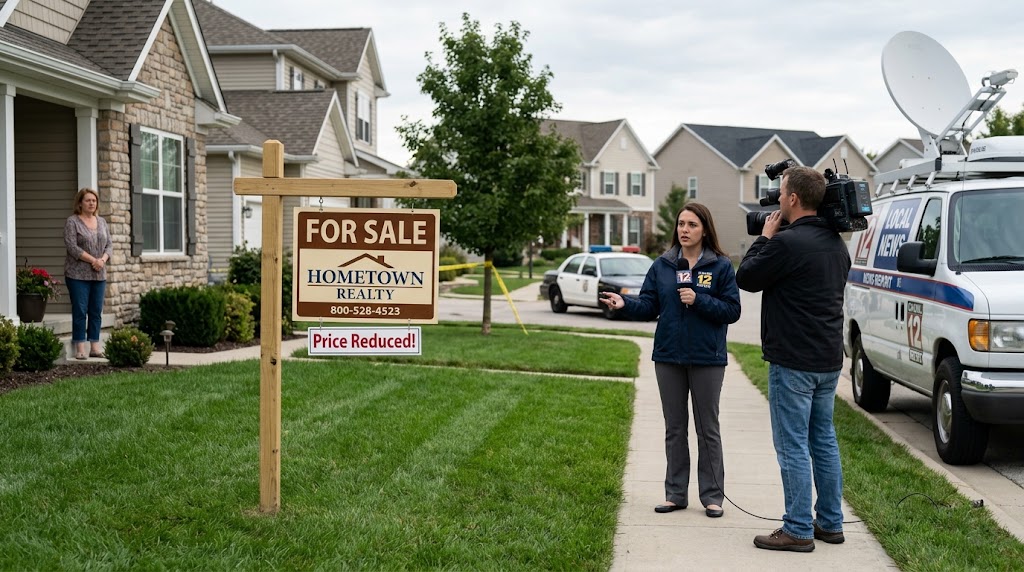
Economists and real estate analysts have long documented the inverse relationship between crime rates and property values.However, emerging research and market data indicate that physical crime itself is only half the equation.The volume, tone, and framing of media coverage surrounding local crime play a disproportionate role in shaping buyer perception, accelerating price discounts, and stalling housing market liquidity.
In modern real estate, home values are driven as much by subjective risk perception as by objective crime statistics.As local news outlets, digital media networks, and hyper-local neighborhood apps amplify safety concerns, media coverage has become a powerful economic variable in urban and suburban property markets.
The Economics of Perception: Hedonic Pricing Meets Media Amplification
To understand how crime reporting influences real estate, economists rely on hedonic pricing models—a framework established to measure how individual attributes, such as square footage, school quality, and neighborhood safety, aggregate into a home’s total market price. Crime operates as a negative externality; when crime risk rises, home buyers demand a financial discount to compensate for the perceived compromise in safety.
However, prospective home buyers rarely consult raw municipal police databases before placing an offer.Instead, their understanding of neighborhood safety is mediated by news coverage and digital information networks.
Media reporting frequently focuses on rare, dramatic, or violent incidents—the classic editorial axiom “if it bleeds, it leads.” Studies by the Pew Research Center indicate that while property crimes are far more common than violent crimes, television news coverage and local outlets cover both with similar frequency, creating a perception gap among consumers.
When media outlets repeatedly spotlight criminal activity in a specific district, they alter the psychological baseline of potential buyers.Even in areas where official crime rates are declining, heavy media coverage can lead buyers to perceive the area as dangerous, prompting lower bids or causing prospective buyers to abandon search listings altogether.
The Spatial Radius of News-Driven Discounts
Economic research demonstrates that the impact of public criminal incidents on property values drops off sharply with distance.Academic studies investigating the economic fallout of publicized crime risks show that properties situated within a tenth of a mile from a heavily reported criminal event experience measurable pricing declines—often ranging from 4 to 10 percent in immediate market capitalization.
What elevates this price suppression from a temporary dip into a persistent trend is sustained news reporting.Isolated incidents that receive minimal media attention rarely disrupt local valuations beyond the immediate block.Conversely, incidents that capture multi-week news cycles generate a lasting “stigma discount”.
This stigma affects the market in several distinct ways:
- Extended Days on Market:Properties in heavily reported crime zones experience longer listing periods, as buyers hesitate to commit during active media coverage.
- Increased Price Concessions:Sellers are often forced to offer significant concessions, such as closing-cost credits or price reductions, to offset buyer risk aversion.
- Shift in Buyer Composition:Owner-occupant buyers, who are generally more risk-averse regarding personal safety, frequently retreat from neighborhoods receiving negative news coverage, leaving institutional investors and landlords to acquire properties at discounted rates.
The Digital Ecosystem: Hyper-Local Apps and Real-Time Noise
The dynamics of crime news coverage have evolved dramatically over the past decade.Historically, real estate markets responded primarily to daily newspapers and evening television broadcasts.Today, the proliferation of real-time neighborhood monitoring applications, police scanner feeds, and social media news aggregation has continuous reporting built into daily life.
Hyper-local platforms broadcast unverified reports of shots fired, package thefts, and suspicious activity directly to smartphone screens in real time.While designed to heighten local awareness, this continuous stream of incident alerts often creates a heightened sense of insecurity.
Real estate agents report that prospective home buyers increasingly reference online crime stories and neighborhood app threads during home viewings. Where buyers once evaluated school districts and property conditions, many now review years of archived digital news stories and forum posts. A single viral news report detailing a local robbery or carjacking can remain indexed on search engines for years, creating an enduring digital paper trail that depresses home values long after local police have resolved the issue.
Socio-Economic Feedback Loops and Municipal Implications
The intersection of media reporting and property values carries broader economic consequences for cities and municipal governments.Property taxes represent the primary revenue source for municipal services, including public education, infrastructure maintenance, and law enforcement operations.
When intense news coverage depresses property values across a neighborhood or district, local tax assessments gradually decline.This drop in tax revenue leaves local governments with fewer resources to fund community safety initiatives, code enforcement, and urban renewal projects.The resulting underfunding can lead to physical neighborhood decay, potentially giving rise to further criminal activity and subsequent negative news coverage.
Furthermore, the economic impact of crime reporting is distributed unevenly across socioeconomic spectrums.High-income communities often possess sufficient structural amenities—such as top-rated schools, commercial hubs, and private security—to absorb negative news cycles and rebound quickly. In contrast, working-class and middle-income neighborhoods are more vulnerable to reputational damage; intense media focus on local crime can spark capital flight and destabilize entire local housing sub-markets.
Navigating the Stigma: Strategies for Market Recovery
Addressing the disparity between actual crime risk and media-driven perception poses a complex challenge for urban planners, municipal leaders, and real estate professionals.
To counter persistent negative narratives, local economic development agencies and neighborhood associations are increasingly investing in proactive public relations and community-building initiatives.Cities that successfully revitalize their housing markets after periods of high-profile crime often combine targeted public safety interventions with proactive efforts to highlight neighborhood amenities, community events, and commercial investments.
For journalists and media executives, the economic impact of crime coverage highlights the necessity of contextual reporting.Responsible journalism requires balancing immediate news reporting with broader contextual data, helping audiences distinguish between isolated criminal events and systemic, long-term trends.
As real estate markets become ever more data-driven, understanding the gap between media narrative and economic reality remains vital.While actual crime rates undoubtedly shape the foundation of neighborhood safety, it is the media’s framing of those events that often dictates the final price tag on the closing table.
Leave a Reply