
Across urban centers, suburban neighborhoods, and rural towns worldwide, communities face a persistent challenge: maintaining public safety amid fluctuating local crime rates and strained law enforcement resources. In response, a growing number of citizens have taken safety into their own hands—not with weapons or badge authority, but with high-visibility jackets, flashlights, radios, and organized walking routes.
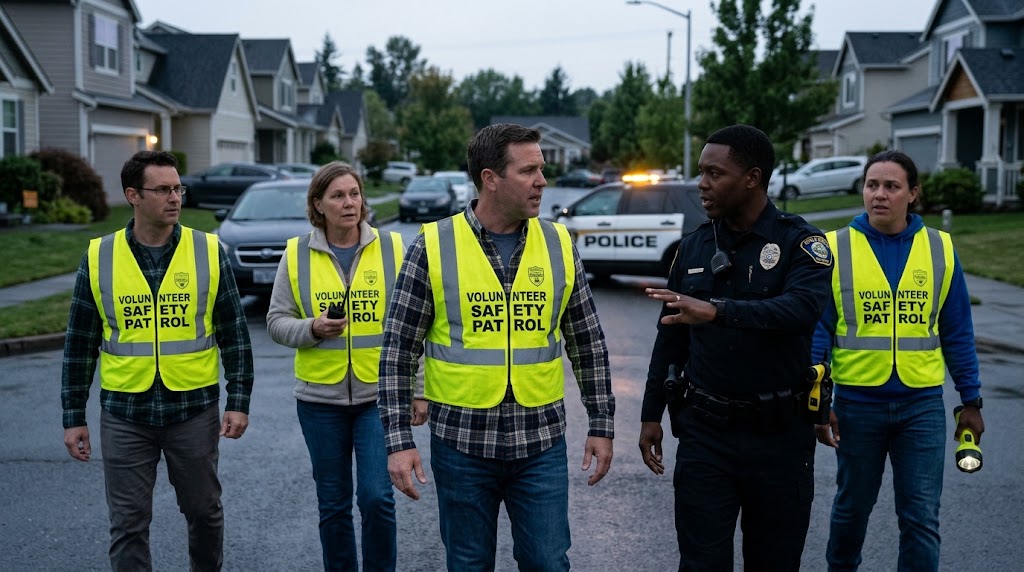
Volunteer safety patrols, ranging from structured organizations like the international Guardian Angels to hyper-local neighborhood watch groups and merchant-led street teams, represent one of the most enduring forms of civic engagement. Their core premise is straightforward: an active, visible presence of community members can deter potential offenders, report suspicious activities before they escalate, and restore a sense of order to public spaces.
Yet, as police departments navigate staffing shortages and municipal budgets face growing scrutiny, critical questions persist regarding the true efficacy of these grassroots safety initiatives. Do volunteer patrols genuinely lower local crime rates, or do they simply offer a psychological security blanket? More critically, where lies the boundary between responsible civic stewardship and dangerous vigilantism?
An examination of criminological data, historical outcomes, and urban policy reveals that while volunteer patrols can indeed reduce certain types of crime, their success depends heavily on structural oversight, clear operational boundaries, and rigorous integration with formal public safety systems.
The Theoretical Framework: Visibility and Collective Efficacy
To understand whether volunteer patrols work, criminologists typically evaluate them through two foundational lens: Routine Activity Theory and the concept of “collective efficacy.”
Formulated by criminologists Lawrence Cohen and Marcus Felson, Routine Activity Theory posits that for a crime to occur, three elements must converge in space and time: a motivated offender, a suitable target, and the absence of a “capable guardian.” In traditional municipal policing, uniformed officers act as guardians. However, police cannot be everywhere at once. Volunteer safety patrols aim to fill this vacuum by serving as visible, non-police guardians whose presence alters the risk-reward calculation for prospective offenders.
Complementing this is the principle of collective efficacy—a concept developed by sociologist Robert Sampson. Collective efficacy refers to the level of mutual trust among neighbors combined with their willingness to intervene for the common good. Research consistently shows that neighborhoods with high collective efficacy experience lower rates of violence and property crime.
Volunteer safety patrols act as a physical manifestion of collective efficacy. When residents walk streets, engage with local business owners, and monitor public areas, they signal to potential offenders that the community actively regulates its shared environment. This dynamic relies heavily on what urban theorist Jane Jacobs famously termed “eyes on the street”—the informal surveillance provided by ordinary citizens engaged in daily life.
What the Empirical Evidence Reveals
While the theoretical grounding is solid, evaluating the tangible, statistical impact of volunteer patrols requires analyzing decades of field research and systematic reviews.
Criminological literature generally divides the impact of community safety patrols into two distinct categories: property crime and violent crime. Overall, systematic reviews—including comprehensive meta-analyses conducted by the Campbell Collaboration on neighborhood watch and community patrol programs—indicate that organized community surveillance initiatives are associated with a modest but statistically significant reduction in local crime.
1. Significant Impact on Opportunistic Property Crime
The clearest evidence of effectiveness appears in the mitigation of opportunistic property offenses. Communities with active, structured volunteer patrols frequently experience measurable drops in:
- Residential Burglaries: Visible patrols alter the perceived risk of entering properties undetected, particularly during daytime hours when residents are at work.
- Vehicle Crime: Theft from auto and vehicle break-ins drop noticeably in parking lots, residential streets, and commercial strips where volunteer teams maintain regular schedules.
- Vandalism and Graffiti: The immediate presence of community observers discourages property damage, which often requires quiet, unmonitored environments to execute.
2. Limited Influence on Violent and Domestic Crime
Conversely, empirical data demonstrates that volunteer patrols have a negligible impact on violent crimes and incidents occurring within private spaces. Impulsive violent offenses, domestic disputes, and alcohol-fueled altercations in nightlife districts rarely diminish purely due to the presence of civilian observers. Because these crimes are seldom premeditated in public view, the deterrence effect of a passing volunteer patrol is minimal.
3. The Question of Crime Displacement
A common criticism of localized safety efforts is the “displacement hypothesis”—the theory that patrols do not eliminate crime, but merely push it into adjacent, unmonitored neighborhoods.
However, criminological evaluations suggest a counter-phenomenon often occurs: the “diffusion of benefits.” Rather than displacing crime next door, high-visibility volunteer patrols frequently create a halo effect, where crime drops not only on the specific blocks patrolled but also in immediately surrounding streets as offenders overestimate the reach of the surveillance network.
The Risks: Overreach, Vigilantism, and Implicit Bias
While the benefits of volunteer patrols can be measured in reduced property loss, the operational risks of civilian surveillance are substantial and well-documented.
The most severe danger inherent in volunteer patrols is the potential for boundary erosion—when unarmed observers transition into active enforcers. Without formal legal training, constitutional education, and rigorous conflict de-escalation protocols, civilian patrollers risk escalating routine encounters into violent confrontations or illegal detentions.
Training Deficits and Legal Liability
Unlike sworn police officers, volunteer patrollers possess no special legal authority beyond that of an ordinary citizen. They operate under standard civilian arrest laws, which are narrowly defined and carry immense legal risk. When untrained volunteers attempt to physically detain suspects or conduct investigative stops, they expose themselves, their sponsoring organizations, and their municipalities to severe civil liability and criminal charges.
Implicit Bias and Racial Profiling
A persistent concern surrounding civilian surveillance is the role of implicit bias. In unmanaged or informal patrol groups, volunteers may equate “suspicion” with race, socioeconomic status, youth culture, or unfamiliarity.
When volunteer patrollers target individuals based on subjective biases rather than objective criminal behavior, the consequences extend far beyond personal harassment. It erodes trust within the broader community, alienates marginalized populations, and undermines the very collective efficacy the patrol was intended to build.
High-Profile Failures
History provides stark warnings regarding the risks of unsupervised civilian surveillance. High-profile incidents across the globe where civilian watch coordinators or neighborhood patrollers confronted unarmed residents have resulted in tragic loss of life, prolonged legal battles, and national civil unrest. These instances underscore a vital takeaway for policy makers: civilian safety groups operating without clear boundaries, strict non-confrontation mandates, and professional oversight pose a serious threat to public safety.
Comparative Patrol Models: From Informal to Structured
Not all volunteer safety patrols operate under the same structure. The effectiveness and safety of these initiatives vary significantly based on their organizational framework, leadership, and operational scope.
| Patrol Model | Primary Operational Focus | Relative Strengths | Major Risks & Limitations |
| Informal Neighborhood Watch | Passive observation, phone trees, reporting to police from private properties. | Low operational cost, high local engagement, minimal risk of confrontation. | Vulnerable to inactivity; low visibility; relies entirely on police response speed. |
| Structured Civilian Patrols (e.g., Guardian Angels) | Unarmed foot patrols in uniform/high-visibility gear; trained in de-escalation; public transit and street focus. | High visual deterrence; strong public profile; organized training structure. | Potential friction with formal law enforcement; risk of physical altercations. |
| Business Improvement District (BID) Ambassadors | Semi-volunteer or low-wage civilian teams patrolling commercial corridors; customer service and safety focus. | High integration with local merchants; consistent scheduling; clear operational scope. | Limited to commercial zones; high turnover; relies on private or commercial funding. |
| Police-Auxiliary / Volunteer Reserves | Uniformed civilians managed directly by municipal police departments; non-enforcement duties. | Direct law enforcement oversight; rigorous vetting and background checks; high legal clarity. | Requires police administrative resources; can be perceived as an extension of police authority rather than community-led. |
The Law Enforcement Relationship: Friction vs. Partnership
The dynamic between volunteer safety patrols and municipal police departments is complex and often fluctuates between mutual appreciation and institutional skepticism.
For police commanders, well-organized volunteer patrols represent a valuable source of situational awareness. Patrols act as additional eyes and ears, providing real-time intelligence on local hot spots, code violations, open commercial doors, and suspicious activity. In communities where police-community relations are strained, neutral civilian safety teams can sometimes bridge communication gaps that formal law enforcement cannot.
However, friction routinely arises when patrols operate independently of police coordination. Law enforcement agencies frequently express concern regarding:
- Safety Risks to Volunteers: Police chiefs worry that unarmed citizens will walk into dangerous situations, forcing officers to divert resources from active emergencies to rescue patrollers.
- Interference with Active Operations: Uncoordinated civilian patrols can inadvertently compromise ongoing undercover operations, contaminate crime scenes, or alert suspects before officers arrive.
- Competing Public Relations: Independent safety groups that publicly critique police responsiveness or claim credit for crime drops can trigger political friction between community leaders and departmental management.
Successful integration requires a formalized relationship. Expert consensus indicates that volunteer patrols achieve their maximum effectiveness when operating under a clear Memorandum of Understanding (MOU) with local law enforcement. Such agreements establish direct communication channels, designate liaison officers, define precise reporting procedures, and mandate that volunteers strictly follow a “observe and report” protocol.
Modern Evolution: Technology-Enhanced Patrols
The traditional image of volunteer patrols—citizens walking blocks with flashlights and physical clipboards—has evolved rapidly in the digital age. Contemporary safety patrols leverage modern communication networks, smart infrastructure, and crowdsourced reporting tools to expand their operational reach.
Many active patrol teams now utilize:
- Real-Time GPS Tracking: Allowing patrol coordinators to monitor volunteer locations, ensure team safety, and track route coverage systematically.
- Encrypted Digital Communications: Utilizing dedicated mobile push-to-talk apps rather than traditional analog radios to maintain instant, secure contact between patrol pairs and dispatchers.
- Body-Worn and Vehicle Cameras: Documenting all civilian interactions to provide objective evidence of incidents and protect patrollers against false claims or liability.
- Integrated Data Mapping: Partnering with local crime analysts to deploy volunteer shifts precisely when and where historical data shows peak property crime occurrences.
While technology enhances operational efficiency, it also requires patrols to navigate new privacy challenges. Responsible volunteer organizations must establish strict data management guidelines to ensure that recorded video footage and location logs are used exclusively for legitimate public safety purposes and handled in accordance with local data privacy laws.
Key Ingredients for an Effective and Safe Volunteer Patrol
For communities, local leaders, and municipal authorities considering the implementation or restructuring of a volunteer safety patrol, evidence points to several essential criteria required to maximize crime reduction while mitigating liability:
1. Mandatory Non-Confrontation Policy
The cornerstone of any safe civilian patrol is an absolute, non-negotiable rule of non-confrontation. Volunteers must be explicitly trained to serve exclusively as observers. If a crime in progress or a volatile situation is identified, the sole duty of the patroller is to retreat to a safe distance, observe details, and notify professional emergency services immediately.
2. Comprehensive Vetting and Background Checks
To maintain public trust and protect community members, volunteer organizations must implement rigorous screening protocols. Mandatory criminal background checks, character references, and personal interviews help prevent individuals with malicious intent, vigilante tendencies, or histories of violent offenses from joining patrol ranks.
3. Structured De-Escalation and Bias Training
Before stepping onto public streets, patrollers must undergo comprehensive training covering conflict de-escalation, situational awareness, implicit bias awareness, and local laws regarding civilian authority. Ongoing refresher courses should be required for active members.
4. High Visibility and Clear Identification
Secretive or undercover civilian surveillance breeds distrust and heightens the risk of dangerous misunderstandings. Patrols should always operate in pairs, wear clearly identifiable, high-visibility uniforms or vests, and carry appropriate identification credentials.
5. Close Coordination with Municipal Services
Effective patrols extend their focus beyond crime detection to include broader neighborhood quality-of-life issues. Reporting broken streetlights, overgrown alleys, abandoned vehicles, and code violations to municipal public works departments addresses the physical environment of a neighborhood—directly supporting the “Broken Windows” theory of crime prevention.
Sustainable Public Safety Beyond the Badge
The question of whether volunteer safety patrols are effective in reducing local crime cannot be answered with a simple binary. When operating as informal, unvetted, or confrontational groups, civilian patrols risk causing more harm than good—inflaming local tensions, courting legal disaster, and worsening safety outcomes.
However, when structured as professional, transparent, and strictly non-confrontational organizations, volunteer safety patrols serve as a proven, cost-effective component of modern community safety strategies. By deterring opportunistic property crime, fostering collective efficacy, and reinforcing the social fabric of neighborhoods, these initiatives demonstrate that safety is not purely a commodity delivered by state authorities, but a shared community responsibility.
In an era of evolving public safety challenges, the ultimate value of volunteer patrols lies not in their ability to act as quasi-police, but in their capacity to remind cities that safer neighborhoods are built when citizens actively care for their shared public spaces and for one another.
Leave a Reply