
Every weekday morning in municipal courtrooms across the nation, public defenders face a scene that resembles a high-speed transit hub during peak commute hours. Dozens of defendants line wooden benches while attorneys carry armfuls of case files—or scan tablet screens containing dozens of active dockets—navigating a crowded schedule where initial appearances, bail arguments, plea negotiations, and sentencing hearings collide within a matter of hours.
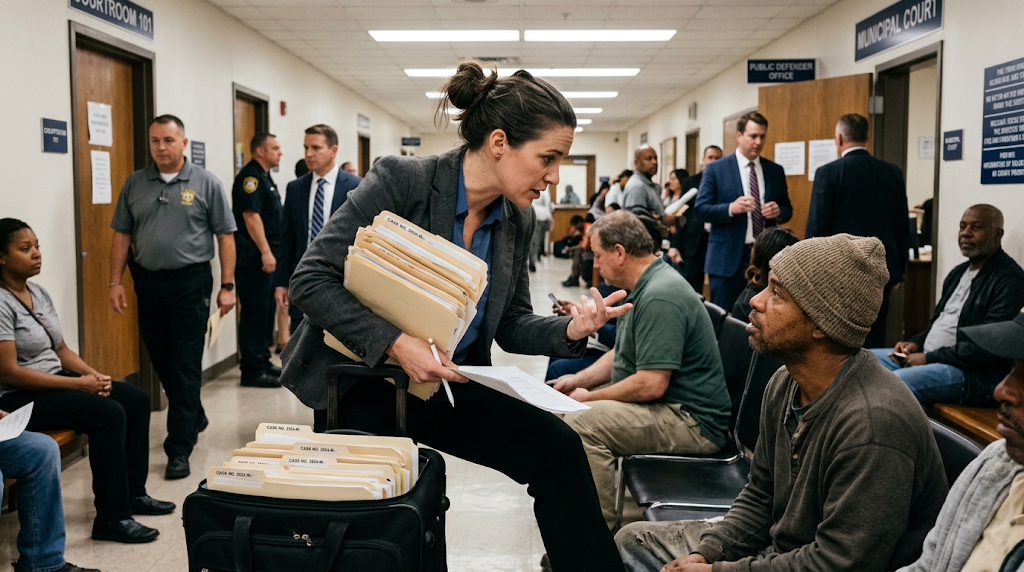
Municipal courts, often referred to as lower courts or misdemeanor courts, process the vast majority of the nation’s criminal legal matters. While high-profile felony trials dominate headlines and television dramas, municipal courts handle millions of quality-of-life offenses, traffic infractions, minor thefts, trespass charges, and local ordinance violations each year.
At the center of this rapid-fire environment is the public defender. Constitutionally mandated to represent individuals who cannot afford private legal counsel, these attorneys operate under continuous structural pressure. With annual caseloads frequently reaching into the hundreds—and in some jurisdictions, exceeding a thousand clients per lawyer—public defenders must employ a complex combination of legal triage, strategic prioritization, procedural routine, and institutional pushback to uphold the Sixth Amendment right to counsel.
The Scale of the Crisis: Standard Rules vs. Everyday Realities
To understand how public defenders manage their workloads, one must first grasp the disparity between professional benchmarks and local court realities.
For decades, public defense systems relied on maximum workload guidelines established in 1973 by the National Advisory Commission on Criminal Justice Standards and Goals (NAC). Those early recommendations suggested that a single full-time public defender should handle no more than 400 misdemeanor cases per year.
However, criminal defense advocates and legal scholars long argued that these 50-year-old numbers were outdated and failed to reflect the realities of modern practice, such as reviewing electronic discovery, body-worn camera footage, and digital forensic data. In 2023, the landmark National Public Defense Workload Study—conducted by the American Bar Association (ABA) Standing Committee on Legal Aid and Indigent Defense alongside the RAND Corporation and other legal research institutions—established new data-driven workload guidelines. The study concluded that modern criminal defense requires significantly more hours per case than previously recognized, meaning effective representation demands substantially lower total caseloads than traditional limits allowed.
Despite these updated benchmarks, actual municipal court dockets frequently surpass safe thresholds. In many growing metropolitan areas and underfunded rural districts, a single public defender may be assigned to represent 15 to 30 clients in a single morning session.
The structural drivers behind these volume surges include:
- High-Volume Charging Practices: Municipal prosecutors and law enforcement agencies frequently utilize criminal charges for minor infractions, public nuisance offenses, and failure-to-appear violations.
- Underfunded Indigent Defense Systems: Public defense budgets in lower courts regularly receive a fraction of the funding allocated to law enforcement and prosecution agencies.
- Support Staff Shortages: Many municipal defender offices lack dedicated investigators, paralegals, translators, or social workers, forcing staff attorneys to absorb administrative and investigative burdens.
The Art of Legal Triage: Managing Dockets in Real Time
Faced with a volume of work that precludes hours of pre-trial preparation for every minor offense, public defenders rely heavily on “legal triage”—the process of rapidly assessing cases to determine where immediate legal intervention will yield the greatest impact.
Legal triage is not a formal procedural framework; rather, it is a practical skill developed through courtroom experience. In a typical municipal morning session, an attorney must quickly classify cases into distinct action categories:
1. High-Priority / Immediate Liberty Risk
Cases where the defendant is currently incarcerated or faces immediate jail time receive primary focus. Public defenders prioritize these matters for immediate bail advocacy, conditional release applications, or urgent evidentiary challenges.
2. Strategic Dismissal Candidates
Attorneys scan discovery documents and police reports for clear legal deficiencies—such as unconstitutional stops, improper searches, or missing statutory elements. Identifying these flaws early allows defenders to motion for immediate dismissals or leverage the defect during initial discussions with prosecutors.
3. Diversion and Alternative Resolution Options
For first-time offenders or individuals facing charges tied to substance use or mental health conditions, defenders focus on securing entry into municipal diversion programs, community service agreements, or specialized treatment dockets that lead to charges being dropped upon completion.
4. Routine Disposition and Plea Negotiations
For cases involving low legal complexity and minimal collateral consequences, defenders work to negotiate swift resolutions that minimize fines, avoid custodial sentences, and resolve active warrants.
While triage allows defenders to keep court dockets moving and secure quick outcomes for straightforward cases, legal scholars emphasize its inherent risks. When forced to operate in triage mode, attorneys face reduced time to interview witnesses, visit crime scenes, or investigate nuanced defenses.
Structural Adaptations: How Public Defense Offices Organize Work
To cope with volume, public defense institutions utilize specific organizational models designed to maximize efficiency without compromising client rights.
Horizontal vs. Vertical Representation
In high-volume municipal courts, offices frequently employ horizontal representation. Under this model, different attorneys are assigned to specific stages of the court process rather than following a single case from start to finish.
- One defender handles initial arraignments and bail hearings.
- Another handles pre-trial conferences and plea negotiations.
- A third defender handles motion hearings and trials.
Horizontal representation allows attorneys to become experts in a specific procedural phase and build familiarity with specific courtroom personnel. However, it requires robust internal case-management software to ensure client notes, discovery files, and strategic goals are seamlessly transferred between lawyers.
Conversely, offices that utilize vertical representation—where one attorney represents the client throughout the entire process—often establish specialized “docket teams” to share preparation duties and conduct joint client intake sessions.
Holistic and Multidisciplinary Defense
A growing number of public defender offices have integrated social workers, case managers, and client advocates directly into municipal court practice. Known as holistic defense, this model addresses the underlying socio-economic drivers of municipal arrests—such as unhoused status, addiction, or unmanaged mental illness.
By pairing attorneys with social service professionals:
- Social workers construct comprehensive rehabilitation and housing plans prior to court dates.
- Defenders present these plans to judges and prosecutors as viable alternatives to incarceration.
- Resolving the root cause of the arrest reduces repeat contacts with the municipal court system, stabilizing attorney dockets over the long term.
Technology and Administrative Optimization
Modern technology plays a critical role in enabling municipal defenders to keep pace with modern dockets. Public defender offices increasingly adopt customized case-management platforms designed to streamline routine administrative tasks.
Key technological strategies include:
- Automated Discovery Review: Software tools help attorneys index and search hours of body-worn camera footage, police audio logs, and dispatch records for key terms or missing timeline segments.
- Digital Client Communication Tools: Automated text reminders and secure messaging portals reduce failure-to-appear rates, preventing warrants that would otherwise generate secondary charges and additional court hearings.
- Template-Based Motion Frameworks: Offices maintain standardized motion libraries for recurring constitutional issues—such as speedy trial violations, discovery non-compliance, or illegal search challenges—allowing attorneys to adapt complex legal arguments to specific cases quickly.
The Ethical Tension: Plea Bargains and Systemic Pressure
The reliant relationship between high caseloads and negotiated plea agreements remains one of the most intensely debated aspects of municipal justice.
In low-level courts, the vast majority of cases resolve through plea bargaining. For many defendants, accepting a plea deal involving “time served,” a modest fine, or probation offers an immediate path out of jail and back to employment or family care, avoiding the delay and financial cost of repeated court appearances.
However, the speed of municipal court proceedings creates a structural pressure often termed the “assembly-line” effect. Defenders must carefully balance the practical benefits of a quick plea against the potential long-term collateral consequences for the client, which can include:
- Criminal records affecting future employment and background checks.
- Driver’s license suspensions or transportation restrictions.
- Impact on housing eligibility or public benefits.
- Immigration consequences for non-citizen residents.
To maintain ethical standards under intense volume, public defender associations stress the necessity of thorough initial interviews and standardized “collateral consequence checklists” during client consultations, ensuring defendants fully understand the scope of any agreement before entering a plea.
Institutional Pushback: Refusals, Litigation, and Systemic Reform
When caseloads cross ethical lines where competent representation is no longer possible, public defenders and institutional offices increasingly exercise formal mechanisms to challenge the status quo.
Drawing on ethics guidelines such as ABA Formal Opinion 06-441—which affirms that public defenders have an ethical duty to decline new appointments or withdraw from existing cases if excessive workloads compromise their ability to provide diligent representation—offices across multiple states have formally declared “unavailability.”
Recent institutional strategies include:
- Formal Motion to Withdraw: Defenders file motions requesting that courts freeze new assignments or appoint private conflict counsel until dockets drop to manageable levels.
- Litigation Against Funding Entities: Public defender agencies and advocacy groups have filed lawsuits against municipal and state governments, citing structural Sixth Amendment violations caused by systemic underfunding.
- Prosecutorial and Judicial Coordination: In some jurisdictions, defender offices collaborate with local prosecutors and court administrators to establish smart-charging policies, decriminalize non-violent ordinance violations, or expand pre-arrest diversion to divert low-level cases out of the court system entirely.
The Path Forward for Municipal Defense
Managing massive caseloads in lower courts requires a daily balancing act between professional dedication and systemic constraint. While public defenders employ sophisticated triage techniques, specialized team structures, and digital tools to advocate for their clients, legal experts broadly agree that operational adaptations alone cannot substitute for structural reform.
Long-term solutions require sustained legislative investment, updated workload limits grounded in modern empirical research, expansion of holistic defense resources, and systemic policy shifts that reduce the reliance on criminal courts for minor societal challenges. Until such reforms are fully realized, public defenders remain on the front lines of municipal justice, working within crowded courtrooms to ensure that the constitutional promise of a fair and equal defense is upheld for every individual.
Leave a Reply