
For decades, the physical infrastructure of community vigilance was defined by a simple, static icon: a metal sign featuring a stylized figure in a trench coat, warning prospective criminals that a “Neighborhood Watch” program was in effect. Community safety relied on periodic block meetings, phone trees, and occasional daytime patrols organized by civic-minded residents.
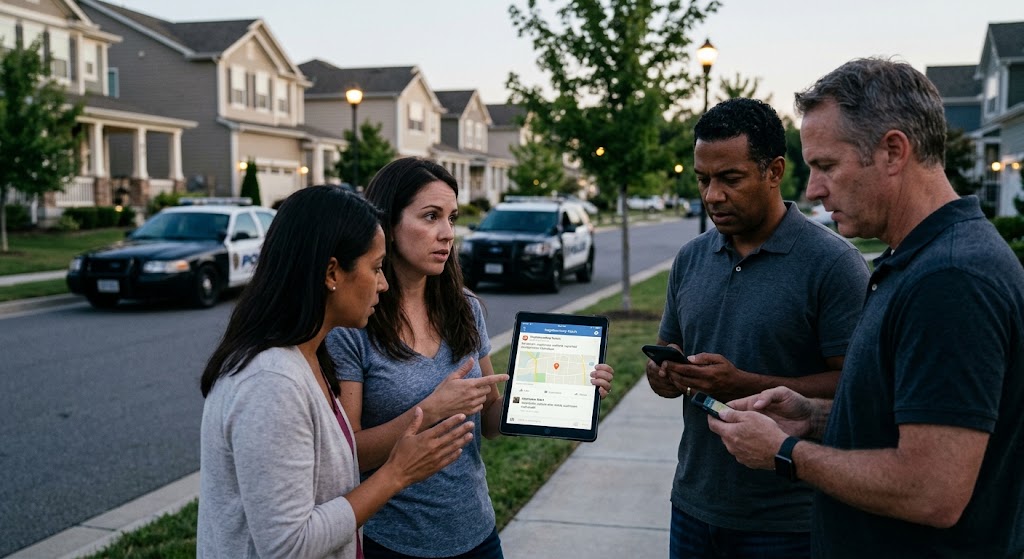
Today, that analog model of civic surveillance has been replaced by a continuous stream of real-time digital notifications. Powered by hyper-local social networking platforms such as Nextdoor, safety apps like Citizen, camera-sharing ecosystems like Neighbors by Ring, and endless localized WhatsApp or Facebook groups, neighborhood watchfulness has migrated directly to the smartphone.
With a single tap, residents can broadcast high-definition video clips of strangers on their porches, alert hundreds of neighbors to unconfirmed gunshots, or tag an unfamiliar vehicle cruising down a residential street.This digital transformation has dramatically lowered the barrier for reporting suspicious activity, granting everyday citizens unprecedented power to observe, record, and publicize local events in real time.
Yet, as community reporting shifts from occasional community hall meetings to instantaneous digital alerts, criminologists, civil rights advocates, and law enforcement agencies are grappling with a complex legacy.While hyper-local platforms provide remarkable speed and invaluable forensic evidence for solving petty property crimes, they are also reshaping public psychology—fueling hyper-vigilance, amplifying implicit bias, and altering how communities define threat, safety, and suspicion.
From Block Meetings to Real-Time Surveillance Streams
The fundamental shift in neighborhood reporting lies in the immediate, frictionless nature of modern communication technology.In the past, reporting a suspicious occurrence required a deliberate effort: observing an event, judging it severe enough to warrant action, and either dialing a non-emergency police number or waiting to mention it at a local association meeting.
Modern hyper-local platforms have eliminated the pause between observation and public broadcast.Smart video doorbells and motion-activated security cameras automatically record activity at the perimeter of private homes.When something unusual occurs, users can seamlessly export video clips directly into localized social feeds.
This integration of smart hardware and social networking creates a participatory surveillance web. A resident sitting at a office desk miles away can receive a push notification when a delivery worker steps onto their front steps, watch live footage, and immediately upload the clip to a feed shared by thousands of nearby households.
Furthermore, apps dedicated specifically to public safety aggregate emergency radio chatter, user submissions, and geo-fenced location data.Instead of waiting for traditional morning news broadcasts or official police press releases, residents receive instant push notifications detailing police responses, reported altercations, or active investigations happening within a few blocks of their living rooms.
This constant connectivity has democratized local intelligence gathering. In many suburban and urban neighborhoods, digital alert groups have effectively become private, crowdsourced intelligence networks operating around the clock.
Crowdsourced Investigation: Speed, Evidence, and Community Action
From a tactical public safety perspective, the digital evolution of neighborhood watchfulness has delivered tangible benefits, particularly in addressing property crime and localized quality-of-life issues.
The most prominent advantage is the rapid aggregation of visual evidence.When package thefts, vehicle break-ins, or acts of vandalism occur, victims no longer have to rely on vague descriptions.Within minutes of an incident, multiple camera angles from different homes along a single street can be posted online, showing a suspect’s physical features, clothing, direction of travel, and getaway vehicle.
This crowdsourced evidence routinely assists law enforcement and leads to swift community-driven resolutions:
- Recovering Stolen Property:High-definition video clips shared across local groups make it significantly harder for porch pirates or opportunistic thieves to operate anonymously, often leading to the rapid identification of repeat offenders.
- Tracking Pattern Crimes:When serial crimes hit a neighborhood—such as catalytic converter thefts or overnight car door checking—aggregated posts allow residents to identify precise timelines and patrol patterns, enabling police to deploy resources more effectively.
- Accelerating Missing Person Searches:In time-critical scenarios involving lost children, wandering seniors, or missing pets, hyper-local social networks allow community-wide search networks to organize within minutes, distributing photos and last-known locations instantly across geographic zones.
In many instances, these digital networks foster a genuine sense of mutual aid.Neighbors assist one another in identifying lost dogs, alerting drivers to open garage doors, or checking on elderly residents during severe weather events, proving that hyper-local tech can strengthen community bonds when focused on constructive engagement.
The Psychological Toll: Hyper-Vigilance and Fear Amplification
Despite these operational advantages, the constant flood of security alerts has introduced profound psychological and social challenges. Communications scholars and sociologists note that hyper-local safety apps tend to induce a digital variant of the “mean world syndrome”—a cognitive bias where individuals perceive their immediate surroundings as significantly more dangerous than statistical reality suggests.
Historically, crime statistics in many developed nations have shown long-term declines or stabilization across various categories. However, user perception frequently moves in the opposite direction when residents subscribe to real-time alert networks.
When a smartphone constantly buzzes with notifications regarding “suspicious persons,” minor trespassing, loud noises, or police helicopter activity, users are exposed to a relentless drumbeat of threat narratives. The geographic proximity of these alerts magnifies anxiety; an incident occurring three streets away feels personally threatening when delivered via an urgent pop-up banner.
This algorithmic amplification of threat creates a feedback loop of hyper-vigilance.As residents become increasingly anxious, their threshold for what constitutes “suspicious activity” drops dramatically.Routine, benign events—a car idling on a public street, a door-to-door salesperson, a stranger asking for directions, or a person taking an evening walk—are frequently flagged, recorded, and uploaded as potential criminal threats.
Over time, this heightened state of alarm transforms quiet residential streets into environments of persistent mutual distrust, where every unfamiliar face is viewed as a security risk rather than a potential neighbor.
Implicit Bias, Racial Profiling, and Digital Mob Mentality
The most severe critical vulnerability of crowdsourced reporting platforms is their susceptibility to implicit racial, cultural, and socioeconomic bias.
Civil rights organizations, technology watchdogs, and academic researchers have extensively documented how hyper-local platforms can become vehicles for digital racial profiling.In unmoderated or poorly moderated neighborhood groups, posts reporting “suspicious activity” disproportionately target Black, Latino, and other minority individuals who are simply engaged in lawful activities—such as delivering packages, working as contractors, resting in public spaces, or walking through residential areas.
The architecture of social media apps often worsens this dynamic.Because platforms incentivize rapid engagement through comments, shares, and reactions, a post featuring an ambiguous photo of a “suspicious person” can trigger a wave of speculative comments within hours.
This digital mob mentality produces severe real-world consequences:
- Harassment of Innocent Citizens:Individuals accused of being suspicious in popular local threads are sometimes confronted directly by armed or aggressive residents, leading to dangerous confrontations.
- False Police Dispatches:Biased app posts frequently translate into unnecessary emergency calls, drawing armed police officers into non-criminal situations and creating high-risk encounters for innocent people.
- Erosion of Public Space:When certain groups are routinely photographed and scrutinized online simply for existing in specific neighborhoods, public spaces become welcoming to some while hostile to others.
Recognizing these risks, platforms like Nextdoor and Ring have implemented algorithmic prompts and strict community guidelines designed to curb implicit bias.For example, some platforms now require users to provide specific, objective behavioral details—such as detailing an actual criminal act like breaking a window—rather than allowing posts based solely on race, clothing, or vague subjective feelings of discomfort.While these measures have reduced blatant violations, subtle forms of bias remain difficult to eliminate entirely from crowdsourced feeds.
Law Enforcement at a Crossroads: Data Goldmine vs. Operational Noise
For law enforcement agencies, the explosion of social-media-driven neighborhood reporting has transformed the mechanics of police work, creating a delicate balance between public engagement and resource management.
Police departments initially embraced direct integration with safety apps.Official police portals allowed detectives to issue geo-targeted requests for video footage following violent crimes, bank robberies, or hit-and-run accidents.This capability significantly streamlined investigative canvassing, saving hundreds of hours of manual labor.
However, the sheer volume of crowdsourced reports has also created significant operational strain.Police departments are routinely flooded with low-priority calls triggered by viral app posts. Officers are dispatched to investigate benign situations that have been exaggerated by online commentary, diverting limited operational resources away from genuine emergencies and core public safety duties.
Furthermore, legal concerns surrounding digital surveillance networks have prompted major policy recalibrations.Privacy advocates argued for years that direct police portals on private camera networks created a quasi-governmental surveillance dragnet without traditional judicial oversight or warrant requirements.
In response to public pressure and legal scrutiny, major technology vendors have gradually scaled back direct law enforcement access features.Modern protocols increasingly require police to post public, transparent requests for assistance or obtain standard legal warrants rather than utilizing back-end portals to solicit footage from private camera owners.
Towards Digital Hygiene and Responsible Civic Vigilance
As social media apps continue to define the future of local safety, the challenge for communities is learning how to harness the collaborative power of digital technology while mitigating its divisive and paranoid tendencies.
Achieving this balance requires deliberate effort from platform developers, municipal leaders, and individual users alike.
Tech developers must continue refining moderation systems, eliminating engagement metrics that reward fear-mongering content, and requiring rigorous friction before users can post warnings about individuals.Platforms should prioritize constructive civic engagement—such as community organizing, emergency preparedness, and local support—over continuous threat streams.
For community members, practicing responsible digital citizenship is essential.Responsible engagement means distinguishing between an actual crime in progress and mere unfamiliarity, resisting the urge to post unverified rumors, and recognizing that a healthy neighborhood is built on personal connections and social trust, not continuous surveillance.
Social media applications have fundamentally altered how neighbors watch their streets.Whether this technology builds safer, more connected communities or deepens fear and division ultimately depends not on the sophistication of camera sensors or algorithms, but on the judgment, empathy, and restraint of the human beings holding the smartphones.
Leave a Reply