
Across commercial corridors and city centers worldwide, an escalating conflict is taking shape between downtown business communities and municipal leadership.Independent shopkeepers, national retail managers, and restaurant operators are mounting coordinated campaigns demanding a return to high-visibility, dedicated police foot patrols—often referred to historically as “walking the beat.”
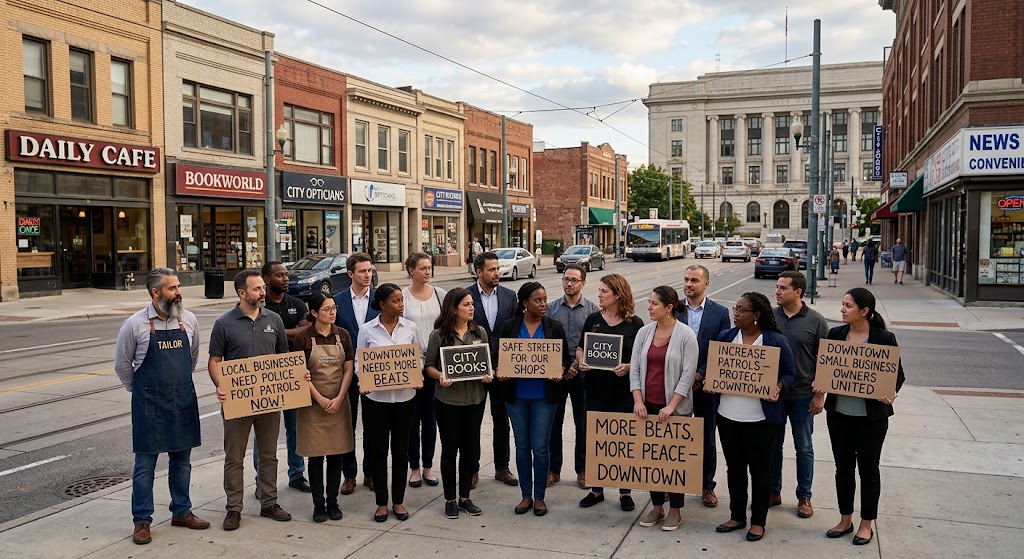
Driven by persistent concerns over retail theft, street disorder, open-air drug use, and declining customer foot traffic, business owners argue that traditional vehicle-based policing is no longer sufficient to maintain public safety or commercial viability.The demand highlights a fundamental tension in modern urban management: while merchants view visible officers on foot as an indispensable economic stabilizer, law enforcement leadership faces severe recruitment deficits, tight municipal budgets, and competing operational priorities that favor motorized emergency response.
The Economic Crisis on Main Street
The push for increased foot patrols comes as urban commercial districts struggle to regain long-term momentum. Hybrid work schedules have permanently altered downtown foot traffic patterns, leaving retailers with shorter peak business windows and smaller margins for error. In this constrained economic environment, persistent safety issues carry magnified financial consequences.
Business associations report that repeat property crime and street-level disruptions hit merchants twice: first through direct inventory and physical repair losses, and second through the subtle erosion of customer willingness to visit downtown shopping districts.
- Direct Operating Costs:Storefronts increasingly absorb expenses for private security guards, high-definition cameras, shatterproof glass retrofits, and escalating insurance premiums.
- Foot Traffic Decline:When prospective shoppers perceive a commercial zone as chaotic or unsafe, regional foot traffic shifts to suburban strip malls and e-commerce platforms.
- Staff Retention Challenges:Retailers and hospitality managers report difficulty hiring and retaining staff willing to work evening shifts in areas prone to unaddressed street harassment or property damage.
For small business owners, safety concerns are not abstract policy debates; they represent daily operational hazards that threaten economic survival.
“Walking the Beat”: The Case for High-Visibility Policing
Criminological literature provides strong backing for the core arguments raised by merchant coalitions.Extensive research—including landmark field evaluations such as the Philadelphia Foot Patrol Experiment—has demonstrated that targeted police foot patrols in high-activity areas lead to measurable reductions in violent and violent-adjacent offenses while significantly lowering public fear of crime.
Unlike officers in patrol cars, beat officers move at human speed.This proximity allows them to establish personal relationships with shopkeepers, recognize regular patrons, and identify individuals exhibiting erratic or predatory behavior before a criminal act occurs.
Traditional Vehicle Patrol: High geographical coverage, reactive emergency response, limited community contact.
Dedicated Foot Patrol: Focused geographical coverage, proactive crime deterrence, strong community trust and visibility.
Beat policing creates what criminologists term “capable guardianship”.The predictable physical presence of a uniformed officer alters the risk-reward calculation for prospective offenders, deterring low-level shoplifting, vandalism, and aggressive solicitation without necessarily increasing arrest volume.Furthermore, merchants note that foot patrols build informal social capital, enabling officers to resolve minor disputes informally and provide immediate reassurance to workers and visitors alike.
Police Bottlenecks and Deployment Realities
While municipal leaders frequently express sympathy for downtown merchants, police executives cite formidable structural barriers to deploying officers on foot full-time.
The foremost obstacle is a widespread policing staffing crisis. Police forces across North America and Europe have reported elevated attrition rates alongside historically low recruitment figures. With fewer officers available per shift, command staff must prioritize primary emergency response—ensuring enough patrol cars are available to handle 911 calls involving immediate physical threats.
| Operational Metric | Vehicle Patrol Units | Dedicated Foot Patrols |
| Response Speed | Fast across broad geographic zones | Restricted to immediate block perimeter |
| Visibility & Interaction | Low interaction; isolated by vehicle frame | High interaction; accessible to store owners |
| Resource Efficiency | High coverage per deployed officer | Requires high officer density for multi-block coverage |
| Primary Objective | Emergency dispatch and rapid intervention | Deterrence, order maintenance, and community trust |
From a resource allocation perspective, static foot beats are labor-intensive.Pulling two officers from a police vehicle unit to walk a four-block radius restricts their ability to cover adjacent neighborhoods during peak emergency hours.Consequently, police chiefs often view foot patrols as a luxury feature dependent on specialized grant funding or overtime budgets, rather than a permanent staffing baseline.
Beyond Enforcement: The Limits of Policing Vulnerability
Social service providers, housing advocates, and legal experts urge caution against relying solely on police foot patrols to solve complex urban issues.They point out that much of the visible street disorder in downtown cores stems from deep-seated socioeconomic challenges, including chronic homelessness, untreated mental illness, and substance dependence.
Increased police visibility can deter criminal activity, but law enforcement officers lack the legal tools and institutional capacity to resolve systemic human suffering.Arresting individuals for minor public disorder infractions often leads to a cycle of brief detention followed by immediate release back onto the same streets, failing to address the underlying causes of the behavior.
To bridge this gap, progressive urban policy favors “co-responder” models.In these frameworks, foot patrol officers walk alongside mental health professionals, social workers, and addiction outreach staff.This hybrid approach allows officers to focus on criminal deterrence and business security while social specialists connect vulnerable individuals with shelter options, medical care, and social support services.
Emerging Hybrid Models and Safety Ambassadors
Faced with police staffing constraints, business districts are increasingly turning to non-law enforcement solutions to supplement foot security.
Many Business Improvement Districts (BIDs) have instituted “Clean and Safe” ambassador programs. Dressed in distinct, brightly colored uniforms, these non-sworn personnel walk downtown beats to serve multiple roles:
- De-escalation and Observation:Ambassadors monitor public space, report active crimes to police dispatchers, and de-escalate minor public space conflicts.
- Visitor Assistance:They provide directions, assist transit riders, and welcome shoppers, creating an active human presence that deters anti-social behavior.
- Merchant Engagement:Ambassadors conduct regular check-ins with storefront managers, offering a direct communication bridge to city services and private security networks.
While ambassador programs cannot replace police authority in violent or high-stakes criminal situations, they offer a scalable, cost-effective way to restore order and human presence to commercial streets.
Reclaiming Confidence in Commercial Cores
The call by local business owners for increased police foot patrols is ultimately a plea for urban stability and predictability. Downtown commercial cores are not merely economic engines; they are social hubs that anchor civic identity and generate municipal tax revenues vital for public services.
Re-establishing a consistent, visible foot patrol presence—whether through dedicated police beat officers, co-responder teams, or integrated community safety ambassadors—represents one of the most effective methods for rebuilding customer confidence and preserving small business ecosystems.As cities navigate the future of their downtown cores, finding a balance between rapid emergency response and proactive human-scale policing remains crucial for long-term urban resilience.
For visual reporting on merchant demands for downtown police beats, watch Victoria businesses calling for foot patrols to restore safety
This local news coverage highlights how downtown business owners actively lobby municipal leaders for dedicated police foot patrols to rebuild safety and consumer confidence in commercial districts.
Leave a Reply